Erez Ben-Yosef’s re-evaluation of the copper mines at Timna has significant consequences for the archaeological evidence for David and Solomon’s era, and David Spoede provides a useful introduction to his discoveries.

Ruth Schuster writes about the history of the date palm tree in the land of Israel.

Bible Archaeology Report: “This month’s news items include three finds related to names that were considered divine in the ancient world: Baal, Horus, and YHWH.”

Ferrell Jenkins shares a recent photo of Mount Hermon after a snowfall.

New release from Eisenbrauns: Megiddo VI: The 2010–2014 Seasons. 1,924 pages, 867 illustrations, $210 (with discount code NR22).

Jerusalem University College is offering three courses in its Online Summer Institute:

  • Egypt and the Old Testament, with Mark Janzen
  • Geographical Lenses on Ezekiel, with Elaine and Perry Phillips
  • The Jewish Context of Jesus and the New Testament, with Oliver Hersey and Joel Willitts

Logos has the Lexham Geographic Commentary digital set on sale for 55% off (2 volumes released; 4 forthcoming).

A tiny Hebrew curse inscription on a folded lead tablet was discovered in 2019 during the wet-sifting of material in the excavation dump on Mount Ebal. The text is written in paleo-Hebrew script, allegedly dating to the 12th century BC or earlier. The hour-long press conference can be watched here. Earlier reports of this discovery are noted here. A journal article is being written and will be published later this year. I will be curious to see how they argue that this was not a Hellenistic-era amulet written in old script; its discovery alongside Late Bronze and Iron Age pottery in a dump is not conclusive, especially at a site likely frequented by pilgrims. I continue to believe that the most sensational announcements require the most rigorous scrutiny, and the public is not well-served by claims not supported by scholarly publication.

HT: Agade, Joseph Lauer, Arne Halbakken, G. M. Grena, Explorator
Share:

“An archaeological study of the floor under the Church of the Holy Sepulchre will be possible for the first time, after a two-year undertaking to repair and restore its pavement stones got underway in an inaugural ceremony on Monday.”

Turkish officials deny the report that Turkey will be returning the Siloam Inscription to Israel. The Jerusalem Post explains the history of this significant artifact.

The discovery of a thousand charred linseed at Tel Burna (Libnah?) has led to the suggestion that the economy of the Shephelah greatly changed after Sennacherib’s invasion.

A carved stele from the 4th millennium was lost in the storage area of the Israel Museum, but now after five years of restoration, it has been put on display for the first time.

Leen Ritmeyer’s post on Capernaum includes a number of beautiful reconstruction drawings.

Ferrell Jenkins is back in Israel and shares a photo of a sunrise over the Sea of Galilee.

A rare March snowfall blanketed Jerusalem and parts of Israel in white this week.

Andrew Lawler’s article for Scientific American on the history of excavations in Jerusalem would have convinced me not to read his book. (I did read it, and it’s much better than some of the revised history he presents here.)

A recent study concluded that “Evangelical Christian travelers would prefer to visit Israel on a trip led by a well-known Christian leader or Bible teacher.”

Video from the 2022 Azekah Conference is now online. You can listen to all seven talks in 1.5 hours.

New release: Excavating the Evidence for Jesus: The Archaeology of Christ and the Gospels, by Titus Kennedy (Harvest House, $25)

On sale at Faithlife: 30 Days in the Land with Jesus: A Holy Land Devotional, by Charles H. Dyer ($5.99).

I am back for part two of “The Babylonian Destruction of Jerusalem” on Digging for Truth (25 min). In this episode I talk about the extensive evidence of the 586 BC destruction, including numerous discoveries in the last five years.

HT: Agade, Joseph Lauer, G. M. Grena, Explorator

Share:

An Israeli official claims that Turkey has agreed to return the Siloam Inscription to Israel. This inscription was discovered and removed from Hezekiah’s Tunnel in the 1880s. Those who know the history here will believe it when they see it.

“Three 1,500-year-old ‘magic’ incantation bowls and hundreds of other rare artifacts — some dating to the biblical period — were seized from an apartment in an ultra-Orthodox Jerusalem neighborhood under suspicion of illegal antiquities trade.”

Lawrence Schiffman suggests that Manetho’s records give evidence that the Israelite exodus was preserved in Egypt’s historical memory.

A new book in German gives the history of the Gihon/Siloam water system. The publisher’s website has a nice summary in English.

The Huqoq excavations were recently featured in National Geographic’s “100 Wonders of the World.”

I’m not quite sure why the Jerusalem Post published this short piece on Magdala.

A new documentary entitled “The Samaritans: A Biblical People,” by Moshe Alafi and Steven Fine, will be presented on March 27 at the Yeshiva University Museum. It will presumably be made more broadly available sometime after.

Save the date – May 18: “The First International Academic Conference  on New Studies in Temple Mount Research Hosted by The Menachem Begin Heritage Center, Jerusalem. Lectures will be in Hebrew or English, and the conference will be broadcast live. I don’t see details online yet (but see this), but speakers include Aharon Tavger, Tehilla Lieberman, David Gurevich, Avraham Solomon, Rina Avner, Peretz Reuven, Yuval Baruch, Dror Czitron, Joseph Patrich, David Jacobson, Nikos Kokkinos, Zachi Dvira, Gabriel Barkay, and others.

Logos has announced a number of solid Carta reference works available at pre-publication discount, including:

HT: Agade, Joseph Lauer, Arne Halbakken, Alexander Schick, Explorator

Share:

“More than 18,000 inscribed pottery ‘notepads’ are uncovered in the long-lost Egyptian city of Athribis, including shopping lists and lines written by students as a punishment”

The Khufu Boat Museum has been demolished, now allowing an unobstructed view of the Great Pyramid of Giza.

Joyce Tyldesley gives a fascinating account of the discovery of the famous Nefertiti bust, how it ended up in Germany, and why it has never been returned to Egypt.

Timed with Friday’s release of the movie, Smithsonian Magazine has an interesting story about how Agatha Christie’s love of archaeology influenced Death on the Nile.

Turkish Archaeological News reviews the discoveries made in Turkey in the month of January.

“A Tunisian history enthusiast is making dye from sea snail shells inspired by a school project decades ago on ancient Carthage and the purple coloring that brought fabulous wealth to the classical world.”

“Archaeologists in southern Italy announced last week that they unearthed two helmets, fragments of weapons and armor, bits of pottery and the remains of a possible temple to Athena at an archaeological excavation of the ancient Greek city of Velia.”

Andrew Knight-Hill has created a 18-minute instrumental composition featuring “beach soundscapes and choral works sung from portions of the ancient flood myth poem Atra-Hasis.”

Paul Collins questions whether the Sumerians were a distinct ethnic people group.

A 6-minute BBC video looks at the decipherment of cuneiform.

K. Lawson Younger is the guest on the Biblical World podcast, discussing parallelomania, Arameans, and ancient conquest accounts.

John DeLancey’s new book is now out: Connecting the Dots: Between the Bible and the Land of Israel. You can read my endorsement there. The pre-order discount has been extended to Feb 19, and shipping is free.

HT: Agade, Joseph Lauer, Arne Halbakken, Explorator, Charles Savelle, Steve Ulrich, Keith Keyser

Share:

Israel’s Good Name reports on his tour of four sites in the Nahal Tirzah area, including a possible site for Gilgal and a Roman army camp.

“People may find it hard to believe that tiny little Israel has more than 300 wineries,” with more than 50 in the foothills between Tel Aviv and Jerusalem.

Foreign tourists are again allowed in Israel, and John DeLancey is posting daily updates about his group’s travels.

With the celebration of his 200th anniversary around the corner, Conrad Schick’s work in Jerusalem is highlighted by Bible History Daily. The article also notes that Shirley Graetz is working on a historical novel about Schick’s life.

Les and Kathy Bruce are leading an English/Spanish tour of Israel in April/May, and a Turkey/Greece tour in May.

Susan Laden and Rob Sugar share about the impact of Suzanne Singer on Biblical Archaeology Review.

New in paperback: Children in the Bible and the Ancient World Comparative and Historical Methods in Reading Ancient Children, edited by Shawn W. Flynn.

Zoom lecture on Jan 26: “The Roman Army in the Negev,” by Alexandra Ratzlaff ($7).

Jerusalem Seminary has announced its spring course offerings, including courses on the “Life and Land of Yeshua,” “Jewish Life and Literature,” and “Faith, Politics and Ministry.” The description and the various instructors in that last course look particularly interesting to me. You can see the full list here.

The latest free maps from Bible Mapper include:

Emanuel Hausman, founder of Carta Jerusalem Publishing House, died this week.

HT: Agade, Joseph Lauer, Explorator, Arne Halbakken

Share:

A new study suggests that the mining operations in the Timna Valley and Faynan thrived in the 10th century because of good management. The underlying journal article is here.

Moshe Gilad wonders whether the Bible can be used as an archaeological travel guide to Israel, and his article in Haaretz is based on the responses of Israel Finkelstein, Aren Maeir, and Yoram Bilu.

Saul Jay Singer writes about the life of Yigael Yadin and his father Eliezer Sukenik.

A couple of scholars are suggesting that Mary Magdalene was not from Magdala. (Now seems to be the perfect time for such a proposal, with all the great finds coming out of 1st-century Magdala…) The underlying journal article is here.

Questions have been raised about artifacts in the Israel Museum that were donated by Michael Steinhardt.

John DeLancey and Kyle Keimer complete their four-part tour of the archaeological wing of the Israel Museum.

The Museum of the Bible and Digital Interactive Virtual Experiences are offering virtual tours of Caesarea on January 20 and Qumran on January 27.

The materials in the Israel Film Archive are now online for public viewing. The Times of Israel identifies some highlights.

Andrew Lawler is on The Times of Israel podcast talking about his recent book, Under Jerusalem. (I enjoyed the book, and I hope to say more later.)

The Jerusalem Post reviews Adventure Girl: Dabi Digs in Israel, an illustrated book for children.

Israel’s Good Name reports on his trek around Horvat Hanut and Salvatio Abbey.

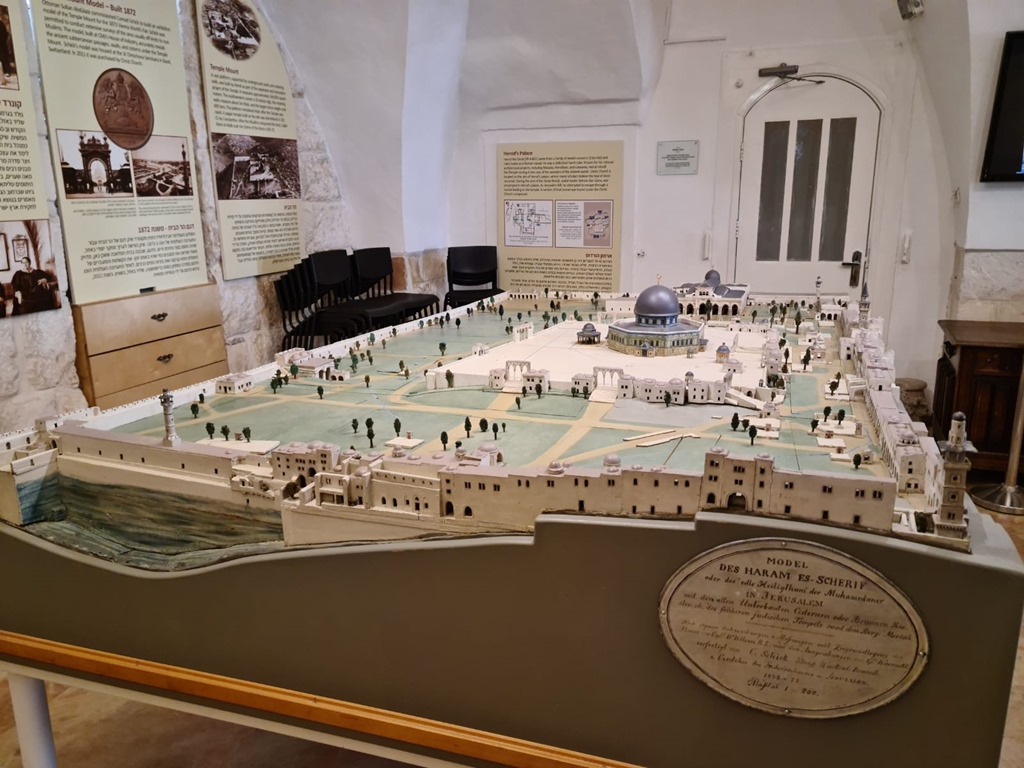
The 200th anniversary of the birth of Conrad Schick is on January 27, and Christ Church in Jerusalem will be having a special event to celebrate on the 28th (10:00-13:00). Their museum includes some of Schick’s models, including the one pictured below.

HT: Agade, Joseph Lauer, Arne Halbakken, Wayne Stiles, Alexander Schick

2

Model of Conrad Schick on display at Christ Church, Jerusalem. Photo by Michael Schneider.

Share: