The recent discovery of a large wine cellar at Tel Kabri is described in the New York Times.

Ran Shapira at Haaretz reports on the latest finds at Gezer.

Guy Steibel is commemorating the 50th anniversary of Yigael Yadin’s excavations of Masada with a tour for journalists. He reveals that the one big thing they haven’t found yet is a latrine.

The Jewish Press has more about the stone altar discovered at Shiloh, including a better photo.

Miriam Feinberg Vamosh has a feature article in Haaretz on women and their work in the ancient world.

Thanksgiving and Hanukkah are rarely celebrated at the same time. This article on the Chabad website explains when it last happened and when it may occur next (in 2070).

Oxford University Press has published The Ancient Near East: A Very Short Introduction by Amanda Podany. At 168 pages (and $9), this will be more appealing to some than the longer (and more costly) introductions.

The official trailer for Noah is out. I’m told by those who have seen more than the trailer that the movie is not faithful to the biblical story.

HT: Charles Savelle, Mark Hoffman, Joseph Lauer, Jack Sasson

Two women grinding in courtyard in front of home, mat04156
Two women grinding, 1930s
Photo from Traditional Life and Customs
Share:

Baker has recently published a book worthy of mention here: The World of the New Testament: Cultural, Social, and Historical Contexts, edited by Joel B. Green and Lee Martin McDonald.

You can use the “Look Inside” feature at Amazon to read the Table of Contents. Here are some of the chapters I would read first:

Chapter 5: The Herodian Dynasty, by Everett Ferguson

Chapter 13: Slaves and Slavery in the Roman World, by S. Scott Bartchy

Chapter 15: Education in the Greco-Roman World, by Ben Witherington III

Chapter 16: Temple and Priesthood, by David Instone-Brewer

Chapter 26: Jewish Education, by Kent L. Yinger

Chapter 28: Reading, Writing, and Manuscripts, by E. Randolph Richards

Part 5: The Geographical Context of the New Testament includes chapters on Egypt, “Palestine” (eek!), Galatia, Macedonia, Achaia, and much more.

Though this work draws from a broad range of authors, some more conservative than others, overall this seems like a terrific resource. At $35 for a 640-page hardcover, this is a good value.

Share:

The collapse of the great civilizations of the Late Bronze Age was the result of climate change, says a new study published in Tel Aviv. A preliminary list of 2014 excavations in Israel is now available. The Carmel Caves have been named the newest UNESCO World Heritage Site. The Bible Lands Museum Jerusalem has opened “The Book of Books” exhibition based on the collection of Hobby Lobby owner Steve Green. Archaeologists are mapping the ancient aqueducts of Rome with the help of lasers and robots. A new BAR Archive DVD is available, providing all issues of the magazine from 1975 to 2012. Wayne Stiles is offering both of his excellent books at a great discount. And this weekend will be the last chance to get them autographed. They make a great Christmas gift for you or someone else… The Virtual Bible Project is profiled in the Baptist Press. After many years of slow progress, Dan Warner has now teamed with Logos Bible Software to add to the four reconstructions already completed. J. B. Hennessy died this week. HT: Bill Soper, Jack Sasson, Charles Savelle, Joseph Lauer Mount Carmel cave with prehistoric remains, tb050900101 Caves on Mount Carmel
Photo from Samaria and the Center

Share:

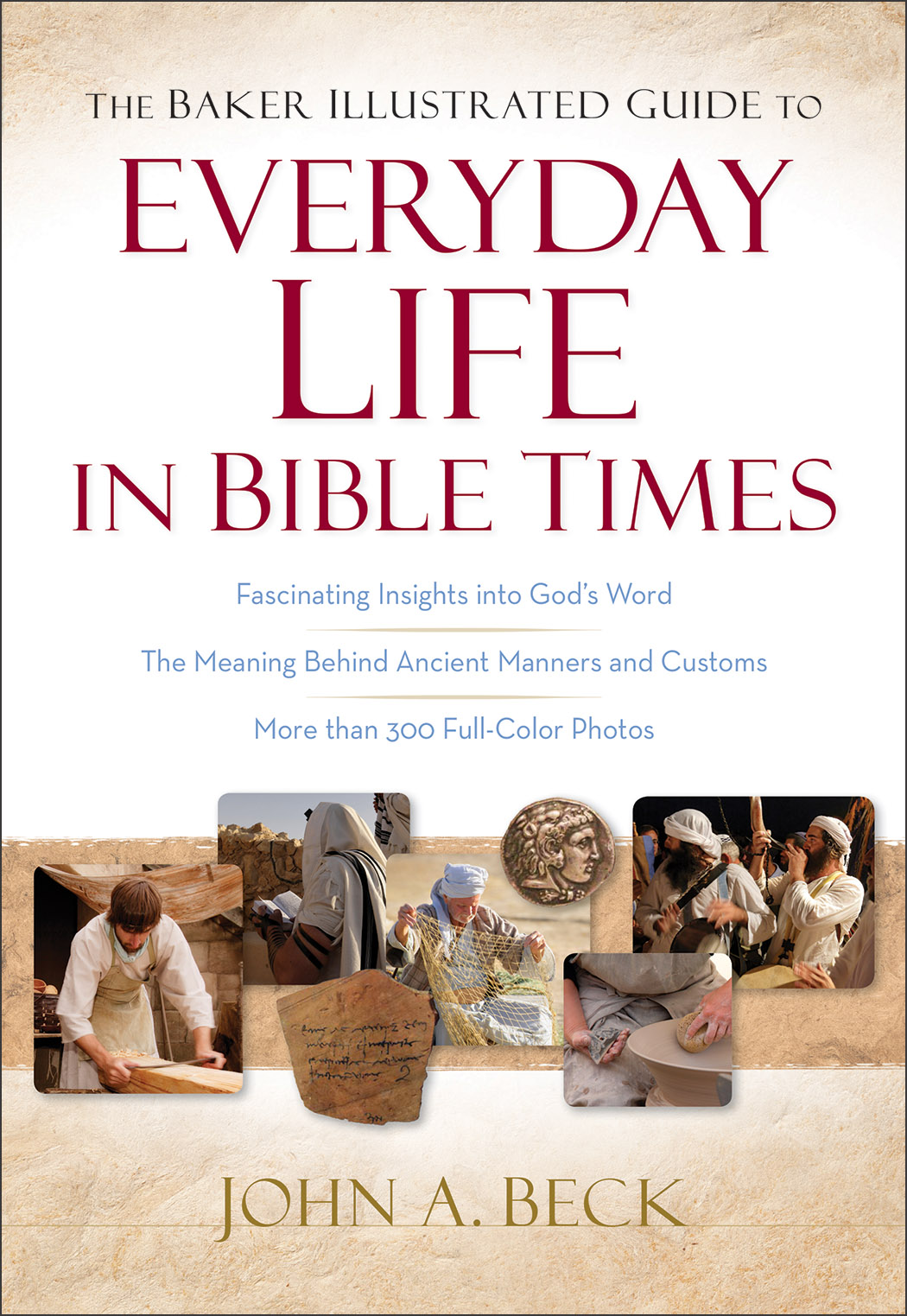
John A. Beck has just published a new book that will be of interest to many readers here. The Baker Illustrated Guide to Everyday Life in Bible Times is an attractive, full-color guide to the culture and customs of the ancient world. Beck is familiar to readers here as one of the authors of the popular A Visual Guide to Bible Events and A Visual Guide to Gospel Events.

The book is comprised of about 100 articles, each three pages long. Every subject is carefully illustrated, and it is difficult to find a page without a photo (or two or three).

The book covers a wide range of subjects such as sacred days, family relationships, agriculture, warfare, clothing, and food. Specific articles include:

  • Anoint
  • Clap Hands
  • Crucify
  • Engrave
  • Kiss
  • Land On Hands
  • Naked
  • Run
  • Shave
  • Thresh
  • Widow

I made note of a few items that may be new to readers here:

  • “We can safely say that no activity was more ordinary in Bible times than the baking of bread.”
  • “The belt of our Western world is very different in appearance and function from the belt of the ancient world.”
  • The clapping of hands sends one of four messages in the ancient world: “(1) to mark a time of joy-filled celebration, (2) to mock or scoff at someone’s misfortune, (3) to express grief or anger, or (4) to play a part in a magical incantation.”
  • The Gadites are noted for their military greatness in part because of their ability to cross the Jordan during flood season (1 Chr 12:14-15).
  • There is one positive use of the word “drunk” in the Bible (Deut 32:42).
  • There are four categories of kissing in the ancient world: (1) the greeting kiss, (2) the departure kiss, (3) the kiss of respect, and (4) the erotic kiss. Beck gives biblical examples for each one and mentions three other types of kisses mentioned in Scripture: the deceptive kiss, the holy kiss, and the figurative kiss.
  • “Jews of the first century carried a combined tax burden that was near or slightly exceeded 50 percent of their income.”

In every article I read, I learned something new. Though written for a popular audience, the book includes footnotes that point to the source of the information or related good resources.

The book is also available on Kindle, but I would guess that it’s not as attractive as it is in print format.

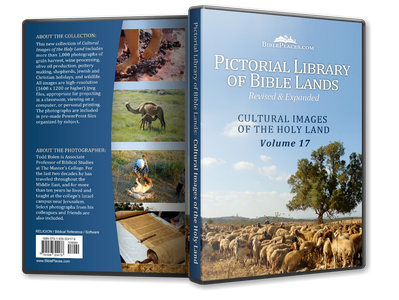
On a related subject, if you’re looking for a collection of photos of Cultural Images of the Holy Land, we know of a good one.

Share:

Gordon Franz reports on his time at the “International Noah and Judi Mountain Symposium” in Sirnak, Turkey. He also provides a summary of a number of the presentations.

On The Book and the Spade this week: “Discovering Dalmanutha” with Ken Dark (direct link).

Norma Franklin believes the Megiddo water system was built during the Middle Bronze Age.

George Athas asks, “What’s New in Biblical Inscriptions?” and he suggests a cautious approach in announcing new discoveries.

An enormous Corinthian capital has been excavated at a temple of Hadrian in western Turkey.

A report in the Belfast Telegraph provides details about the ongoing excavations at Sidon.

Aviva and Shmuel Bar-Am provide a tour of Gezer.

Before there was writing, there were clay balls. Scholars are trying to decipher the code from objects found in Iran.

Dove Booksellers reports that the retail price is jumping up to $395 for The Oxford Encyclopedia of the Bible and Archaeology. It’s on sale for $257 until Tuesday (cheaper than Amazon).

HT: Jack Sasson, Joseph Lauer, Explorator

Mount Cudi from west, adr1005222380
Cudi (Judi) Dagh, possible location of Mount Ararat, from west
Photo from Eastern and Central Turkey
Share:
(Post by A.D. Riddle)

About four years ago, we were happy to see the arrival of Barry Beitzel’s revised atlas, The New Moody Atlas of the Bible.

And now, this year, the atlas has been translated into Dutch, Italian, and German—for those who know a missionary, a mother-in-law who does not speak English, an overseas pen-pal, or a graduate student who has to learn foreign languages. (This list is not exhaustive. Some humor is intended.)

The newest translation which just appeared is the German Großer Atlas zur Bibel for €49,95. (Note that the link is to Amazon Germany, not Amazon USA.)

For the Dutch speaker/reader in your life, there is De grote Bijbelatlas for €35,28. (Note that the link is to Amazon Germany, not Amazon USA.)

For those seeking Italian, there is Nuovo atlante biblico (we could not find a link for ordering).

In the coming months, we have heard that the atlas will also be translated into Spanish, Portuguese, Korean, and Chinese.

Share: