“Egypt archaeologist Kathleen Martinez is convinced that she has pinpointed the final resting place of Queen Cleopatra, after discovering 200 coins depicting her face at an ancient temple site in Alexandria.”

The Grand Egyptian Museum is 90% complete and will include the world’s first hanging obelisk.

Though unimpressive on the outside, the pyramid of Unas at Saqqara is filled with inscriptions from the Old Kingdom period.

Here is a list of five ancient tombs that scholars would like to find; four are Egyptian and one is Alexander the Great.

According to a new study, “the Hyksos were not invaders, but rather Asiatic immigrants who settled in Egypt – specifically in the Nile Delta region – lived there for centuries and eventually managed to stage a takeover of power.” (Underlying journal article here.)

Egypt is in a dispute with Ethiopia over a dam that could severely restrict the Nile River’s water supply.

“The early inhabitants of Lisan Peninsula, on the southern corner of the Dead Sea, explored the potential of the spring waters for irrigation.”

“Archaeologists were able to uncover more than 14,000 settlement sites in northeastern Syria thanks to help from satellite technology from NASA’s Shuttle Radar Topography Mission.”

French archaeologists are conducting “secret excavations” in a part of Syria occupied by the YPG/PKK.

The Hagia Sophia in Istanbul has been converted into a mosque. Greece is threatening to impose sanctions.

A Luwian inscription discovered in Turkey may provide evidence of the famous King Midas.

Leon Mauldin shows how Perga’s watercourse provides a picture of the new Jerusalem’s river of the water of life.

Carl Rasmussen explains the relevance of the Lycian Confederation to the history of the United States.

Carlotta Gall and photographer Mauricio Lima visited the Hasankeyf valley repeated for a half a year to witness its destruction as the waters rose behind the Ilisu Dam.

An underwater museum in Alonissos, the first in Greece, will open to visitors next month.

Pamela Gaber examines Cypriot sculpture from the Iron Age.

A new museum in Gozo, Malta, will incorporate an ancient Roman quarry into its layout.

There is controversy over the proposal to add a roof to the tomb of Augustus in Rome.

The entire collection of the Museum of Anthropology in Tehran was stolen by a burglar.

“7 Sides of a Cylinder” is a compilation of 7 videos about the Cyrus Cylinder and its significance to young Iranians.

A tourist describes a recent visit to Iran.

Archaeologists are discovering architectural remains from the time of the Medes at Ecbatana.

David Stronach, founding Director of the British Institute of Persian Studies and excavator of Pasargadae, has died.

HT: Agade, Joseph Lauer, Alexander Schick, Ted Weis, Explorator, Jared Clark

Share:

For only the 4th time, a Bar Kochba coin has been found in Jerusalem, possibly brought there by a Roman soldier. This article has nice photos, and this article has a short video.

The Jerusalem Post surveys how archaeology in Israel has been affected by governmental actions in response to COVID-19.

El-Araj, a good candidate for Bethsaida, has been flooded by this winter’s rains and the rise of the Sea of Galilee.

Critics are claiming that construction by the Palestinian Authority is destroying remains at Tel Aroma, the northernmost Hasmonean fortress in Samaria.

“Exploratory drilling has started just outside the Old City for a project to extend the Tel Aviv-Jerusalem fast rail to the Old City’s Dung Gate — the main entrance to the Western Wall.”

The Greek Orthodox Church of Jerusalem has filed a lawsuit demanding closure of Ein Yael outdoor museum.

Four fragments of Dead Sea Scroll fragments that were thought to be blank are not.

A new excavation at Petra will focus on the lower part of the Treasury as well as nearby tombs and facades.

A new burial chamber has been discovered at the mummification workshop complex of the 26th Dynasty at Saqqara.”

“A stone chest excavated by archaeologists near Deir el-Bahari and the temple of Hatshepsut could lead archaeologists . . . to a royal tomb.”

Egypt’s decision to move ancient objects from their original setting in Luxor to Cairo’s Tahrir Square is stirring controversy.

“The excavation team working on the site of the ancient city of Patara, near the Mediterranean resort city of Antalya, has unearthed a new inscription in the ancient theater.”

“A small sinkhole that appeared next to the Pantheon in Rome has enabled archaeologists to examine the original Roman paving that was laid when the Pantheon was built by Marcus Agrippa around 27-25 BC.”

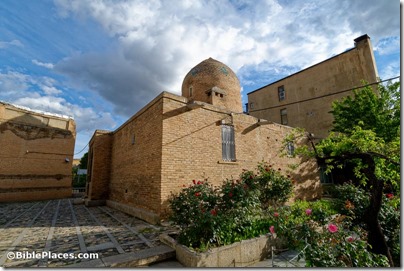
The traditional tomb of Esther and Mordechai in Hamadan, Iran, was set afire yesterday.

David Moster has created a new video on “Biblical Pandemics.”

The Temple Mount Sifting Project Symposium on May 24 features eight lectures via Zoom on the archaeology of Jerusalem and the Temple Mount. Registration is required.

Francis I. Andersen died recently. His breadth of publications is remarkable.

Thomas O. Lambdin died on May 8.

HT: Agade, Ted Weis, Joseph Lauer, Explorator, BibleX

Ecbatana tomb of Esther and Mordecai, tb0510183126

Traditional tomb of Esther and Mordecai in Hamadan (biblical Ecbatana) before attack

Share:

The Western Wall plaza reopened this week, with worshippers limited in number, required to wear masks and to have their temperature checked.

A new excavation has determined that Solomon’s Pools were built by the Romans in the 2nd century AD. The academic report was published in Palestine Exploration Quarterly last year.

“The Dead Sea Scrolls in Recent Scholarship” is a 4-day virtual conference hosted by NYU that begins on May 17. Registration is free and required for each day.

Thieves have plundered and destroyed remains at Khirbet Astunah as well as a number of other sites in the West Bank.

Bill Barrick has written an interesting and well-illustrated post on the ancient city of Jezreel.

King Saul appears to be the theme of the week, as Ferrell Jenkins shares photos of Gibeah, Beth Shean and flowers on Mount Gilboa.

Shmuel Browns shares photos from a recent visit he made to Samaria-Sebaste.

Scott Stripling is interviewed in the second installment of “Discussions with the Diggers.”

Walking the Text has created a number of study guides for recent series, including Psalm 23, The Lord’s Prayer, and The Sabbath.

Patrick D. Miller died last week.

HT: Ted Weis, Agade, Joseph Lauer, Charles Savelle, Explorator

Share:

Coronavirus fears have led to a number of restrictions in Israel and the West Bank, including the closure of the Church of Nativity in Bethlehem, the banning of all foreign tourists from hotels in the West Bank, and the quarantining of travelers arriving from certain European countries. Now Israel is talking about forbidding entrance to Americans.

The Step Pyramid, Egypt’s oldest, is open again to tourists after a long renovation. As of this writing, the homepage of ArtDaily has a number of photos from the interior (or here).

A new geochemistry analysis indicates that the “Nazareth Inscription” apparently came from the island of Kos, and not from Nazareth. The underlying study is here.

New technology is being used to determine the date and location of horse domestication in the ancient world.

The latest newsletter of the Oriental Institute is now online.

An exhibit on Tall Zirā‘a will run at the Museum of the Yarmouk University through the end of June.

King Omri is the latest subject of the archaeological biography series by Bryan Windle. In that, he links to a website for renewed excavations of Tirzah (Tell el-Farah North) that I was unaware of.

Ray Vander Laan is leading a free web-based video course beginning Monday on “The Path to the Cross.”

Carl Rasmussen visits the new museum at Troy and shares a photo of a human sacrifice depicted on a sarcophagus.

Phillip J. Long just began a “Missionary Journeys of Paul” trip through Turkey, and he is posting daily summaries (Day 1, Day 2).

The Greek City Times has a feature on Nashville’s replica of the Parthenon.

A call for papers for two sessions at SBL on the “Historical Geography of the Biblical World” ends on Wednesday.

New from Brill: The City Gate in Ancient Israel and Her Neighbors: The Form, Function, and Symbolism of the Civic Forum in the Southern Levant, by Daniel A. Frese.

William H. Shea died last month.

HT: Agade, Ted Weis, Explorator

Share:

Leen Ritmeyer has written an informative and well-illustrated post on the significance of Shiloh and the recent excavations. Ritmeyer’s reconstruction drawings are available for purchase in his image library, including his new drawing of Shiloh.

A government committee in Jerusalem has authorized the construction of a cable car to the Dung Gate.

A $37 million visitors’ center has been opened at the Huleh Valley Nature Reserve.

Anthony Ferguson shares 5 surprising details about the discovery of the Dead Sea Scrolls from Weston Fields’ history.

“The only project agreed on by Israel and Jordan that could possibly, in the foreseeable future, help save the Dead Sea from further shrinkage is stuck in a byzantine web of politics, bilateral tensions and Israeli foot-dragging.” This is a well-researched article on a subject frequently in the news.

Excavations have resumed at Tell Ziraa in Jordan, with the recent discovery of an Iron Age house with several dozen loom weights.

Colin Cornell considers whether the Jews living in Elephantine worshipped a goddess in addition to Yahweh.

Egyptian authorities have announced the discovery of a cemetery in Ismailia that dates to the Roman, Greek, and pre-dynastic eras.

The October issue of the Newsletter of the Egyptian Ministry of Antiquities is online.

History Magazine has the story of how Howard Carter almost missed King Tut’s tomb.

Two vast reproduction Assyrian statues were unveiled in Iraq on Thursday as part of a project designed to restore the cultural heritage of Mosul.”

Wayne Stiles explains the significance of the Arch of Titus and the relevance of an olive tree planted beside it.

“A team of international scholars versed in culinary history, food chemistry and cuneiform studies has been recreating dishes from the world’s oldest-known recipes.”

In a 10-minute video, David McClister explains who Flavius Josephus was.

On sale for Kindle:

Tim Bulkeley has died. He began his biblioblog in 2004 and was a regular encouragement to me over the years. He will be missed.

HT: Agade, Charles Savelle, Keith Keyser

Share:

I go away for one week, and I come back to a large pile of stories in the biblical and archaeological world. This is going to take three long posts to catch up.


Discoveries:

Excavations at the synagogue of Huqoq have uncovered a mosaic depicting the Israelites’ encampment at Elim as well as two of the four beasts of Daniel 7.

Recent research has revealed that Tel Shikmona was not a trading settlement but a purple dye manufacturing center.

The Siloam Road, connecting the Pool of Siloam to the Temple Mount of Jerusalem, was officially opened this week.

Archaeologists discovered an ancient baptismal font hidden inside another baptismal font at the Church of the Nativity in Bethlehem.

An ancient Roman-era shipwreck has been discovered at the bottom of the Mediterranean Sea off the eastern coast of Cyprus.”


Excavations:

The Tel Burna crew has finished three weeks of their summer dig, with daily posts providing summaries of the finds along with photos. Here’s the latest. John DeLancey has posted his perspective as a volunteer.

The Gath expedition is halfway finished with their season, and they are unearthing a road, a window, architectural remains, and a monster wall.

This summer’s excavations at el-Araj (Bethsaida?) have produced more mosaics from the Byzantine church, a mold for making lead fishing weights, part of a roof roller, and Roman flagstones.


The Jerusalem Report has a feature piece on recent excavations at Tell Beth Shemesh.

Excavations are beginning in Laodicea on the road that leads to the ancient stadium.


Studies:

A new DNA study indicates that Philistines living in Ashkelon in the late 12th century BC originated from Greece, Crete, or Sardinia. These articles are based on a journal article published in Science Advances (pdf).

“New research explains why salt crystals are piling up on the deepest parts of the Dead Sea’s floor.”

Joe Zias argues that nearly all, if not all, of the human remains found at Masada are ethnically non-Jewish.

A new study shows that masons’ marks were used at Hippos only from the late first century to the late second century (Haaretz premium).


Sad News:

Doug Greenwold died on June 23. Doug was the Senior Teaching Fellow at Preserving Bible Times and a co-founder of The Institute of Biblical Context. He will be greatly missed.

HT: Joseph Lauer, Ted Weis, Charles Savelle, Agade, Explorator, Lois Tverberg

Share: