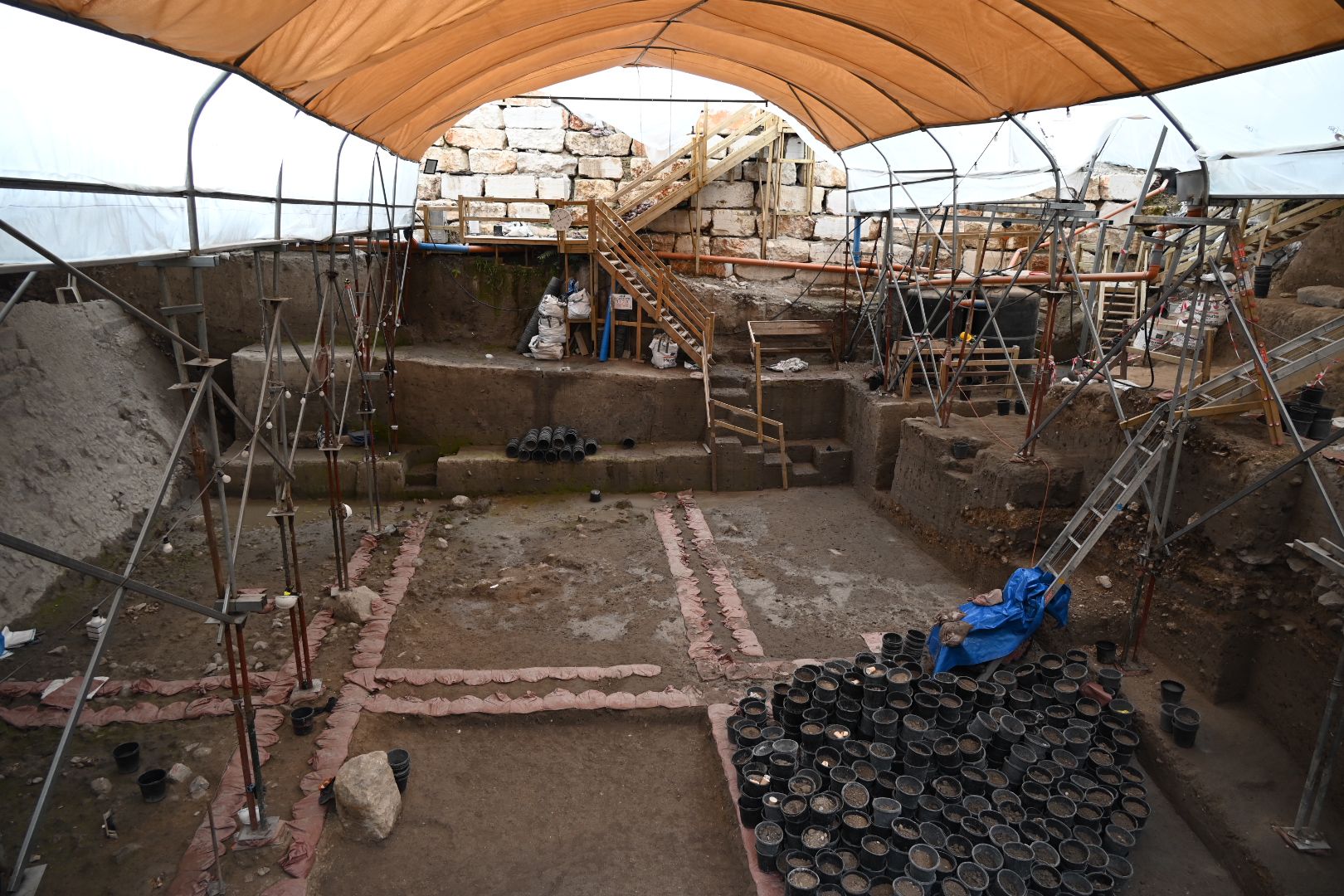
“A magnificent assortment of 364 gold and silver coins dating back to the 14th and 15th centuries CE has been unearthed” at Huqoq in Galilee.

The “Faithful Farmer” is the subject of the latest episode in the “Biblical Images of God” series.

On a recent episode of Digging for Truth, Bryan Windle surveys the top 10 biblical archaeology discoveries in 2024.

A new series of 9 videos entitled “Unveiling Megiddo-Armageddon: The Mother of All Tells” features conversations between archaeologists Israel Finkelstein and Matthew J. Adams. It was filmed during the 2022 excavation season.

On the Biblical World podcast, John Monson discusses the historical geography of the Bible.

Leon Mauldin has posted some photos from the Philistine city of Ekron, Moresheth Gath, Sardis, and Pergamum.

Jerusalem Seminary has just announced a Master of Arts in Biblical Studies.

The Israel Antiquities Authority Publication Portal is a new resource hosting more than 10,000 “open access excavation reports and studies published in journals, books, conference proceedings and monographs.” That includes ‘Atiqot, Qadum, and IAA Reports. The site includes lists of the most popular papers and the latest additions.

Available for pre-order for Logos: Jesus and Archaeology, edited by James H. Charlesworth

Westminster Bookstore has a number of archaeological, geographical, and historical books on sale through Monday. One of the best deals is the three volumes (released to date) of the Lexham Geographic Commentary series (for $100).

Several excavation reports published by the Nelson Glueck School of Biblical Archaeology, Hebrew Union College, are now available as open access pdf files:

  • Excavations at Maresha Subterranean Complex 169, Final Report, Seasons 2000-2016, by Ian Stern (2019)
  • The Excavation of the Templar Fortress at Jacob’s Ford, Seasons 1993-2009, by Kate Raphael (2023)
  • The Golan in the Mamluk and Ottoman Periods: An Archaeological and Historical Study, Excavations at Naʿarān and Farj, by Kate Raphael and Mustafa Abbasi (2024)
  • Dan IV: The Iron Age I Settlement, by David Ilan (2019)

Edward “Ted” Campbell, biblical scholar and field director of the excavations at Shechem in the 1960s, died earlier this month.

In celebration of 200 maps and 20 years, Bible Mapper Atlas is offering registration keys for Bible Mapper 5.1 for only $20.

HT: Agade, Gordon Franz, Ted Weis, Arne Halbakken

Share:

A Byzantine monastery with a mosaic inscription from Deuteronomy 28:6 was discovered near Kiryat Gat in southern Israel.

A stash of rare coins with the image of Hasmonean king Alexander Jannaeus was found during an excavation project in the Jordan Valley.

Archaeologists found a small mikveh, apparently for private use, near an ancient drainage channel in the City of David. The Hebrew version includes to a short video.

Scholars have a new theory on why there are no cave drawings from the Stone Age in Israel.

Marion Fischel writes about the massive Herodian column that was abandoned in an ancient quarry in the Russian Quarter.

The Tel Dan Inscription is returning home after its brief tour in the US.

New Release: The Tel Aviv University Excavations in Ancient Jaffa , Volume I, by Meir Edrey, Boaz Gross and Ze’ev

New release: ‘Akko III: The 1991-1998 Excavations: The Late Periods. Part II, The Knight’s Hotel Site, the Messika Plot and Miscellaneous Studies, by Danny Syon and Ayelet Tatcher (IAA Reports; open-access).

Zoom lecture on January 16: “A Wise Woman and a Bearded Male: Excavations at Tel Abel Beth Maacah in Northern Israel,” by Nava Panitz-Cohen (Anglo-Israel Archaeological Society; free)

Hybrid lecture at the Albright on Feb 12: “The Hula Provides: Reconstructing Animal Economy and Provisioning under Empire at Kedesh,” by Alexander Dorr

Clinton Bailey, the world’s foremost expert on the Bedouin communities of Israel, died recently.

The latest Jerusalem in Brief compares two 19th-century photos of the Mount of Olives to a modern one, considers the neglect of the Mosque of the Ascension, and a recently discovered book on Jerusalem in the British Mandate period.

HT: Agade, Gordon Franz, Ted Weis, Joseph Lauer, Arne Halbakken, Explorator

Share:

“New evidence shows that the well-preserved Roman Imperial Highway crossing the Golan was constructed in the second half of the second century CE.” The underlying journal article is here.

A new study claims that Bar Kochba only joined the revolt named after him in the middle of the insurrection. The underlying journal article is here.

The oldest inscription with the Ten Commandments sold for $5 million to a buyer who plans to donate it to an Israeli institution.

The Tel Dan Inscription is on display at the Jewish Museum in New York City until January 5.

The latest Jerusalem in Brief explores the conflicting accounts of the surrender of Jerusalem in 1917.

Applications are now open for $2,000 dig scholarships offered by the Biblical Archaeology Society.

Biblical Archaeology Society has also posted this year’s excavation opportunities, including summer projects at Hippos, Azekah, and Dan.

New Release: The Capture of Jerusalem by the Persians in 614 CE by Strategius of Mar Saba, by Sean W. Anthony and Stephen J. Shoemaker (University of Chicago; $35; open access)

Ze’ev Meshel, longtime archaeology professor at Tel Aviv University, died last week at the age of 92.

Lois Tverberg explains why she likes our photo collections.

HT: Agade, Gordon Franz, Ted Weis, Mark Hoffman, Arne Halbakken

Share:

Excavations have identified a 2nd-century BC military fortress at Ashdod-Yam.

“Researchers have discovered 50 rare cave pearls, some of which contain ancient Greek artifacts from the Hellenistic era, in an underground water system near Jerusalem.”

Some scholars are questioning whether the oldest copy of the Ten Commandments—scheduled to be sold next week at auction—is authentic.

In a short video, Eitan Klein shows how a band of antiquities thieves were caught in the act, robbing a cave in the Shephelah.

Expedition Bible’s latest video looks at the archaeological evidence for the location of Jesus’s crucifixion.

John DeLancey filmed on location at the Ketef Hinnom tombs in Jerusalem.

Appian Media has released a new short film entitled “Explore Petra” (12 min). I’m curious how they got the drone footage.

Christopher Rollston explains why the Megiddo Mosaic is important on The Book and the Spade.

“New Orleans Baptist Theological Seminary held a 10th anniversary celebration for its Museum of the Bible and Archaeology” last week.

Eliezer Oren, longtime Professor of Bible, Archaeology, and Ancient Near Eastern Studies at Ben-Gurion University of the Negev, died this week.

Jerusalem University College has announced its online semester courses for the spring, including:

  • Archaeological Methods and Theory, taught by Chris McKinny and Kyle Keimer
  • Introduction to the Modern Middle East, taught by Oded Yinon
  • Jewish Thought and Practice, taught by Rabbi Moshe Silberschein
  • The Book of Revelation and the Seven Cities of the Apocalypse, taught by Chris Vlachos

HT: Agade, Gordon Franz, Alexander Schick, Arne Halbakken, Ted Weis

Share:

A team from Johns Hopkins believes they have identified alphabetic writing that dates to 2400 BC.

Israel Finkelstein and Tallay Ornan have published an article in Tel Aviv (open-access) of recent finds at Tall adh-Dhahab al-Gharbi, and they suggest that the site is biblical Mahanaim. (They locate Penuel at the adjacent site to the east, the reverse of how I would identify them based on the sequence in Genesis 32.) In any case, this is an important study on a pair of neglected sites. The article is summarized by Israel365 News.

Egypt’s Ministry of Tourism and Antiquities denies that the Great Pyramid is being destroyed.

Scientists have discovered hallucinogenic residue in a 2,000-year-old Egyptian vase.

Jaafar Jotheri, professor of geoarchaeology, shares his thoughts on the past, present, and future of archaeology and Assyriology in Iraq.

Zoom lecture on Dec 17: “Visual Strategies in the Art and Archaeology of the Achaemenid Empire,” by Pierfrancesco Callieri

The second Digital Ancient Near Eastern Studies Conference will be held as a virtual event on December 5 and 6.

J. Cheryl Exum, longtime professor at the University of Sheffield, died recently.

Colin Renfrew, founding director of McDonald Institute for Archaeological Research, died recently.

Bryan Windle reviews the top three biblical archaeological reports for the month of November.

Apparently, not everything in Gladiator II is historically accurate.

HT: Agade, Gordon Franz, Arne Halbakken, Ted Weis, Explorator

Share:

A new study of DNA extracted from the bones inside Pompeii’s famous plaster casts has largely debunked long-held assumptions based solely on the physical appearance and positioning of the casts.”

The Pompeii Archaeological Park is now limiting the number of daily visitors to 20,000 and using timed personalized tickets with the visitors’ full names.

In a new program sponsored by Airbnb, some tourists will be chosen to participate in a mock gladiatorial fight inside Rome’s Colosseum.

An amulet depicting the “prophet Solomon” was discovered in Karabük, Turkey.

The earring holes on King Tut’s famous golden mask indicate that it was originally created for a female or child.

“Scientists at Chicago’s Field Museum are studying Egyptian mummies using a mobile CT scanner.”

Ellie Bennett tells the story of one of the “Queen of the Arabs” mentioned in Assyrian inscriptions.

“On Sunday, November 17, 2024, from 10:00 AM to 4:00 PM, followed by a keynote from 6:00-7:30 PM, the George Washington University Department of Classical and Near Eastern Languages and Civilizations & the Capitol Archaeological Institute will co-host an international symposium focused on the Amarna Letters, a collection of 14th-century BCE diplomatic correspondence which offers a rare insight into the political dynamics of the ancient Near East.” Register here for the full day, or here for the keynote.

Virtual tour on Nov 20: “Rome’s Legendary Emperors: Nero, Hadrian, and Constantine”

Available for preorder on Logos: Archaeology and the Ministry of Paul: A Visual Guide, by David A. deSilva ($28). This is the first of three planned volumes.

New release: The Labors of Idrimi: Inscribing the Past, Shaping the Present at Late Bronze Age Alalah, by Jacob Lauinger (SBL Press, $58-$78; open-access ebook).

New release: The Archaeology of the ‘Margins’: Studies on Ancient West Asia in Honour of Peter M.M.G. Akkermans, edited by Bleda S. Düring and Jo-Hannah Plug (Sidestone, €15+; read online for free)

Barbara Aland, former director of the Institute for New Testament Textual Research, died earlier this week.

Dan Diffendale has posted many thousands of photos, organized by albums on Flickr. He has written a short guide to using them.

Biblical Field Studies are funded study trips to biblical sites in Turkey for Bible scholars and teachers in the Majority World. The program is designed to equip Christian teachers and professors who work in the Majority World by introducing them to the geographical, historical, and social contexts of early Christianity. The 2025 trip (June 11–18, 2025) will visit the sites related to the Seven Churches of Revelation and the Seven Ecumenical Councils.”

There will be no roundup next weekend. If you will be attending ETS or SBL, stop by the BiblePlaces booth and say hi.

HT: Agade, Gordon Franz, Arne Halbakken, Mark Hoffman, Ted Weis, Wayne Stiles, Paleojudaica

Share: