“An impressive section of Jerusalem’s fortification wall from the second century BCE has been uncovered on the grounds of the Tower of David complex in the Old City.” About 130 feet of the “First Wall” has been uncovered in the Kishle.

Archaeologists have found evidence for the famous battle at Bet Zecharia described in 1 Maccabees. “It is the first time we have possible archaeological evidence from one of Judah Maccabee’s battlefields.”

A scholar believes that he has cracked Cryptic B, a rare alphabet known only from two uses in the Dead Sea Scrolls.

Coins previously believed to sloppy versions of coins minted by Alexander Jannaeus should instead be understood as coming from the economically weak era of the Hasmonean civil war between 60 and 40 BC.

Hartebeests went extinct in Israel not in the Iron Age but in the Byzantine period.

Doron Spielman spoke about some of his experiences in the City of David at a recent event in Jerusalem.

On Digging for Truth, Scott Stripling explains the archaeology that is related to Hanukkah.

On the Biblical World podcast, Kyle Keimer talks with David deSilva about his two new archaeology books.

Dig has released a 27-minute video about Labayu of Shechem.

The foundation stone of the Pontifical Biblical Institute in Jerusalem was laid 100 years ago.

A powerful winter storm caused death and destruction all over Israel this week.

New release: The Archaeology of the Kingdom of Judah, by Yosef Garfinkel (SBL Press, $75)

You can now purchase soil from the Temple Mount.

Jerusalem University College will be presenting its 6th annual online seminar on January 10. The “Geography and the Bible” seminar is free and will include four sessions:

  • “Road Systems from Egypt through Sinai,” by James Hoffmeier
  • “Trekking from the Desert to the Land of Milk and Honey,” by Hélène Dallaire
  • “What Does it Mean that Jerusalem was ‘Built as a City which is Compact Together?’ A Geographical and Archaeological Reading of Psalm 122:3,” by Chandler Collins
  • “The Early Church’s Encounter with the Roman Imperial Cult,” by Carl Rasmussen

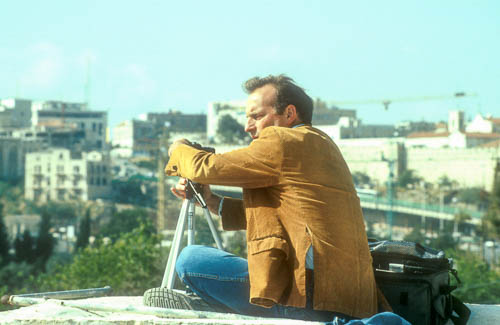
There is no hat tip (HT) below to Gordon Franz, because Gordon died on November 22. I met Gordon when studying at IHLS in the early 90s, and we stayed in touch over the years, including a tour he gave my family of NYC. Gordon taught for various schools over the years, including the Israel and Turkey/Greece/Rome programs for the Talbot School of Theology.  Most recently Gordon sent me stories for these roundups, and in the last email he wrote me, he said he was on his way to buy Rabbi Landy’s latest book. He was quite the book connoisseur. And he had much yet he planned to accomplish. Some of Gordon’s writings are still available on his website. A recording of his celebration of life service is online. He will be missed.

Gordon Franz taking photos from the rooftop of the Institute of Holy Land Studies in Jerusalem, 1993

HT: Agade, Ted Weis, Keith Keyser, Arne Halbakken, Alexander Schick, Explorator

Share:

Archaeologists have found remains of a royal palace on the northwestern slope of Alexandrium (Sartaba).

“Israel’s Civil Administration says it seized dozens of archaeological artifacts from a site north of Ramallah in Area B today and transferred them to the Museum of the Good Samaritan archaeological site in Area C.”

The top three reports in biblical archaeology last month were “about an Early Bronze Age winepress, a Late Bronze Age site, and Iron Age trade.”

Bryan Windle is on Digging for Truth to discuss the identity of the Magi.

Josephus Christianus is a new research project devoted “to studying the reception of Flavius Josephus’ works within the Greek Christian tradition from the second to fifteenth centuries CE.”

Online course from the Biblical Archaeology Society: “The Arameans and the Bible,” taught by K. Lawson Younger Jr., Feb 3 to March 12 ($319)

Westminster Books is the first I’ve seen to have available the Lexham Geographic Commentary on the Historical Books, Volume 1: Joshua-Ruth, edited by Barry J. Beitzel ($34). They also have the set of the four available volumes on sale ($130). Amazon will have the book next week ($38).

HT: Agade, Alexander Schick, Ted Weis

Share:

A new study of the Masada siege system reveals that the “circumvallation wall stood to a height of 2–2.5 m and served several functions – as an obstacle, a means of psychological warfare, and a platform from which to mount counterattacks.” It also was built quickly.

Artifacts stranded outside of Gaza since the Hamas coup in 2007 are on exhibit in Paris, and strong interest has led to extending the exhibition.

“Ancient textiles from the Judean Desert reveal that many Roman-era ‘purple’ garments were not dyed with costly murex but with a clever blend of madder and woad.”

The Biblical Museum of Natural History is hosting a “culinary expedition into the unexpected corners of kashrut” on December 24.

Israel’s authorities over the West Bank are expropriating 445 acres of land around the ancient Israelite capital of Samaria.

An agreement has been reached for a 2026 theatrical release of Legends of the Lost Ark, starring Chris McKinny.

Jerusalem Dateline has a 20-minute special on Bethsaida (el-Araj) that reports on the recent wildfire and its effects on the archaeological excavations.

Biblical Archaeology Society interviews archaeologist Achia Kohn-Tavor on location at Chorazin.

On Digging for Truth, Thomas Schmidt reports on his research into Flavius Josephus and his connections with the high priests who executed Jesus and James.

New release: Jews vs. Rome: Two Centuries of Rebellion against the World’s Mightiest Empire, by Barry Strauss (Simon & Schuster, $15-$25). This looks like a good one. (WSJ review here)

Andy Cook gives a year-end update about the work at BibleStock.

The latest issue of Biblical Archaeology Review includes articles on Bethlehem, Khrbet al-Rai, Megiddo, and putting the Bible back in biblical Archaeology.

Walking The Text has been working for the last six years on a high-quality documentary on the Lord’s Prayer. The movie releases on Angel on Tuesday, and the video footage of the biblical world is spectacular! A companion book also releases on Tuesday, and you can pre-order now to receive bonus content (after purchase, fill out this form).

HT: Agade, Arne Halbakken, Alexander Schick, Gordon Franz, Ted Weis, Explorator

Share:

A fragment of an Assyrian tax notice from the time of Hezekiah was discovered in Jerusalem. The inscribed potsherd mentions “a delay in payment, the first day of the month of Av, and the title of an Assyrian officer.” This is the first time “written evidence of the relations between the Assyrian Empire and the Kingdom of Judah has been discovered” in Jerusalem.

A 7th-century cremation burial at Horvat Tevet contains an “unparalleled” burial treasure that sheds light on Assyrian rule over northern Israel.

Aren Maeir wrapped up a mini-season of excavations at Gath/Tell es-Safi.

Frank Turek interviews Titus Kennedy about “12 biblical archaeological discoveries you’ve never heard of before.” Comet (see below) just gave me a quick summary (and saved me 45 minutes of watching), and I’ve heard of all of them.

The latest episode of Digging for Truth is about this summer’s season at Shiloh and the team’s evacuation when the Israel-Iran War began.

Kristine Garroway has written an article about the death of children in ancient Israel that is based on her new book.

Zoom lecture on Nov 12: “American Archaeology through the Lens of Albright’s Work at Tel Beit Mirsim, and Beyond,” by Igor Kreimerman, Michael Freikman, and Rachel Hallote

Free ebook for a limited time: Between Yahwism and Judaism: Judean Cult and Culture during the Early Hellenistic Period (332–175 BCE), by Yonatan Adler (Elements in The Archaeology of Ancient Israel; Cambridge University Press)

Ebook available to read online, in Hebrew: A History of the Israel Exploration Society, by Lina Dar and Raphael Kitron

Available for pre-order on Logos: The Archaeology of the Bible, by James K. Hoffmeier ($14)

The Wall Street Journal says that the Perplexity browser (Comet) is currently the best, and I’ve been happy with Perplexity.ai for the last year (its strength is citing its sources). If you are a student or teacher, you can sign up for a free year of Perplexity Pro, and if you use this link, I’ll get an extra free month ($4.99 value).

HT: Agade, Ted Weis, Gordon Franz, Explorator

Share:

The cargoes of three superimposed shipwrecks dating to the 11th, 9th, and 7th/6th centuries BC have been retrieved from the ancient harbor of Dor.

“Researchers excavating Yehudiya Nature Reserve in the central Golan Heights uncovered an ancient synagogue whose location had remained unknown for decades.”

Joshua N. Tilton has released a new ebook on Jaffa Gate and its Place in the History of Jerusalem ($10).

Jim Parker is interviewed about a new book to which he contributed, “The Canaanite Water System at Gezer.”

Aren Maeir tells a story about a dead cow and the cost of obeying Exodus 21:33-34.

The Jerusalem Post has a story on various archaeological finds made in Israel over the years.

NY Times: “There are good reasons to be drawn to antiquities, but also many reasons to hesitate before buying, starting with concerns about illicit trade” (gift link).

Erin Hill asks, “Are the religious practices of the northern Kingdom of Israel adopted from Phoenician elements or reflected of a broader Canaanite continuity?”

HT: Agade, Gordon Franz, Explorator, Ted Weis

Share:

“In a groundbreaking achievement that requires no actual breaking of ground, Israeli researchers have demonstrated the archaeological utility of a technology that acts like an ‘X-ray’ for the Earth, revealing hidden spaces beneath an ancient site in Jerusalem.” The scan of the City of David revealed previously undiscovered cavities. The underlying journal article is here.

A trove of nearly 100 gold coins from the end of the Byzantine era were discovered in the excavations at Hippos. The discovery “challenges some previous assumptions about life in Hippos” at this time.

Ancient grape varieties discovered in archaeological excavations in the Negev will be planted in the Shivta National Park, in a new vineyard plot currently being established among the remains of ancient Byzantine terraces.”

“Israeli authorities prevented what they described as a deliberate attempt by the Palestinian Authority to damage… the Biblical city of Gibeon.”

Nathan Steinmeyer explains the role that stables played at Megiddo during the time of the Northern Kingdom.

The Samaria Touring and Study Center in Shavei Shomron will be hosting visitors during Sukkot who want to sift earth from the recent excavations of Samaria.

A webinar series begins on Oct 27 with “The Middle Bronze Age in Canaan: Innovation, Society, and the Rise of Early Cities,” by Helena Roth (₪60).

Doron Spielman is on The Book and the Spade talking about his latest book on the City of David. The first of four episodes is now available.

On the Biblical World podcast, Chris McKinny and Kyle Keimer continue their introduction to archaeology by discussing Albright, Wright, Kenyon, New Archaeoology, and questions of faith and history.

Shimon Gibson has written a positive review of Jodi Magness’s Jerusalem Through the Ages: From Its Beginnings to the Crusades.

The Feast of Tabernacles begins at sundown on Monday. An article in Israel My Glory looks at the feast during the time of Jesus.

BibleStock has just released a Christmas package for pastors and Bible teachers, with coaching videos and links to all of the photo and video resources. You can download all of the Christmas resources for free (with an email address). There’s a lot of great material here.

HT: Agade, Gordon Franz

Share: