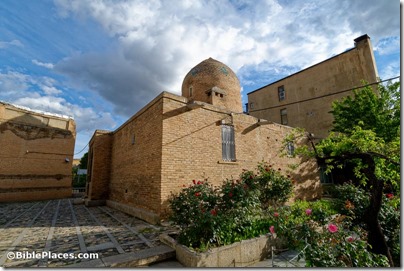
The Tel Moza website gives details for joining the spring excavation as well as background about recent discoveries.

A family volunteering at an excavation in Lower Galilee discovered remains of an iron industry from the 6th century AD.
 
Some of the latest discoveries from Shiloh are described in a somewhat disjointed article in the Jerusalem Post.
 
The “Tomb of the Kings” in Jerusalem has been reopened to visitors (again) by France, which owns the site. Access is allowed only to the outer courtyard.
 
Naama Sukenik explains how new technology is being used to provide insights into counterfeiting dyes in the ancient textile industry.
 
Mark Barnes looks at the significance of the Mount of Olives in the Bible, including some interesting comparisons and contrasts between David’s and Jesus’s time there.
 
Who is Gallio and why is he so important to New Testament history? Bryan Windle explains in a well-illustrated article.
 
The “world’s oldest natural pearl” has been discovered in excavations on an island near Abu Dhabi.
 

“Ancient Assyrian stone tablets represent the oldest known reports of auroras, dating to more than 2,500 years ago.”

“Life at the Dead Sea” is a new exhibit about the cultural history of the lowest place on the planet that recently opened at the State Museum of Archaeology Chemnitz.

An exhibit of Egypt’s southern neighbor, “Ancient Nubia Now,” is on display until January 2020 at the Museum of Fine Arts in Boston.

Sculptures from the Torlonia Collection will go on public display for the first time ever at the Capitoline Museums in Rome beginning in March.
 
The Washington Pentateuch is going on display at the Museum of the Bible.
 
The archaeological museum in Basra is adding English labels in hopes of welcoming more international visitors.
 
Jaafar Jotheri provides an overview of excavations in Iraq in the last year.
 
A conference will be held at the Louvre on November 25 on Tappeh Sialk: A Key Site for the Archaeology of Iran.
 
Farrell Monaco will be lecturing on “Dining with the Romans” at the Walters Art Museum on November 10.
 
4,500 tourists watched the sun illuminate the face of Ramses II in the temple of Abu Simbel.
 
Wayne Stiles is leading a tour of Israel (and pre-tour to Egypt) in October 2020.
 
There will be no roundup next weekend.
 
HT: Ted Weis, Mike Harney, Joseph Lauer, Keith Keyser

Share:

The latest sensational claim in biblical archaeology is that Kiriath Jearim is Emmaus.

“Archaeologists have discovered a new sanctuary preceding the ancient city of Troy in Turkey’s western Çanakkale province.”

156 cuneiform tablets, brought illegally to the UK, are being returned to Iraq with the help of the British Museum.

One of the big controversies in biblical geography in recent years is the location of Bethsaida, with two candidates. Bryan Windle provides a good survey of the criteria for Bethsaida along with an evaluation of the first candidate, et-Tell.

Mark Barnes has some good observations in the similarities and differences between Elisha’s and Jesus’s raisings of boys on either side of the hill of Moreh.

Megan Sauter explains the value of inscriptions in understanding worship in the Samaritan temple on Mount Gerizim.

The two most popular national parks for Israelis this summer were Sachne and Nahal Senir.

Wayne Stiles has released a new book on Kindle: Top 10 Places in Jesus’ Life: Why They Matter in Yours.

Eisenbrauns has put thirteen of their most popular textbooks on sale.  

Joel Kramer is leading a study tour of Israel in March 2020.

Ferrell’s Favorite Foto #26 – Shepherds by Night

A tourist bought a shwarma in Jerusalem and when he returned home, he found that it cost him 10,100 shekels.

HT: Agade, Joseph Lauer, Ted Weis

Share:

A Times of Israel article discusses the newly deciphered Moabite inscription found an an altar from Ataroth.

With international tourism to Lebanon on the rise, there is a new interest in preserving the country’s cultural heritage.

Claudine Dauphin has been trying to figure out how Umm ar-Rasas, in the semi-arid steppe of central Jordan, was able to survive, including in the Byzantine period when it included 16 Byzantine churches.

The July issue of the Newsletter of the Egyptian Ministry of Antiquities is now available.

Bryan Windle selects the top three reports in biblical archaeology for the month of August.

The Anglo-Israel Archaeological Society has posted an archaeological report for August 2019. Future lectures are also listed.

Jimmy Hardin is interviewed on The Book and the Spade on the controversial topic of state formation in the 10th century.

On the 250th anniversary of Napoleon’s birth, the Jerusalem Post looks at the French general’s visit to the Holy Land.

Alex Joffe wonders what the ancient Near East would look like without the year 1919.

Appian Media is close to meeting two fundraising goals for developing new video resources, but the deadline is today.

Two of John Beck’s geography books have just been released as audiobooks: Land without Borders and Along the Road.

John DeLancey is offering a free online course called “Biblical Israel – Learning the ‘Playing Board’ of the Bible.” You can watch the preview here or see a replay of the first session here.

Carl Rasmussen shares photos of Domus Galilaeae, a Catholic retreat center near the Sea of Galilee that is normally not open to visitors.

Ferrell Jenkins posts a nice color photo of winnowing grain at Shechem.

New: Atlas of the Biblical World, by Mark Vitalis Hoffman and Robert A. Mullins. Mark shares the details on his excellent blog.

HT: Agade, Joseph Lauer

Share:

Writing for Christianity Today, Steven Notley provides the background and evidence for identifying el-Araj as the New Testament city of Bethsaida.

Sergio and Rhoda have released a new video about Bethsaida and “The Church of the Apostles in Galilee.”

A mosaic floor in a church at Hippos apparently depicts Jesus’s multiplication of the fish and loaves (Haaretz premium).

NPR: Here’s what tourists might see if they were allowed to visit Gaza…


Smithsonian Magazine: Two tour guides—one Israel, one Palestinian—offer a new way to see the Holy Land.

The first post in Ferrell Jenkins’s new series “Agreement of Book and Land” is from Psalm 1:1-3.

Israel’s Good Name made a couple of evening trips to the Rishon LeZion sand dunes where he found gazelle, scorpions, and vipers.

New from DeGruyter: The Late Bronze and Early Iron Ages of Southern Canaan, edited by A. M. Maeir, Itzhaq Shai, and Chris McKinny.

The grandma whose congresswoman granddaughter refused to visit lives in the town once known as Upper Beth Horon.

HT: Agade, Tom Powers, Lois Tverberg

Share:

Madeleine Mumcuoglu and Yosef Garfinkel explain how a shrine model discovered at Khirbet Qeiyafa may help us to better understand Solomon’s Temple.

Samuel Dewitt Pfister asks whether the latest claim about Bethsaida and the Church of the Apostles should be trusted.

ABR has announced the discovery of three altar horns in their excavations at Shiloh this summer. (Press release not online as of this writing.)

Applications for excavating at Shiloh in 2020 with the Associates for Biblical Research are now being accepted.

“Hamas has done little to protect Gaza’s antiquities and in some cases actively destroys them.”

Though rare and significant, few people know about a First Temple period cistern discovered near the Western Wall of Jerusalem’s Temple Mount.

Joe Zias looks at ancient crucifixion, considering the difficulties of the lone archaeological bone and arguing that crosses were shaped as a T.

Clyde Billington reviews the latest archaeological news on this week’s The Book and the Spade.

A slideshow/video on the work of M. G. Kyle at Tell Beit Mirsim’s excavations from 1926 to 1932 is on YouTube. The photos have captions, and if you read faster, you can advance more quickly through parts. The video clips may be the earliest from an excavation in the Holy Land. Near the end, there are scenes from a grain harvest as well as footage from Jerusalem in 1930.

HT: Ted Weis, Agade, G. M. Grena

Share:

New excavations in Perga have revealed the well-preserved(!) foundation of the Tomb of Plancia Magna. And Carl Rasmussen also has photos of new reconstruction work at Thyatira.

Pat McCarthy’s newest page at Seetheholyland.net is about the Sisters of Nazareth excavation, including a church possibly built over Jesus’s childhood home.

Aaron Demsky explains how the Samaria Ostraca shed light on the names of Zelophehad’s daughters and Israel’s settlement in Manasseh.

Mark Barnes draws out some lessons from Shechem, including how conflict, covenant, and choice defined its history.

In a new podcast, Clint Burnett discusses the background of the Nazareth Inscription as well as assessing whether it provides evidence of Jesus’s empty tomb (Apple).

Peter grew up in Bethsaida and ended up in Rome. Wayne Stiles explains how he got there by a series of “hard left turns.”

Shemesh Online reports on the compromise reached that will allow for the construction of the highway over the tell, the reduction of the width of that road, as well as the building of a pedestrian overpass to connect the two sides.

Kristina Killgrove gives five reasons why you shouldn’t buy that ancient artifact.

Cathie Spieser looks at the theology of birth and rebirth in ancient Egypt.

Chapter 8 of The Gospel of Mark in the LUMO Project has been dubbed in Koine Greek.

On The Book and the Spade, Clyde Billington and Gordon Govier discuss some recent stories, including Macherus, Melchizedek, and the Philistines.

In his ongoing Footsteps series, Bryan Windle identifies three things Paul likely saw in Corinth.

Ferrell’s Favorite Foto #24 is of Gibeon.

HT: Agade, Jared Clark, Joseph Lauer

Share: