Israel plans to build hotels, guest villas, and a conference center on manmade islands in the Dead Sea.

Archaeologists carrying out a survey on Mount Zion discovered a graffiti inscription of Knight Adrian von Bubenberg, a Swiss hero who made a pilgrimage to Jerusalem in 1466.

“The 2022 International Bible Marathon was held over the Sukkot holiday in the Shiloh bloc of communities in Samaria, with both its starting and ending points in Ancient Shiloh.”

The Caesarea Maritima International Conference 2022 runs from Sunday to Wednesday. A full program is online, and both in-person and webinar attendance is free. The lectures of Hohlfelder, Burrell, and Schiffman look particularly interesting.

Gordon Govier interviews Steve Ortiz, Cynthia Shafer-Elliott, and Jonathan Greer about Israel’s ArchaeoTourism Initiative.

It’s not April 1st, but you wouldn’t know it from the Jerusalem Post’s story identifying Solomon as Pharaoh Shishak.

Jonathan Klawans takes his readers to Tel Dan in the Site-Seeing column in the latest issue of Biblical Archaeology Review.

Saar Tauber Tamir suggests five places to visit in Israel that are not as well-known.

The latest episode of This Week in the Ancient Near East looks at the ivory furniture decorations recently discovered in Jerusalem.

The Friends of ASOR Tour to Israel next year visits 27 sites and museums in 13 days, with an impressive list of tour guides. The website describes the full program.

New release: The Ancient Israelite World, edited by Kyle H. Keimer and George A. Pierce (Routledge, $200; Amazon)

Chris McKinny’s My People as Your People: A Textual and Archaeological Analysis of the Reign of Jehoshaphat is marked down to $9 now on Amazon, from $80 (hardcover). I suspect after a few copies sell, the price will jump back up.

Online courses have been announced for JUC’s spring semester, including:

  • Archaeology of the Galilee, with Chris McKinny and Kyle Keimer
  • Geographical Voices in the Psalms, with Paul Wright
  • Literature of Ancient Israel’s Neighbors, with Bryan Beyer
  • Physical Settings of the Bible, with Chandler Collins

Classes are beginning soon at the Biblical Language Center (Randall Buth) and the Jerusalem Seminary.

My topic on the latest episode of Digging for Truth is “The Bible and the Karnak Temple.”

HT: Agade, Charles Savelle, Arne Halbakken, Alexander Schick, Ted Weis

Share:

Forty-four pure gold coins were recently found hidden in a wall during excavations at the Banias archaeological site.” The coins were minted in the reigns of the last two Byzantine emperors before the Muslim conquest in AD 635.

Mahmoud Hawari has a brief report on the Khirbat al-Mafjar Archaeological Project at Jericho.

As a follow-up to his previous post about a 1st-century synagogue at Chorazin, Carl Rasmussen shares some photos taken earlier this week on the current restoration project.

Leen Ritmeyer shares a number of reconstruction drawings from the Double Gate in Jerusalem, which he identifies with the Beautiful Gate of Acts 3.

The Museum of the Bible and DIVE (Digital Interactive Virtual Experiences) are hosting a virtual tour of the Kidron and Hinnom Valleys on November 9. The cost is $20.

Ferrell Jenkins provides some history and photos of Tirzah, the second capital of the northern kingdom of Israel.

Zoom lecture on Oct 26: “One Site, Two Peoples: Phoenicians and Jews at Kedesh of the Upper Galilee,” by Andrea Berlin

Bryan Windle has written another well-illustrated archaeological biography, this one on Hazael, the Aramean king who boasted of defeating Israel and the “house of David” in the famous Tel Dan Inscription.

New release: Encyclopedia of Material Culture in the Biblical World. A New Biblisches Reallexikon, edited by Angelika Berlejung with P.M. Michèle Daviau, Jens Kamlah, and Gunnar Lehmann (Mohr Siebeck, $223).

Eretz Magazine has created a new travel guide to the Herodium, lavishly illustrated with photos, maps, and reconstructions.

New subscribers to Approaching Jerusalem (Chandler Collins) receive a free e-booklet, “Golden Heights: Five Accessible Panoramas of Jerusalem.”

HT: Agade, Arne Halbakken, Alexander Schick, Ted Weis, Explorator, Paleojudaica

Share:

Geomagnetic surface surveys at Khirbet al-Minya on the northwestern shore of the Sea of Galilee have revealed an earlier Jewish or Christian settlement.

A new study of the Solomonic-era copper mines at Timna reveals that the enterprise came to a sudden halt around 850 BC because the miners overexploited the sparse desert acacia and white broom trees used to fuel their furnaces (Haaretz subscription).

Carl Rasmussen links to a video that shows evidence for a first-century synagogue at Chorazin. He also shares a photo of the synagogue in 1967 before reconstruction began.

Here is a video of the 7th-8th century AD shipwreck recently discovered off the coast of Israel.

“Hundreds of ancient decorated toga pins, earrings, rings and figurines of animals and idols were found in the home of a man who used to be an antiquities dealer in northern Israel.”

Albright Institute lecture on Oct 27: “The Austrian Expedition to Tel Lachish (2017-2022),” by Katharina Streit & Felix Höflmayer. Register to join by Zoom here.

Marc Zvi Brettler explains the Hakhel Ceremony, in which the assembly gathers together every seven years to read the Torah. This event will be celebrated at the Western Wall on October 11.

Ferrell Jenkins shares a photo of sheep grazing near Tirzah, the second capital of the northern kingdom.

HT: Agade, Keith Keyser, Arne Halbakken

Share:

Israel HaYom surveys the history of Shiloh along with the present quest to discover the location of the tabernacle. Scott Stripling believes he knows the location but is not sure he’ll ever be able to prove it.

“Archaeologists announced Tuesday the discovery of a 1,200-year-old estate in Israel’s southern Negev desert, boasting unique underground structures that allowed its owners to overcome the searing summer heat.”

Nathan Steinmeyer takes viewers to excavations at Tel Shimron in a 4-minute video that is the second in a series on excavating in the Bible lands. Tel Shimron is one of the largest sites in the Jezreel Valley region.

Archaeologists are excavating a fortified village in Samaria that existed at the end of the Bar Kochba Revolt. You can see a drone video of the site here and more information and photos here.

Writing for The Jerusalem Post, Aaron Reich’s article claims to provide “everything you need to know about the Church of the Holy Sepulchre.” It’s a decent introduction.

The oldest synagogue in Jerusalem is a non-rabbinic form of Judaism known as Karaism. Daniel J. Lasker has written a book about the subject, and his post on the ASOR Blog gives an introduction.

“Between the former rains (in autumn) and the latter rains (in spring) Israel receives all its rainfall. Except for this week, when it rained in summer!”

Ferrell Jenkins reports on a recent visit to Taanach.

There is a campaign to turn Hebron Road in Jerusalem into a “pedestrian-friendly space with cafes, bike paths, and more.”

Rejuvenation podcast: “Dr. Jodi Magness, the outstanding archaeologist, prolific writer and excellent educator, joins Eve Harow to talk about her renewed decade long excavation at the ancient Jewish village of Huqoq in the Galilee.”

Zoom lecture on Sept 15: “Flavians in Galilee (67 CE): Their Aims and Activities,” by Steve Mason

The Fall 2022 issue of Biblical Archaeology Review includes articles on Diaspora Jews living in Jerusalem in the 1st century, the lethal capabilities of slings, and the location of Magdala.

HT: Agade, Arne Halbakken, Joseph Lauer, Explorator, Paleojudaica

Share:

Several magnificent 4th-century AD Roman sarcophagi will soon be on display in Ashkelon.

The site of ancient Samaria (Sebastia) has been damaged by arson and looters. The article discusses more broadly the destruction of archaeological sites in Judea and Samaria.

Artifacts discovered in a salvage excavation next to the Machpelah in Hebron may be buried to provide a path for disabled visitors.

Plans have been shelved that would have transformed the ruins of Lifta on the outskirts of Jerusalem into a residential and commercial area.

The arrest of three antiquities thieves in the West Bank resulted in the recovery of Roman and Byzantine coins, jewelry, doors, and a stone olive press.

Israel’s tourism industry is on it way to record highs.

“The Experience of Resurrection” is a new multimedia exhibition at the Franciscans’ Christian Information Center (CIC) located inside the Old City’s Jaffa Gate. The same Jerusalem Post article reports on several other new tours, including one which explores Wilson’s Arch.

After going on an international tour, the Magdala stone has returned home.

James McGrath reports on his tour of the region of Samaria, led by the grandson of the Samaritan high priest. This is part of a series entitled “In the Footsteps of John the Baptist.”

John DeLancey shares a video of the 1st-century pilgrimage road that runs from the Pool of Siloam to the Temple Mount.

The Temple Mount Sifting Project is seeking more financial support.

Ilan Ben Zion summarizes two views on the origins of the Philistines. Aren Maeir believes that Philistines came to the land of Canaan in a series of mass migrations, arriving from many locations in the eastern Mediterranean over many decades, whereas Daniel Master argues that they came from Crete around 1175 BC.

Joseph Aviram, long-time director of the Israel Exploration Society, died at the age of 106 (Haaretz premium).

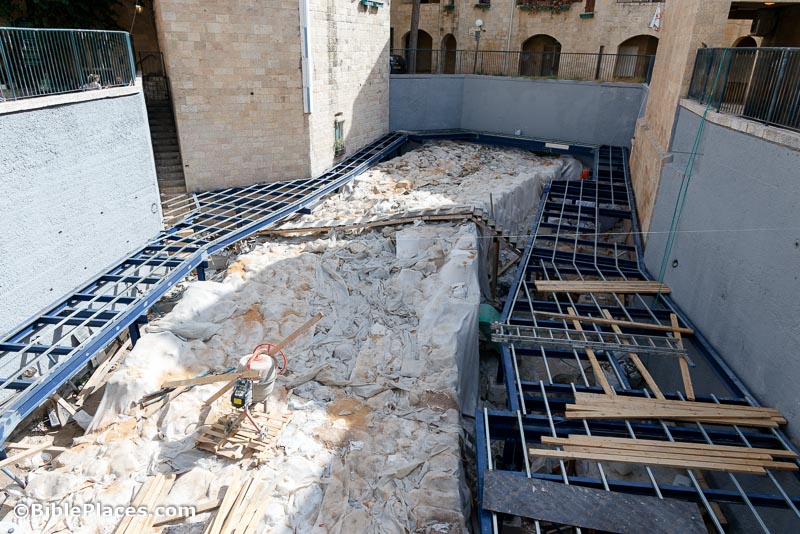
Chandler Collins reports on the transformation of a mound of dirt in the Armenian Quarter of Jerusalem’s Old City into a paved parking lot. He has done a great job with before-and-after photos. (You can support his work and gain some nice benefits by becoming a patron.)

HT: Agade, Arne Halbakken, Joseph Lauer, Explorator, Paleojudaica

Share:

A lot happened while I was away, and it’s going to take five or six days (!) to catch up. Let’s get to it.

Archaeologists excavating el-Araj discovered a mosaic in the Byzantine church that mentions the “chief and commander of the heavenly apostles,” further strengthening the site’s claim to be Bethsaida, the hometown of Peter. They are hoping to find an inscription mentioning Andrew in the October excavation.

“Archaeologists working at Tel Shiloh earlier this summer discovered piers that they believe formed a door into a gate complex at the northern edge of the biblical city.” Scott Stripling thinks this is the gate where Eli died.

Also at Shiloh, archaeologists discovered five intact storage jars from the Late Roman or Byzantine eras.

Excavations have begun at Kh. Tibnah, possibly Joshua’s city of Timnath-heres. Early discoveries include a Roman spearhead. Also, there is a dispute over ownership of the site (subscription).

The first Roman military amphitheater ever found in Israel was recently uncovered at Megiddo.

Matthew Adams talks about the excavations this summer at Megiddo on The Book and the Spade.

A Byzantine convent dedicated to Hannah was recently re-discovered at Horbat Hani in central Israel. There are some nice photos here.

A collection of 530 astragali (animal knucklebone gaming dice) from the Hellenistic period were discovered at Maresha-Bet Guvrin with names inscribed of Aphrodite, Eros, Hermes, Hera, and Nike.

A volunteer at the Temple Mount Sifting Project discovered what may have been a cheater’s die, with the number 5 where the number 4 should have been.

“A bronze Roman coin dating back 1,877 years with the symbol of the Cancer zodiac sign and a Moon goddess was discovered at Carmel Beach in Haifa.”

Computer calculations of 70 CE Roman arsenal uncovered in excavations in Jerusalem demonstrate veracity of Jewish historian Josephus’s report of intense fighting near Third Wall.”

Lior Schwimer has reviewed nearly 15,000 panels of Negev rock art with more than 50,000 carvings.

Steven Ortiz is a guest on the Biblical World podcast, talking with Chris McKinny about the Lanier Archaeological Center at Lipscomb University, the Gezer Archaeological Project, and the Tel Burna Archaeological Project (28 min).

Bryan Windle identifies the top 3 reports in biblical archaeology for the month of July.

Registration for Jerusalem University College’s fall online courses ends on Monday.

HT: Agade, Arne Halbakken, Joseph Lauer

Share: