The Atlantic sews together the story of the “first-century Mark,” Hobby Lobby, and Dirk Obbink.

Stephen Oryszczuk takes a tour of the only accelerator mass spectrometry lab in the Middle East, and its contribution to ongoing archaeological excavations.

Scholars are studying erasures and corrections in the Leningrad Codex.

Ruth Schuster considers what caused the collapse of Byzantine farming in the Negev highlands.

Ianir Milevski and Liora Kolska Horwitz investigate the domestication of donkeys in the ancient Near East.

The summer issue of Biblical Archaeology Review includes articles on forced resettlement at Tel Hadid, old Christian manuscripts, and the scarab. (BAR appears to have quietly cut its number of issues each year from 6 to 4.)

The British Museum has created historical city travel guides to Nineveh in the 7th century BC and to Rome in the 1st century AD.

Pompeii Live, “the British Museum’s most popular exhibition of the last decade is set to return, in the form of an online broadcast” that will premiere on May 20.

Lachish is the subject of a 7-minute video, the latest in the Life Lessons from Israel series.

The Ancient World Online (AWOL) has now surpassed ten million page views.

Satire: Stanford will be offering a new course entitled “How to be a Gladiator,” and signed waivers will be required to enroll.

A NPR piece looks at what has happened with tourism at Petra, going from 8,000 people a day to zero. Now the place is being taken over by cats, sparrows, and wolves.

Assassin’s Creed Discovery Tours of Ptolemaic Egypt and Classical Greece are free through May 20. Explore those worlds in a “living museum.”

Accordance has photo resources related to biblical archaeology on sale.

There is no shortage of material for an archaeological biography of King Ahab.

Israel’s Good Name describes his university field trip to Tel Arad and Tel Beersheba.

To celebrate his birthday, Shmuel Browns drove up to Sussita and took some beautiful photos.

Church of the Holy Sepulcher locked, nf7550-sr_thumb[1]

All locked up: The Church of the Holy Sepulcher in Jerusalem, May 12, 2020

HT: Agade, Ted Weis, Keith Keyser, Joseph Lauer, Explorator, Brian Johnson
Share:

A first-century synagogue discovered at Beth Shemesh will have to be moved because it is in the line of the highway-widening project. An article in Hebrew at Makor Rishon includes a photo.

Haaretz: A “study of the three oldest stone enclosures at Göbekli Tepe has revealed a hidden geometric pattern, specifically an equilateral triangle, underlying the entire architectural plan of these structures.”

A project to preserve and popularize a group of megalithic dolmens in northern Lebanon has been completed.

Brent Nongbri asks whether Qumran Cave 1 is really Cave 1.

Bryan Windle’s Top Three Reports in Archaeology in April look to technology stories as well as the impact of COVID-19.

Wayne Stiles explains how Paul’s incarceration in Rome is instructive in our present crisis.

Christopher Rollston is the guest on The Book and the Spade, talking about the Dead Sea Scroll forgeries (part 1, part 2).

Nijay Gupta recommends the best resources for studying New Testament backgrounds and context. And Brad Cooper shares a broader list of similar resources that also includes online courses, online resources, and more.

The latest Biblical Studies Carnival is online, filled with links to stories, blogposts, podcasts, and book reviews from the past month.

HT: Agade, Ted Weis, Joseph Lauer, BibleX

Share:

A team excavating Khirbet a-Ra‘i (the alleged Ziklag) in January and February discovered “a rare ‘smiting god’ figurine, a bronze calf figurine, two seals and decorated Canaanite and Philistine pottery from the 12th Century BCE.”

With everyone home, antiquities thieves are having a field day in Judea and Samaria.

With the Israel Museum closed, the Dead Sea Scrolls are now safely stored “behind five locked doors in a humidity and temperature-controlled vault at the Shrine of the Book.”

Owen Jairus reports on discoveries made in the Nazareth Archaeological Project, as recently published by its director Ken Dark.

The summer season at Tell es-Safi/Gath has been cancelled. Other excavations have apparently cancelled as well, though I haven’t yet seen those notices.

The Temple Mount Sifting Project has unveiled a new virtual exhibition.

The Palestine Open Maps project has just launched, and it is based on the 1940s survey maps from the British Mandate.

On Kindle for $2.99: Jesus and the Eyewitnesses: The Gospels as Eyewitness Testimony, by Richard Bauckham.

Hisham’s Delights is a new digital cookbook from the kitchen of the Albright Institute.

HT: Agade, Ted Weis, Joseph Lauer

Share:

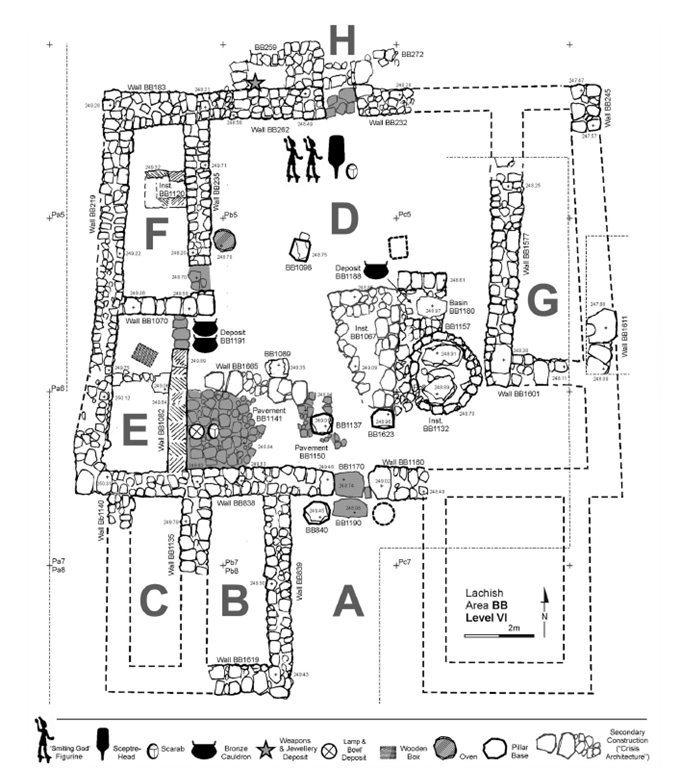
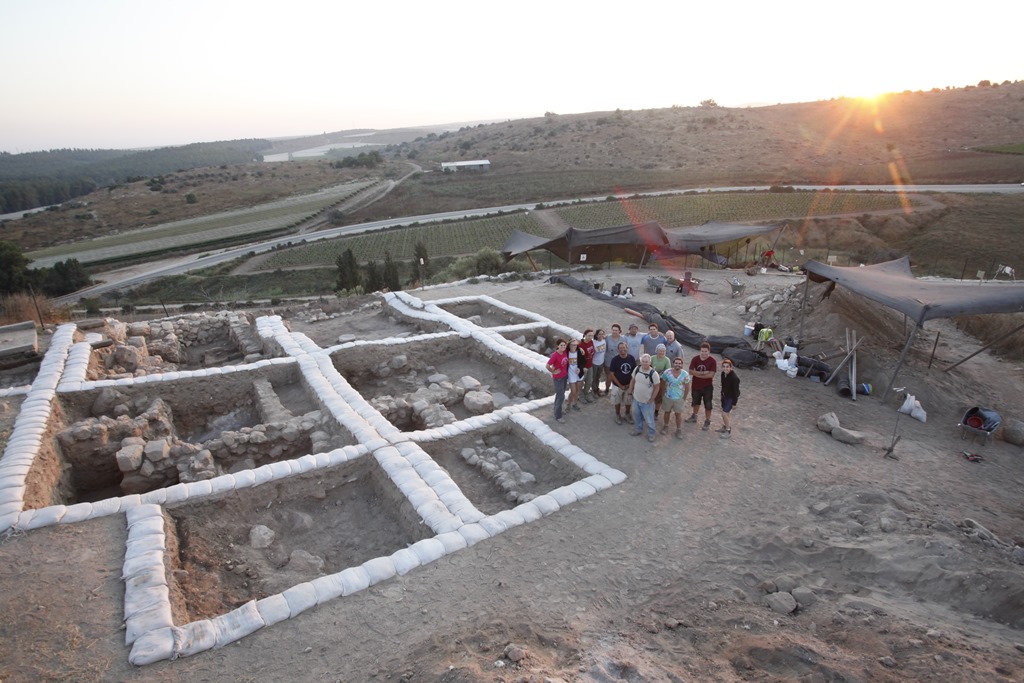
Archaeologists from Hebrew University excavating at Lachish have uncovered a temple from the Canaanite period. The full study is published in Levant, and the university has issued a press release, portions of which are excerpted here.

In a study published last month in Levant, [Yosef] Garfinkel and his co-authors revealed, for the first time ever, extensive ruins of a Canaanite temple dating to the 12th century BCE that they uncovered in National Park Tel Lachish, a large Bronze Age-era settlement near the present-day Israeli city of Kiryat Gat…

The layout of the temple is similar to other Canaanite temples in northern Israel, among them Nablus, Megiddo and Hazor.  The front of the compound is marked by two columns and two towers leading to a large hall.  The inner sanctum has four supporting columns and several unhewn “standing stones” that may have served as representations of temple gods.  The Lachish temple is more square in shape and has several side rooms, typical of later temples including Solomon’s Temple.

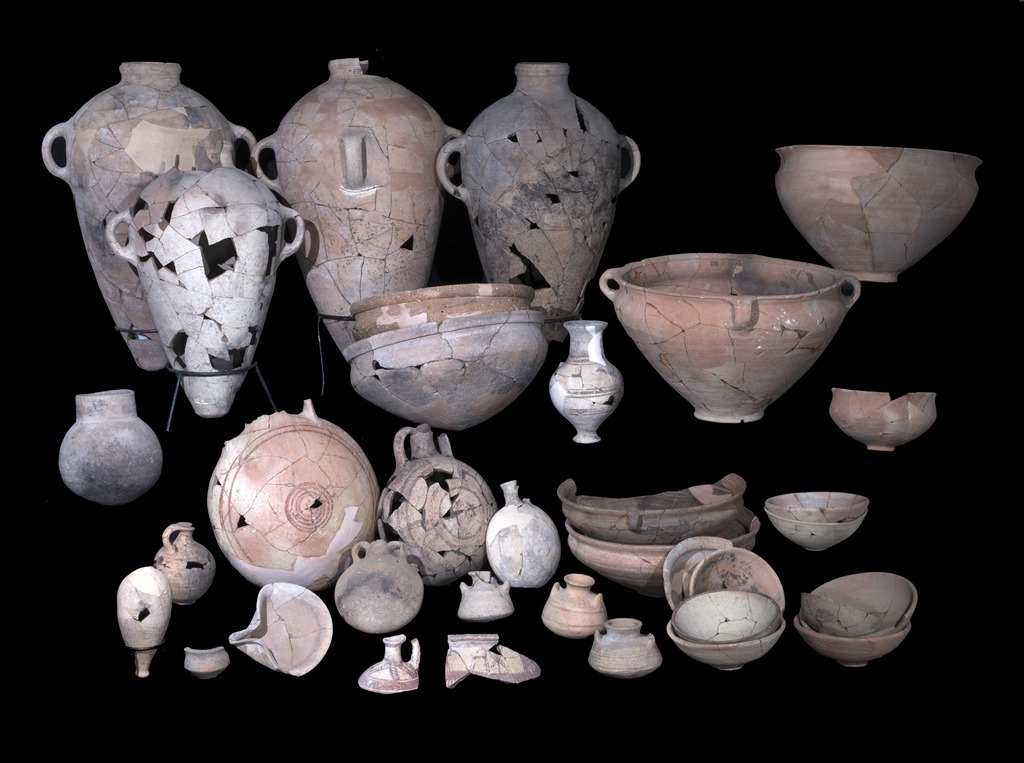
In addition to these archaeological ruins, the team unearthed a trove of artifacts including, bronze cauldrons, Hathor-inspired jewellery, daggers and axe-heads adorned with bird images, scarabs, and a gold-plated bottle inscribed with the name Ramses II, one of Egypt’s most powerful pharaohs.  Near the temple’s holy of holies, the team found two bronze figurines.  Unlike the winged cherubs in Solomon’s Temple, the Lachish figurines were armed “smiting gods”.

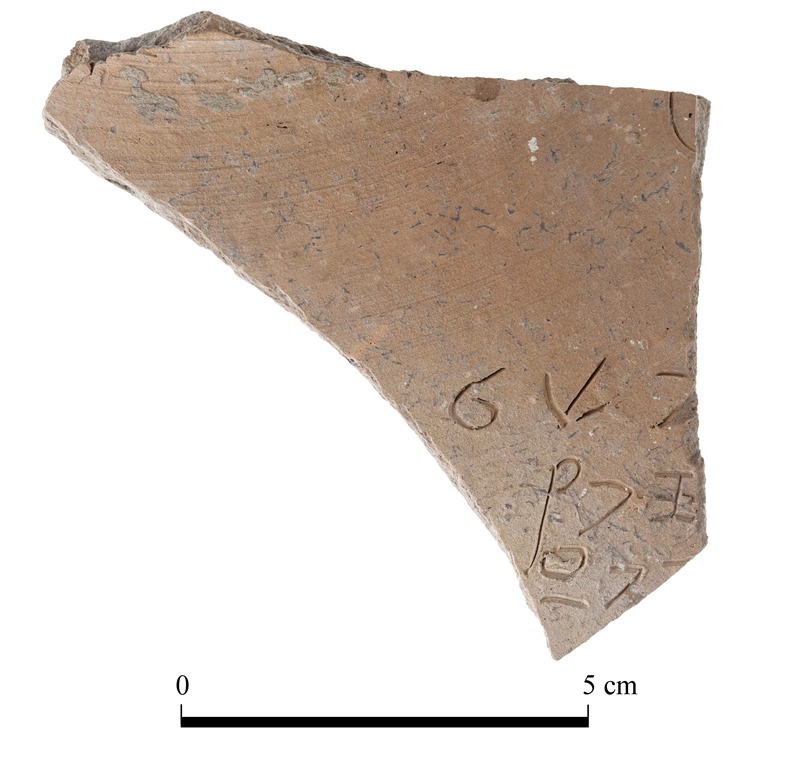
Of particular interest was a pottery sherd engraved with ancient Canaanite script.  There, the letter “samek” appears, marked by an elongated vertical line crossed by three perpendicular shorter lines.  This makes it the oldest known example of the letter and a unique specimen for the study of ancient alphabets.

The story is currently being reported by Jewish Press and Arutz-7, with more surely to follow.

HT: Joseph Lauer

Temple at Tel Lachish_Courtesy of the Fourth Expedition to LachishJPG

Temple at Tel Lachish, courtesy of the Fourth Expedition to Lachish

Plan of the North-East Temple_Credit J. Rosenberg.

Plan of the North-East Temple, by J. Rosenberg

Letter samek, 2nd row on right, inscribed on storage jar_Credit T. Rogovski

Letter samek, 2nd row on right, inscribed on storage jar; photo by T. Rogovski

Pottery uncovered in Temple_Credit C. Amit_IAA

Pottery uncovered in temple, photo by C. Amit, IAA

Share:

Few people will get excited about a “large stone found at Beth Shemesh,” but if you claim that the ark of the covenant sat there, that’s another matter. The archaeologist helpfully notes that the stone is located in the wrong place, and I’ll add that the temple dates to the wrong century and the stone looks to be much too small to qualify as a “large stone” in Israel.

An ancient seawall near Haifa allegedly was built to prevent flooding caused by climate change in the Neolithic period. The journal article on which these stories are based is here.

“A small 1st century factory that produced fermented fish sauce — arguably the most desirable foodstuff of the Roman era — was recently uncovered during excavations near the southern coastal Israeli city of Ashkelon.”

A Bronze Age painting of an Asian monkey on a Greek island suggests that trade and cultural contacts were more far-reaching than previously known.

“Two large tombs have been discovered and excavated at the site of the ancient city of Pylos in southern Greece, suggesting that Pylos played a surprisingly prominent role in early Mycenaean civilization.”

Archaeologists have found physical evidence of the mysterious pointy “head cones” found in Egyptian art.

“Egypt’s Ministry of Antiquities witnessed a fortuitous weekend, discovering rare red granite Ramses II statue and seizing 135 relics in a Kidney dialysis centre.”

The homes of ancient Egyptians, Mesopotamians, and “Israelis” are presented in this collection of 40 photographs.

Shawn Zelig Aster has written a short but interesting article explaining how Assyria treated ambassadors from Israel, Judah, and other nations in order to turn them into emissaries for Assyrian ideology.

Bryan Windle pulls together all of the evidence, and a number of photographed inscriptions, in his archaeological biography of Quirinius.

Carl Rasmussen shares a few photos from his visit to the new museum at Caesarea Maritima.

The final Stars Wars movie is the latest Hollywood production to be filmed in Jordan’s Wadi Rum.

Phillip J. Long is quite positive in his review of the new Lexham Geographic Commentary on Acts through Revelation.

Don McNeeley provides a summary of the presentations given at the 2019 meeting of the Near East Archaeological Society.

Pac McCarthy (seetheholyland.net) has written a hymn with a Holy Land theme. A video recording is now on YouTube.

HT: Agade, Ted Weis, Keith Keyser, Joseph Lauer, Mark Hoffman

Share:

Here’s a gem: a video about the excavations at Corinth made in 1945.

The first season of The Holy Land: Connecting The Land With Its Stories with John (Jack) Beck is now available on YouTube.

The Bible and Interpretation has an abridged version of a chapter from Margreet Steiner’s new book, Inhabiting the Promised Land: Exploring the Complex Relationship between Archaeology and Ancient Israel as Depicted in the Bible. This chapter surveys the history of modern scholars trying to locate the patriarchs in various periods.

A new exhibit at the Oriental Institute reveals the original colors of Assyrian reliefs.

Analysis of clay jar lids from the Qumran caves reveals residue of papyrus, supporting the theory that scrolls were once stored in the jars.

Ferrell’s Favorite Foto #33 is of the Cave of Adullam.

John Byron is on The Book and the Spade discussing the subject of his new book, A Week in the Life of a Slave (and Part 2).

The Temple Mount Sifting Project is now enjoying a new state-of-the-art greenhouse.

If you’ve ever been to an academic conference, you may appreciate this series of videos, especially the last one.

Biblical Archaeology Society is selling many DVDs for $5.

A couple of sets of Lois Tverberg’s excellent books are available for reduced prices this month.

HT: Agade, Joseph Lauer

Share: