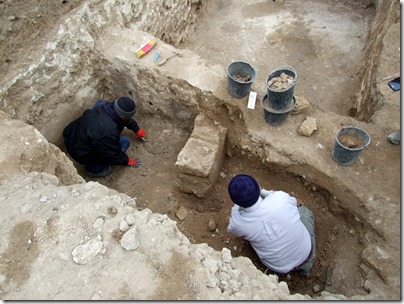
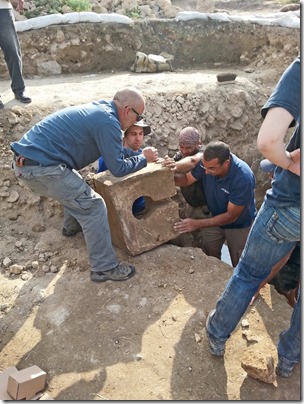
Teenagers working in an excavation in Galilee discovered a rare gold coin from the 8th century.


The New York Times has a story on the recent exposure of the burial bed inside Church of the Holy Sepulcher. Carl Rasmussen found some unique photos of the excavations here.

With the release of the editio princeps, Christopher Rollston has posted some more thoughts on the (possibly forged) Jerusalem Papyrus. The IAA is defending the inscription’s authenticity. Shmuel Ahituv is interviewed on Rejuvenation podcast.

Israel HaYom looks at early Muslim sources that acknowledge the Jewish history of the Temple Mount.

Shem Tov Sasson shares his experience of the first day of a new excavation at Tel Kedesh.

Ynet runs a story on the Qeiyafa exhibition at the Bible Lands Museum in Jerusalem. Haaretz has a similar story.

King University in Tennessee is hosting a conference on Nov 13-14 entitled, “What’s Going on with Biblical Archaeology?

Timothy P. Harrison shares an appreciation of the life and work of John S. Holladay Jr.

TouristIsrael recommends five unique places to stay in Israel.

Wayne Stiles provides an interesting overview of Nazareth past and present.

Excavations on Mount Zion this summer uncovered a destruction layer from a Crusader battle in Jerusalem in AD 1153.

Accordance 12 was released this week, along with a new free version called Accordance Lite.

Upgrades are also very affordable.

HT: Joseph Lauer, Agade, Charles Savelle, Mark Hoffman

Share:

An ancient Christian “crossword puzzle” has been discovered in the agora of Smyrna.

A sewage system in the Urartian city of Van that dates to 800 BC has been fully excavated.

You missed the first-ever “Swim the Corinth Canal” event, but perhaps you can join next year.

Greece’s National Archaeological Museum is celebrating its 150th anniversary.

At the ASOR Blog, the executive producer of a new documentary about Gertrude Bell provides some background. You can also watch the trailer.

New paper at Academia: “Computer Experiments on the Khirbet Qeiyafa Ostracon,” by Eythan Levy and Frédéric Pluquet.

Nigel Fletcher-Jones considers the ethical problem of the public display of mummies and alternative approaches.

A French-Egyptian citizen turned over a golden mummy mask to the Egyptian government.

The November/December issue of Biblical Archaeology Review is now online.

If you’re a subscriber to the Wall Street Journal, you can read Roger Toll’s “The Real Adventurer’s Guide to the Ancient City of Petra.”

I made it into Wayne Stiles’s post this week about the Dead Sea Scrolls. Check out the great quote by Frederic G. Kenyon.

Shmuel Browns shares a couple of photos he took at Machtesh Qatan.

The extraordinary Bible collection of the late Charles Ryrie is being auctioned off by Sotheby’s.

HT: Charles Savelle, Agade, Joseph Lauer, Ted Weis, Paleojudaica

UPDATE: Next weekend’s roundup will be delayed by several days.

Share:

Archaeologists working at Tel Lachish have excavated the second half of a six-chamber gate and claim to have discovered two horned altars suggested that this was a “shrine in the gate” that was desecrated in the reforms of Hezekiah (2 Kgs 18:4). The evidence of the desecration is a stone toilet that was never used but that recalls Jehu’s conversion of the Baal temple in Samaria into a latrine (2 Kgs 10:27). The horns of one(?) of the altars were removed in the reform as well. The gate was destroyed in the invasion of Sennacherib in 701 BC.

For more information, take a look at the IAA press release or read the reports in the Jerusalem Post and The Times of Israel. The first four photos are courtesy of the Israel Antiquities Authority. More photos and videos are available here. I’m curious to see Aren Maeir’s take, but he has not yet posted on it.

HT: Joseph Lauer, Chris McKinny

1
Aerial view of the excavated gatehouse at Tel Lachish.
Photo by Guy Fitoussi.
4
Excavation of the gate shrine with the “altar” visible in the center. Photo by Saʽar Ganor.
7
Evidence of “altar’s destruction.” Photo by Yoli Shwartz.
14
Removal of the stone toilet. Photo by Igor Kramerman.
Lachish inner gate reconstruction, tb060816602
Reconstruction of gatehouse, taken in June, following the January–March excavations.
Share:

Philippe Bohstrom reports in Haaretz on the discovery of a large royal structure immediately adjacent to the Solomonic city gate.

A palatial building dating to the era of King Solomon 3000 years ago has been discovered in the royal city of Gezer, though there is no evidence which of the Israelite kings lived there, if any.
The monumental building dates to the 10th century BCE, the era associated with King Solomon, who is famed for bringing wealth and stability to the newly-united kingdom of Israel and Judah. The American archaeological team also found a layer featuring Philistine pottery, lending credence to the biblical account of them living in the city until being vanquished by King David.
The complex features a large central courtyard, like contemporary palace-like buildings found throughout the southern Levant, including at Hatzor and Megiddo. Though there’s no telling who ruled from there, if anybody did, the edifice is significantly larger than the size of ordinary houses of the time, excavation co-director Prof. Steve Ortiz, representing the Tandy Museum of Southwestern Baptist Theological Seminary of Fort Worth, Texas, told Haaretz. Among the features not found in usual domestic structures is ashlar masonry – large rectangular-shaped monolithic hewn stones – in the corners of rooms, Ortiz said.
[…]
The main feature is two parallel long rooms, or courtyards, surrounded on all sides by various rooms, numbering at least 15. The palace has two entrances from the east and west. The entrance from the west also connects this building to the monumental six-chambered gate associated by most scholars with Solomon. This entrance is more robustly built than the rest of the building: The walls are constructed with two to three rows of stones wide, built of roughly dressed field stones somewhat smaller in size than those used in the rest of the building.

The article contains photos and more background about the historical importance of Gezer along with a little bit of the reasoning for dating this stratum to the 10th, and not 9th, century.

HT: Joseph Lauer

Gezer aerial from west, ws073114058b
Gezer from the west, showing area of palace excavations
Photo by Bill Schlegel
Share:

In work to construct a mikveh in the Jewish Quarter of Jerusalem, archaeologists discovered a Roman bathhouse and below that a cistern connected to the aqueduct from Bethlehem.

Hundreds of Roman fresco fragments from a large building, dating to the 2nd century, have been excavated in Zippori National Park (Sepphoris).

A journalist gets a rare chance to visit Mount Ebal and its “altar.”

A site proposed as one of the Gilgals of the Bible is in danger because of the establishment of a new garbage dump.

Nadav Shragai asks why the media ignores illegal Muslim activity on the Temple Mount.

A new music video by Michael W. Smith was filmed entirely in Israel and includes some beautiful drone footage.

The Baptist News interviews a zooarchaeologist who excavated in the Philistine cemetery of Ashkelon.

A collection of Dead Sea Scroll fragments owned by the Museum of the Bible have been published in a book edited by Emanuel Tov, Kipp Davis, and Robert Duke.

It’s not just the words, but where they were spoken, argues Wayne Stiles.

Dan Warner is on the Book and the Spade this week talking about his excavation of the Canaanite water system at Gezer.

Seth Rodriquez appreciates the support he received for his trip to teach biblical backgrounds at the
Baptist Theological Seminary of Zimbabwe and he reports on his time there.

HT: Joseph Lauer, Ted Weis, Agade, Charles Savelle

Mount Ebal altar from northwest, ws092213002
Proposed altar on Mount Ebal
Photo by Bill Schlegel
Share:

The Israeli police arrested five members of the Waqf for erecting scaffolding and carrying out structural changes on the Dome of the Rock without authorization.

A new study suggests that there was widespread literacy in the kingdom of Judah in the 6th century BC. The full study is available for purchase or free through Academia.

The Temple Institute is planning to open the first school for training priests to serve in the Jerusalem temple.

Jeremy Smoak compares the silver amulets from Jerusalem with the Ekron temple inscription.

Wayne Stiles: “God inspired metaphors of biblical geography and botany to highlight one of the most important aspects in any healthy marriage.”

The Winter 2016 issue of DigSight is now online and includes stories on Qeiyafa finds, past lectures, and a new exhibit.

An article on the Inspiration Cruises website gives a little history of a Finnish moshav established in Israel in the 1970s and named in memory of Jews surrendered to the Nazis in World War II.

Frank L. Benz, longtime professor at Wartburg Seminary, died last week. Several years ago, we mentioned here his little-known New Testament marking guide to the Student Map Manual.

Martin Bachmann, the German Archaeology Institute’s deputy Istanbul director and the head of the Pergamon excavations, died this week at the age of 52.

George Mendenhall died yesterday, 8 days shy of his 100th birthday.

HT: Joseph Lauer, Agade

Share: