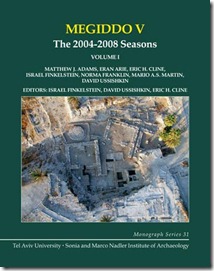
Several significant excavation reports will be published in the next couple of months and Eisenbrauns is offering major discounts on pre-orders.

Megiddo V: The 2004-2008 Seasons

Gezer VII: The Middle Bronze and Later Fortifications in Fields II, IV, and VIII

Sepphoris I: The Pottery from Ancient Sepphoris
MegiddoVcover.indd
With the ongoing debate over the chronology of the Iron Age II, the Megiddo volumes may receive the most attention from scholars.

Eisenbrauns has a number of other excavation reports on sale, including volumes on Bab edh-Dhra, Lahav (volumes I-II), Tell el-
Hesi (volumes II-V), Gezer (volumes I-III, V), and Dothan. For those interested in a popular work, the Timnah volume is now marked down 50% (to $15).

There doesn’t seem to be a direct link to the sale page, so go to the home page, read about their phenomenal new “Online/Offline
Backup Service” (announced on April 1), and follow the link to the sale from there.

A couple of recently published excavation reports are reviewed in the current issue of Biblical Archaeology Review. In the article now available online, William G. Dever reviews Ashkelon 3: The Seventh Century B.C. and Hazor: The 1990–2009 Excavations: The Iron Age.

Wayne Stiles wonders why the largest ancient site in Israel has been largely forgotten today.

Leen Ritmeyer provides context to the recent excavations of the “gate of hell” in Hierapolis.

On April 1, Luke Chandler revealed a stunning new translation of the Khirbet Qeiyafa Ostracon.

Few tourists are visiting Egypt these days and it’s hurting many who work in the industry.

Travel Weekly recommends how to spend a day visiting the harbor city of Jaffa (biblical Joppa).

A review of the new excavations of Azekah is available in a professionally-made 12-minute video.

HT: Charles Savelle, Jack Sasson

Azekah from northeast, tb030407700
Azekah from the northeast
Photo from the Pictorial Library of Bible Lands

Information on the second Qeiyafa inscription coming later this year (Luke Chandler)
The Tel Burna Arch
aeological Project (ASOR Blog)

Israel approves drilling for oil in Golan Heights (Jerusalem Post)

John the Baptist: The First Christian Martyr (Bryant Wood)

Review of The Unsolved Mystery of Noah’s Ark (Gordon Franz and Bill Crouse)


NIV Study Bible for Kindle marked down to $6.64 (Amazon)

Ferrell Jenkins has begun a series on famous people buried in the Protestant Cemetery on Mount
Zion, including Horatio G. Spafford and James Leslie Starkey.

Online Battle Over Sacred Scrolls, Real-World Consequences (New York Times) Includes an interview with Raphael Golb.

Oak forest on Golan Heights, tb020506169
Oak forest on Golan Heights
Photo from Galilee and the North

The Gezer Excavation Project includes a major regional survey under the direction of Eric Mitchell.

A preliminary report of the first five seasons (2007-2011) has now been published in Hadashot Arkheologiyot. Some excerpts:


Purpose: “The purpose of the project is to carry out a systematic high resolution archaeological survey of the region, within 1 km of Tel Gezer, and to locate and publish all features therein. This survey will aid in gaining a better understanding of the historical development of relationship between the ancient city of Gezer and its surrounding landscape.”


History: “The immediate vicinity of Tel Gezer has been investigated by R.A.S. Macalister who noted over 200 archaeological features within 1.5 km of the tell (Macalister 1912 III: Pl. VIII). In recent years, A. Shavit conducted a survey of the entire Gezer Map. Shavit noted that his survey was intensive but he was selective in the surveyed areas.”


Methodology: “To date, 1260 features have been recorded during the current investigations. Features are defined as any individual cultural element deposited on, built on, or carved into the landscape.

Therefore, with features such as winepresses, which include a basin, vat, channel, and cupmarks, each individual feature was added to the total and thus, the number of sites can be reduced significantly.”


Tombs: “Forty-one tombs were accessible for interior survey. Seven basic categories of tomb type have been encountered during the survey. These include tombs with irregularly shaped interior plans (6), simple bench-style tombs (4), arcosolium or recessed bench tombs (5), a distinct simple double arcosolia type (5), loculus or kokhim tombs (9), tombs with multiple styles (3), and tombs that are incomplete, partially filled, or otherwise do not fit into the above categories (9).”


Surface Visibility: “While modern and old disturbances could have easily hidden the existence of tombs, caves, and presses where agricultural land now stretches, the ploughed fields and orchards now offer excellent surface visibility and provide ample opportunity to observe and collect pottery, tesserae, and chert flake scatters, which would otherwise have been obscured by dense brush.”


Conclusions: “The results of the 2007–2011 Tel Gezer Survey seasons have been encouraging in terms of both artifacts and features documented, as well as total area covered. At the current rate, it is estimated that two to three additional seasons will be necessary to complete surveying a 1 km radius around Tel Gezer. Our goal for the future is to publish a catalog of features within our survey area, as well as articles on the tombs and presses of Tel Gezer. At the end of the project, we will analyze all our GPS location data for features and artifacts from every season via mapping software. Using this data, we can construct a clearer understanding of distribution patterns for various features, as well as draw wider conclusions about the use of the land around the ancient city of Gezer.”

The full report includes five images. Check out the official website for information about joining the team.

gezer-tomb
View of arcosolia in Gezer tomb
Photo by Tel Gezer Regional Survey

A cave above En Gedi is revealing well-preserved artifacts from the first century AD.

Luke Chandler has word that Yosef Garfinkel plans to follow his Khirbet Qeiyafa dig with excavations at Lachish.

The Daily Mail has photos of the newly opened exhibit of King Herod at the Israel Museum. Shmuel Browns has more.

Some are claiming that the Waqf is destroying more antiquities on the Temple Mount.

Gordon Franz evaluates Robert Cornuke’s use of a computer model to predict the location of Paul’s shipwreck on Malta.

A website for the excavations of Tel Abel Beth Maacah is now online.

En Gedi and Nahal David aerial from northwest, tb010703272
Aerial view of Nahal David and En Gedi

The Times of Israel takes its readers into the new Herod exhibit at the Israel Museum one week ahead of its opening. The article includes many photos, but may be slow loading.

Wayne Stiles has put together some great visual resources of Caesarea, including photos, video, map, and Google Street View.

City Lights over the Middle East – NASA has posted a short video taken from the International Space Station.

Air pollution has been a problem since the days of ancient Rome.

The Oriental Institute has launched its Integrated Database. Phase II will include images.

Metro publishes the “Top 10 archaeological finds of all time.”

Yosef Garfinkel will be lecturing on “Sanctuaries and Cult at Khirbet Qeiyafa” at the Southern
Adventist University’s Lynn H. Wood Archaeological Museum Lecture Series.

Keith Schoville is retiring from The Book & The Spade radio program.

I am excited to announce that our photo collection Views That Have Vanished is now available as a
module for Accordance. The collection now has all the bells and whistles you would expect from Accordance.

HT: Daniel Wright, Aren Maeir, Charles Savelle, Jack Sasson

views-vanished-bivin-accordance
Screenshot from Views That Have Vanished