Hanukkah begins today.  You can read all about it in this month’s issue of Jewish Magazine.

JTA has an article on how the Maccabees would be viewed in today’s world.  “My guess is that most liberal Jews today wouldn’t necessarily get along with the Maccabees if they showed up again,” says Rabbi Jill Jacob.

Hanukkah is also the occasion for the Jerusalem Post to discuss in two articles the Heliodorus Stele and three additional fragments discovered earlier this year (previously mentioned here).

Israeli archaeologists have also found evidence recently that the Hasmoneans controlled territory south of the biblical Negev (near modern Sede Boqer).  The IAA has a few high-resolution images here. Apparently Josephus was right, after all.

Aren Maeir has posted a stratigraphic chart from Gath in PowerPoint format.

This article brought tears to my eyes, especially when I read about the pottery that has been found from the “Persians, Umayyad, Crusaders, Mukluks and Ottomans.”  The Mukluks—oh, I love that!  I just wish I had a lecture to give now on the Mukluks.  (The rest of the co-authored article is likewise
unreliable.) 

HT: Joe Lauer

Share:

The “Hall of Ages” in Jerusalem was opened recently after new techniques were developed to prevent the room from collapsing during excavation.  This room is located in the Western Wall Tunnels area and gets its name because the hall was used by various people groups over the centuries.

You can now visit Pompeii with Google Street View.  The idea is very impressive, though execution was (for me) slow, perhaps because of a slew of excited visitors.  Here’s a direct link.

A reconstruction drawing of the Aramean siege of Gath in the 9th century is posted on the Gath Weblog.

The officials at the Megiddo prison are still planning to relocate the inmates in order to open a visitor’s center focused on the early Christian place of worship.

Share:

Everyone knows the story of David and Goliath.  Many are probably not aware, however, of what happened next.  That was the subject of James Hoffmeier’s recent lecture at the Bible and Archaeology Fest.  “Exploring David’s Strange Antics after Defeating Goliath” looked specifically at 1 Samuel 17:53-54.

1 Samuel 17:53-54 (ESV) “And the people of Israel came back from chasing the Philistines, and they plundered their camp. 54 And David took the head of the Philistine and brought it to Jerusalem, but he put his armor in his tent.”

If these verses are not baffling, remember that David had not yet conquered Jerusalem (he would do that after he became king, in 2 Samuel 5).  The other difficulty here is the phrase, “he put his armor in his tent.”  Presumably the “he” is David, “his armor” refers to Goliath’s gear, but whose tent is involved?  Some think it is the tent of David (see the translation of the NIV), others think it is the home of David (“tent” being used elsewhere of one’s home), and an intriguing suggestion is that it is the tent of Yahweh (but that requires changing the text). 

Hoffmeier’s lecture gave a tour of tents in the Ancient Near East, including those of Ramses II and Sennacherib.  Kings Thutmose III and Sargon II are recorded as having plundered the tent of their enemies.  Hoffmeier suggested that this statement indicates that David took Goliath’s tent and weapons back to Bethlehem.

As for Goliath’s head, did David store it in his refrigerator for a few years until he conquered Jerusalem?  Probably not.  While some scholars view this statement as an anachronistic error, Hoffmeier has identified a number of ancient scenes where conquerors carried off the heads of the defeated, tying them to their chariots or garden trees.  Heads were often displayed as warnings to potential enemies.  Perhaps, then, David had it in his mind to conquer the Jebusite stronghold already as a youth, and he took Goliath’s head to serve notice to Jerusalem that they were next.
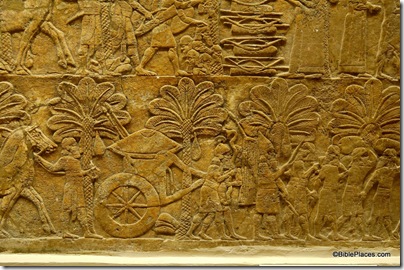
Ashurbanipal after capture of Babylon, tb112004733dddAssyrian relief depicting Ashurbanipal’s army after capture of Babylon, c. 650 BC.  Relief now in British Museum.  Notice the pile of heads in the upper center.  This same king put a hook in Manasseh’s nose and hauled him off to Babylon (2 Chr 33).

I found Hoffmeier’s lecture enjoyable and his ideas provocative.  This is a difficult problem, and I find his solution preferable to the alternatives.  My comments here are an unofficial record (I may have made a mistake in my note-taking), but you can read some of his findings in his article, “The
Aftermath of David’s Triumph over Goliath,” in Archaeology in the Biblical World, Spring 1991, pp. 18-23.

Hoffmeier is, of course, best known for his work in Egypt, and he has written a couple of excellent books on the subject of historical and archaeological evidence for the Israelites in Egypt:

One on his works on my shelf that I have not yet had time to read is The Archaeology of the Bible, published in 2008.

Share:

A promising new blog started last week with the intention of chronicling the excavation of a site from the very beginning.  The Tel Burna Excavation Project is headed by Itzhaq Shai and Joe Uziel of Bar Ilan University and we look forward to continued informative postings.  So far, they have covered:

The Arabic name for the site is Tell Bornat, and it has been identified as Libnah by W. F. Albright and A. F. Rainey.

Tell Bornat, possible Libnah, from west, tb011606860 Tel Burna from the west
Share:

There’s a recent article on Khirbet Qeiyafa that is relevant for anyone interested in the discussion concerning the site’s identity as Shaaraim (for a primer on Qeiyafa, go here) or in archaeological methodology. Since the article’s thesis is that the survey results contradict the excavation results, it is significant that the author is Yehudah Dagan, director of the Judean Shephelah Survey Project which began in 1977.

The article is entitled “Khirbet Qeiyafa in the Judean Shephelah: Some Considerations” and it was published this year in Tel Aviv, volume 36, pages 68-81. If you or your institution has a subscription to Ingenta, you can access it online (or pay $39).

This is the article’s abstract:

The excavations at Khirbet Qeiyafa have attracted attention recently following the discovery of a city gate and the proposals of the excavators that it be dated to the 10th century BCE and identified with biblical Sha’arayim. Based on my survey of the site, I suggest an alternative settlement history and a different interpretation of the construction stages of the circumference wall. I also propose an alternative identification of the biblical city of Sha’arayim.

In short, Dagan’s conclusions concerning the settlement of the site are nearly the opposite of what the excavators have reported.  Dagan found pottery from Early Bronze, Middle Bronze, and Iron I, but the excavators apparently found nothing significant from these periods.  The chief period of occupation according to the excavators is Iron IIa (roughly the time of King David), and Dagan says he found nothing from this period!  The excavators then say the site was abandoned until the Hellenistic period, but Dagan says that the majority of potsherds from the site are from the Iron IIb-c period.  Dagan also found material from Roman, Byzantine, Early Islamic, Mamluk, and Ottoman periods, about which little has been said by the archaeologists (to my recollection). 


Survey


Excavation
Early Bronze Yes No
Middle Bronze Yes No
Iron I Yes No
Iron IIa No Chief period
Iron IIb-c Majority Nothing
Hellenistic Yes Yes
Roman Yes ?
Byzantine Yes ?
Early Islamic Yes ?
Mamluk Yes ?
Ottoman Yes ?

Any way you approach it, what we have here are startlingly different conclusions from survey results versus excavation work.  It is one thing to find material from one or two periods which were not represented in a survey (which is limited to potsherds found on the surface).  But this is almost a complete mismatch, making one wonder if they are studying the same site.

To say it a different way, it’s less significant that Dagan did not find any Iron IIa material in his survey than it is that Garfinkel has found no Iron IIb-c material.  Sites are not always evenly settled (or preserved) and archaeologists often find a period of occupation missing in one area of the tell. 

But Iron IIa was relatively short-lived (less than 100 years) and Iron IIb-c lasted several centuries (c. 930-586).  Dagan claims that the majority of the potsherds he collected was from this period, and that’s not surprising given the large population of the Shephelah during the Divided Monarchy.  What is quite unusual, and the cause of much discussion last year, was Garfinkel’s conclusion that this was a single-period site in Iron IIa.  He said that it was settled, quickly fortified, and then abandoned within a generation.

The point here isn’t to resolve the debate, but merely to note its existence.  It certainly is a lesson in the need for excavation, and not a reliance upon survey alone.  However, if Dagan’s survey has merit, the discrepancies with the present excavation results require some explanation.  An example of the severity of the disagreement concerns the famous Iron Age gate, which Dagan says may actually be Hellenistic!  He writes,

Hellenistic finds were discerned in the passage and all the chambers of the gate, and a floor with Hellenistic pottery was exposed in the southeastern chamber of the gate, resting on bedrock (Garfinkel and Ganor 2008c: 128–129). Four-chambered gates are not alien to the Hellenistic period (e.g., Mount Gerizim) (page 76).

Another lesson from this matter: interpretations are only as good as the data they are based on.  If Dagan is right (and I don’t know that he is), all of the discussion about identifying the site as Shaaraim, Ephes-dammim, or other may be misguided. 

Stay tuned.  No doubt Garfinkel has some new data from his 2009 excavations and this article has undoubtedly lit some fires.  Perhaps it is not irrelevant that Dagan conducted his survey under the auspices of Tel Aviv University and Garfinkel is a professor at the Hebrew University of Jerusalem. 

(As far back as Yadin and Aharoni, if one said black, the other said white.)  We look forward to clarification.

Share: