Archaeologists working at Hyrcania discovered tools used to make Holy Land souvenirs in the Byzantine period. They have also found a couple of Greek inscriptions and a Hebrew inscription.

The find of the month for the Temple Mount Sifting Project is an skewed palm-chisel, also known as a scarpel.

Leen Ritmeyer writes about, and illustrates, the origin of Hanukkah.

The Jerusalem Tracker is being split into two editions, with the first focusing on new books and articles related to Jerusalem. The second highlights new pop/social media and blogs, digital resources, developments, and upcoming events about Jerusalem.

I’ve learned that the free “Geography and the Bible” seminar being hosted by Jerusalem University College on January 10 includes a $300 travel course voucher for all registered attendees who join the seminar live online.

“After years of delays and spiraling costs, Rome inaugurated two new metro stations on Tuesday, including one by the Colosseum, showcasing archaeological discoveries that might become tourist attractions in their own right.”

Archaeologists are not agreed over the significance of the victims of Pompeii wearing woolen cloaks in August.

Imagery in an AI-generated video about ancient Rome is filled with errors.

Webinar on Jan 7: “Beyond Edutainment: Reclaiming Archaeology in a Clickbait World,” by Amanda Hope Haley

New release: Stones Still Speak: How Biblical Archaeology Illuminates the Stories You Thought You Knew, by Amanda Hope Haley

“Iraq’s famed Tigris is heavily polluted and at risk of drying up.”

Archaeologists may have discovered the Mycenaean palace in the region of ancient Sparta.

James Davila notes a couple of fascinating comments that Irving Finkel recently made concerning writing at Göbekli Tepe and a supposed Babylonian looting of the Library of Ashurbanipal.

We will post our annual roundup of stories, including the top 10 discoveries of the year, on Monday. There will be no roundup next weekend.

HT: Agade, Arne Halbakken, Alexander Schick, Explorator

Share:

“An impressive section of Jerusalem’s fortification wall from the second century BCE has been uncovered on the grounds of the Tower of David complex in the Old City.” About 130 feet of the “First Wall” has been uncovered in the Kishle.

Archaeologists have found evidence for the famous battle at Bet Zecharia described in 1 Maccabees. “It is the first time we have possible archaeological evidence from one of Judah Maccabee’s battlefields.”

A scholar believes that he has cracked Cryptic B, a rare alphabet known only from two uses in the Dead Sea Scrolls.

Coins previously believed to sloppy versions of coins minted by Alexander Jannaeus should instead be understood as coming from the economically weak era of the Hasmonean civil war between 60 and 40 BC.

Hartebeests went extinct in Israel not in the Iron Age but in the Byzantine period.

Doron Spielman spoke about some of his experiences in the City of David at a recent event in Jerusalem.

On Digging for Truth, Scott Stripling explains the archaeology that is related to Hanukkah.

On the Biblical World podcast, Kyle Keimer talks with David deSilva about his two new archaeology books.

Dig has released a 27-minute video about Labayu of Shechem.

The foundation stone of the Pontifical Biblical Institute in Jerusalem was laid 100 years ago.

A powerful winter storm caused death and destruction all over Israel this week.

New release: The Archaeology of the Kingdom of Judah, by Yosef Garfinkel (SBL Press, $75)

You can now purchase soil from the Temple Mount.

Jerusalem University College will be presenting its 6th annual online seminar on January 10. The “Geography and the Bible” seminar is free and will include four sessions:

  • “Road Systems from Egypt through Sinai,” by James Hoffmeier
  • “Trekking from the Desert to the Land of Milk and Honey,” by Hélène Dallaire
  • “What Does it Mean that Jerusalem was ‘Built as a City which is Compact Together?’ A Geographical and Archaeological Reading of Psalm 122:3,” by Chandler Collins
  • “The Early Church’s Encounter with the Roman Imperial Cult,” by Carl Rasmussen

There is no hat tip (HT) below to Gordon Franz, because Gordon died on November 22. I met Gordon when studying at IHLS in the early 90s, and we stayed in touch over the years, including a tour he gave my family of NYC. Gordon taught for various schools over the years, including the Israel and Turkey/Greece/Rome programs for the Talbot School of Theology.  Most recently Gordon sent me stories for these roundups, and in the last email he wrote me, he said he was on his way to buy Rabbi Landy’s latest book. He was quite the book connoisseur. And he had much yet he planned to accomplish. Some of Gordon’s writings are still available on his website. A recording of his celebration of life service is online. He will be missed.

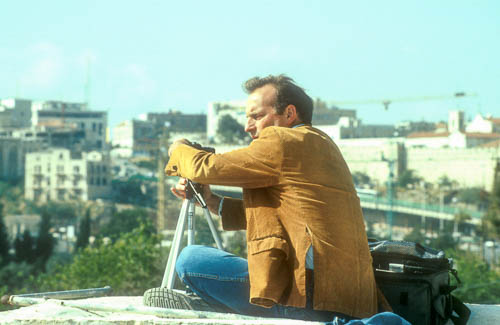
Gordon Franz taking photos from the rooftop of the Institute of Holy Land Studies in Jerusalem, 1993

HT: Agade, Ted Weis, Keith Keyser, Arne Halbakken, Alexander Schick, Explorator

Share:

A system of tunnels has been discovered under the Gan Hashlosha National Park, used during the Mamluk period for sugar mills.

The Temple Mount Sifting Project’s find of the month is a bronze crotal bell with an iron chain attachment.

On Digging for Truth, Abigail Van Huss reports on her research into Israel’s settlement in the hill country.

“What happened to the ark of the covenant?” is the topic of Chris McKinny’s conversation with Gordon Govier on The Book and the Spade.

Ami Nadir graduated with his PhD in archaeology from Ben-Gurion University at age 81.

Stephen Pfann, Dead Sea Scrolls scholar and co-founder (with his wife Claire) of the University of the Holy Land, died recently.

New release: A Prophet to the Nations: Archaeological and Historical Perspectives on Jeremiah 46–51, edited by Jordan Davis and Benedikt Hensel (Vetus Testamentum et Orbis Antiquus, Vandenhoeck & Ruprecht; EUR 140; digital is open access)

The latest issue of Tel Aviv is fully open access. It includes articles on Hazor, Horvat Tevet, and more.

HT: Agade, Gordon Franz, Alexander Schick, Arne Halbakken, Charles Savelle, Explorator

Share:

The Pilgrims’ Road, leading from the Pool of Siloam to the Temple Mount, was inaugurated this week, and visitors can now walk the full length.

A hoard of bronze coins found at Tel Huqoq in Galilee provides insight into the little-known Third Jewish Revolt against the Romans in AD 351.

“Over the course of millennia, inhabitants of the Levant used irrigation to mitigate the effects of climate change and maximize the production of olives and grapes, demonstrating resilience and ingenuity.” The underlying journal article is here.

Scholars at Tel Aviv University’s School of Computer Science have developed a new tool to analyze the writing on the Dead Sea Scrolls.

Achia Kohn-Tavor is on The Book and the Spade to talk about the excavations at el-Araj/Bethsaida, including the recent fire.

Turkiye Today has a history of Israel’s requests that Turkey send the Siloam Inscription back to Jerusalem.

The latest issue of Near Eastern Archaeology is dedicated to Megiddo in the Iron Age. A subscription is required for access.

“After 800 years of silence, a pipe organ that researchers say is the oldest in the Christian world roared back to life Tuesday, its ancient sound echoing through a monastery in Jerusalem’s Old City.”

BibleStock has released a new teaching video for the Parable of the Sower which “includes links to some amazing drone footage of the fields around the northern shoreline of the Sea of Galilee.”

David M. Jacobson has posted some recent articles on Academia:

The Feast of Trumpets (aka Rosh Hashanah) begins Monday evening.

Tom and Joann Doyle hosted me on their Uncharted Ministries podcast (Spotify, Apple), and we had a fun time reminiscing about Israel, photography, teaching experiences, excavations, Isaiah, my family, my “legacy,” and more. This is the most personal interview I’ve ever done, and the experts at Uncharted loaded up the YouTube version with lots of photos.

HT: Agade, Gordon Franz, Explorator

Share:

Archaeologists excavating 15 miles east of Tel Aviv uncovered “the largest [ancient] Samaritan site outside of the Samaritan homeland,” including colorful mosaics, two ritual baths, and lots of coins and oil lamps.

“Israeli archaeologists discovered rare preserved lamp wicks believed to be some 4,000 years old during excavations for a new neighborhood in Yehud, in central Israel.”

A ceramic bearing reed impressions is the “find of the month” for the Temple Mount Sifting Project.

The Times of Israel has more about the effects of the wildfire that burned the excavation site at el-Araj, likely the New Testament site of Bethsaida.

John DeLancey writes and shares photos from his time volunteering at the Tel Eter excavation.

Megiddo: A City Unearthed, A Past Imagined marks 100 years since ISAC’s first major archaeological expedition (1925–1939), which revealed layers of palatial complexes, fortifications, and elite material culture.”

Correction: Eric Cline’s upcoming lecture will be on Sept 9, not Sept 8.

Zoom lecture on Sept 18: “Excavations of Crusader Akko,” by Danny Syon, sponsored by the Anglo-Israel Archaeological Society.

The latest issue of Tel Aviv has been released, and it includes open-access articles about Tel Azekah, Manasseh’s wall in Jerusalem, and Late Roman mansion in the Givati Parking Lot excavations in Jerusalem.

“The top three reports in biblical archaeology from August 2025 included reports of gold, silver, and a monumental structure in Jerusalem.”

HT: Agade, Arne Halbakken, Gordon Franz

Share:

“Analysis of 3,000-year-old smelting droplets shows copper from Timna and Feinan was alloyed with tin at a mountain site in Samaria, revealing a budding regional trade and technology network.” The underlying journal article is here.

A fire along the shore of the Sea of Galilee cleared the overgrowth at el-Araj (possibly Bethsaida), exposing piles of stones which may be ancient buildings.

A new video tours the not-yet-open museum below the Western Wall plaza (22 min).

The first volume of the excavation reports is now open-access: Jerusalem Western Wall Plaza Excavations I: The Roman and Byzantine Remains; Architecture and Stratigraphy, by  Shlomit Weksler-Bdolah (IAA Reports, 2019)

“Police arrested a 27-year-old Jewish suspect on Monday, accused of spray-painting ‘There’s a Holocaust in Gaza’ on the ancient stones of the Western Wall, Judaism’s second-holiest site.”

Chandler Collins explores the location and significance of the Mishneh in Jerusalem.

Archaeologists have found two ancient church buildings in Egypt’s Western Desert.

“It’s now official—the Grand Egyptian Museum (GEM) will hold its long-awaited grand opening on November 1.”

“A new artificial intelligence (AI) system has accurately read an ancient Hammurabi tablet with 98% precision, marking a significant step forward in translating some of the world’s earliest written laws.”

New release: Ancient Mediterranean Incarceration, by Matthew D. C. Larsen and Mark Letteney (UC Press, $13, open-access)

Bible Mapper Atlas has posted an audio-visual reading of Judges 4.

With excavations underway at Colossae, Ferrell Jenkins recalls his first visit to the site several decades ago.

HT: Agade, Gordon Franz, Ted Weis, A.D. Riddle, Arne Halbakken, Wayne Stiles, Gordon Dickson, Andy Cook

Share: