Joseph Patrich provides a great survey of what we know about Caesarea Maritima from archaeological excavations.

Ferrell Jenkins has written a couple of illustrated posts on Saint Catherine’s Monastery in the Sinai Peninsula.

The IAA has more information about the Byzantine prayer box discovered in the City of David (aka
“Walls around Jerusalem” National Park).

The West Semitic Research Project has made three RTI images available to BAR readers to view without requiring registration. (Background here.)

Wayne Stiles transports his readers to the Mount of Beatitudes in the spring.

You can now register for the 2012 season at Gath. This is one of the most popular excavations in the world.

The ancient mikveh discovered near Zorah is the subject of a 1.5 minute video at the Jerusalem Post.

A bill submitted to Israel’s parliament “aims to preserve the Dead Sea and its internationally treasured natural resources, maintain the salty waters for the benefit of the next generation, curb the plunging water levels of the northern basin and determine new terms of management for the region, which will provide for continued reasonable extraction of minerals while protecting the ecosystems and biodiversity.”

Israel’s Knesset has refused to declassify the Temple Mount Report. “Shin Bet officials argued the report should remain confidential on the grounds its contents were sensitive and its publication could result in confrontations and geopolitical changes at the site.”

A scholar claims that the number of ancient stone wheels visible only from the sky may number more than a million. Google Earth is now being used to identify these throughout Syria, Jordan, and Saudi Arabia.

Iraq has budgeted $8.5 million to develop the infrastructure at the ancient city of Babylon.

HT: Joseph Lauer, Jack Sasson

Share:

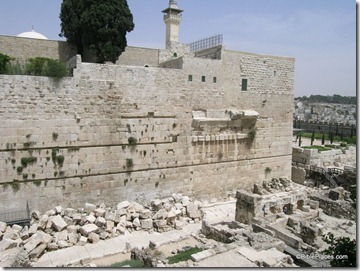
The bridge from the Western Wall plaza to the Temple Mount has been in the news frequently since the collapse of the earthen embankment in 2004. Arutz-7 reports on the latest in the saga:

Jerusalem’s engineer demands that the ”Mughrabi” bridge for Jews to the Temple Mount be repaired or closed because of dangers.
The complaint of its stability could not come at a worse time for Israel. The bridge, also known as the Rambam Gate, has been a potential explosive subject involving Israel, the Palestinian Authority and Jordan.
Jerusalem engineer Shlomo Eshkol wrote a letter to the Western Wall Heritage Foundation and demanded that the safety hazard in the temporary structure be fixed within 30 days. Although “temporary,” the structure has existed for several years after the collapse of the old permanent bridge.
Eshkol said authorization for a new bridge was granted last May, but action has been stalled because all parties involved disagree over who has the authority to tear down the current bridge and finance a new one.

The story continues here. For background, see here and here.

Ramp from Western Wall prayer plaza to Temple Mount
Share:

Tom Powers has posted today his experience in traveling through the drainage channel up from the City of David to the street below Robinson’s Arch. You’ll need to go there for the dozen photos and a step-by-step description, and I’ll encourage you to do that with a couple of sections from his conclusion:

MY TAKE on the experience:  It’s hard to see this underground route turning into a major tourist draw on the order of Hezekiah’s Tunnel. I see it being more for the hard-core afficionado (like me). For one thing, after the initial novelty of traversing an ancient sewer wears off, it gets a bit, well… tedious – it’s 650 meters from Siloam up to the Davidson exit!…. I anticipated entitling this post “Final Section…” but it turns out there is obviously more to come in terms of opening these underground spaces. First, where the present route makes its final jog to the east to run along the foundation courses of the Temple Mount, the cleared drain channel continues straight ahead, northward, but is still blocked/gated. However, a friend of mine (who shall remain nameless) said he found the way open a few weeks ago — and follwed it. He went quite a ways, he said, until there was no more lighting and he had to turn around; he estimated he might have been under the Western Wall prayer area….

I appreciate Tom’s careful work to allow all of us to “visit” this newly opened excavation in Jerusalem.

Share:

Haaretz carries a story similar to that noted here yesterday in Ynetnews, reporting that Israel is “shocked” that Jordan would lie about their agreement with Israel.

They follow up with another in which the police recommend that construction on the bridge be delayed from next week until September, when presumably the eyes of the world will be on the UN’s debate over statehood for the Palestinians. From Haaretz:

Ever since an earthen ramp leading to the gate collapsed in 2005 and was replaced by a temporary wooden bridge, the security establishment has been dragging its feet over building a more permanent structure to link the Temple Mount entrance to the Western Wall plaza.
In recent weeks security officials have been engaged in feverish debate over when to begin work.
[…]
Police officials at the meeting contradicted the municipal officials’ assessment that the current bridge was unsafe, and said it did not need replacing right now.
[…]
However the adviser to the Jerusalem District of the police said that any violation of the status quo on the Temple Mount would rally Arab opposition and lead to riots throughout the capital.
The adviser said that it would be best to postpone construction until September when the attention of the Arab would not be focused on Jerusalem because of the expected vote on Palestinian statehood in the United Nations at that time.
Other officials in the police’s Jerusalem District said they believed quiet will prevail in Jerusalem because the East Jerusalem Arab community rejects what they see as disruptive influences like the Northern Branch of the Islamic Movement.

The full story is here.

It’s worth remembering that this debate is not about the Temple Mount itself but an external access route to the Temple Mount. Sensitivities in Jerusalem are high. See yesterday’s post for links to the history of this issue.

HT: Joseph Lauer

Share:

From Ynet News:

A diplomatic crisis is brewing between Israel and Jordan over the planned renovations of the Mughrabi Gate Bridge, Yedioth Ahronoth reported Monday.
Plans for razing the old Mughrabi Gate bridge, which leads from the Western Wall plaza in Jerusalem to the to the al-Aqsa Mosque and Temple Mount, in favor of a new one have been in the works for a while.
According to the report, the bridge was to be torn down next week, but upon signing the final agreement, Israel was stunned to learn that Jordan, along with Egypt, Iraq and Bahrain, filed a complaint against Israel with the United Nations Educational, Scientific and Cultural Organization (UNESCO) over the planned renovations.
The motion asks for a UNESCO censure of Israel. Jordan is also demanding that UNESCO order Israel to stop the archeological excavations in the Old City.
In the petition, Amman said it was “concerned over a decision by the Jerusalem Planning and Construction Committee concerning the Mughrabi Gate.”
Jerusalem was reportedly enraged by the move and immediately began trying to thwart it.
Jordan initially denied ever signing any agreement with Israel pertaining to the bridge. It admitted doing so only following US pressure.

The story continues here.
Previous stories (with photos) of the bridge date back to Feb 2010, Dec 2007, Feb 2007, Dec 2006, and earlier.

HT: Joseph Lauer

Share:

Leen Ritmeyer explains why he disagrees with Eilat Mazar’s claim that the Second Temple is “waiting to be unearthed.” 

Shmuel Browns has a well-illustrated article on Popular Archaeology entitled “Netzer’s Legacy: The Wonders of Herodium.”

Wayne Stiles makes a connection between the feast of Shavuot (Weeks or Pentecost) and Beth Shemesh.

Al Arabiya News profiles the Nimrud ivories, and Ferrell Jenkins provides some additional commentary and photos.

Haaretz takes the occasion of the inauguration of Jerusalem’s Light Rail to reminisce about an earlier, short-lived rail project from Jerusalem to el-Bireh/Ramallah. The author describes it as an electric rail system, but the accompanying photo shows the train billowing smoke.

The Jewish Quarter in the Old City of Jerusalem is almost entirely Ultra-Orthodox.

An article in the Telegraph lists the top five religious mysteries as the Ark of the Covenant, the Holy
Chalice, the True Cross, the Dead Sea Scrolls, and the Sudarium of Oviedo.

The New York Times celebrates the completion of the Chicago Assyrian Dictionary, ninety years after it was begun.

If you’re wondering what is brand new and most popular for the week, see the lists at bib-arch.org.

Share: