From Arutz-7:

The ancient crevices of the Western Wall, filled with prayer notes tearfully tucked inside by tens of thousands of worshippers during the course of the year, underwent their twice-yearly cleaning-out on Sunday, under the watchful eye of the Rabbi of the Holy Sites, Rabbi Shmuel Rabinovich.
The notes are emptied out of the Wall just before Passover and just before Rosh HaShanah. The purpose is to make room so that people can “insert their prayer notes at the Wall without fear that the notes will fall out and be trampled upon,” Rabbi Rabinovich explained.
The notes, many of which contain the full names of family members, as well as requests for health, sustenance, a spouse, solutions for personal problems, and more, are treated with great respect by the workers.  The workers even immerse themselves in a mikveh (ritual bath) before beginning the holy work of removing the notes.
The notes are removed without the use of metal bars or utensils – which stand for warfare and the taking of life (see Exodus 20,22) – but rather with wooden rods.  Following their removal, the notes are taken to the nearby ancient Mt. of Olives cemetery for burial.

Western Wall men cleaning out prayers, tb090402207 Removing prayer notes from Western Wall
Share:

Daily Mail has a report and photos of the stunning model of Herod’s Temple Mount being constructed by Alec Garrard.  At 30 years and counting, Garrard has worked longer on his model than Herod did on the original (at the time of his death).

Sunday’s Zaman has a review of the “Top 10 Museums” in Turkey.  Most, but not all, of the museums are related to the ancient world.  HT: Explorator.

Dr. Platypus (Darrell Pursiful) has posted the Biblical Studies Carnival XXXIX.  As always, the carnival is a great way to see what is going on in the wider blogosphere.

John Walton posts on what the Bible means in its description of “the land flowing with milk and honey.”

Arabia meets America in the Wild Wadi Water Park.

Share:

The current issue of Biblical Archaeology Review (Jan/Feb 2009) includes an article by Ehud Netzer on the size and location of the Antonia Fortress (teaser here).  Built by Herod the Great, this imposing structure both protected the Temple Mount on its vulnerable northern side and it served as a convenient monitoring station for potential uprisings in the Temple area.  When Paul was accused of bringing a Gentile beyond the Court of the Gentiles, a riot began.  Paul’s life was spared by Roman officials who arrested him and took him to the Antonia Fortress (Acts 21:27-22:29).

Netzer is a renowned scholar, whose work on the Herodian sites of Jericho, Herodium, Caesarea, Jerusalem and elsewhere has led some to dub him “Mr. Herod.”  He realized a lifelong dream in 2007 with the discovery of King Herod’s tomb.  He has not excavated in the area of the Antonia Fortress because the Muslim authorities forbid any scholarly activity on the Temple Mount.

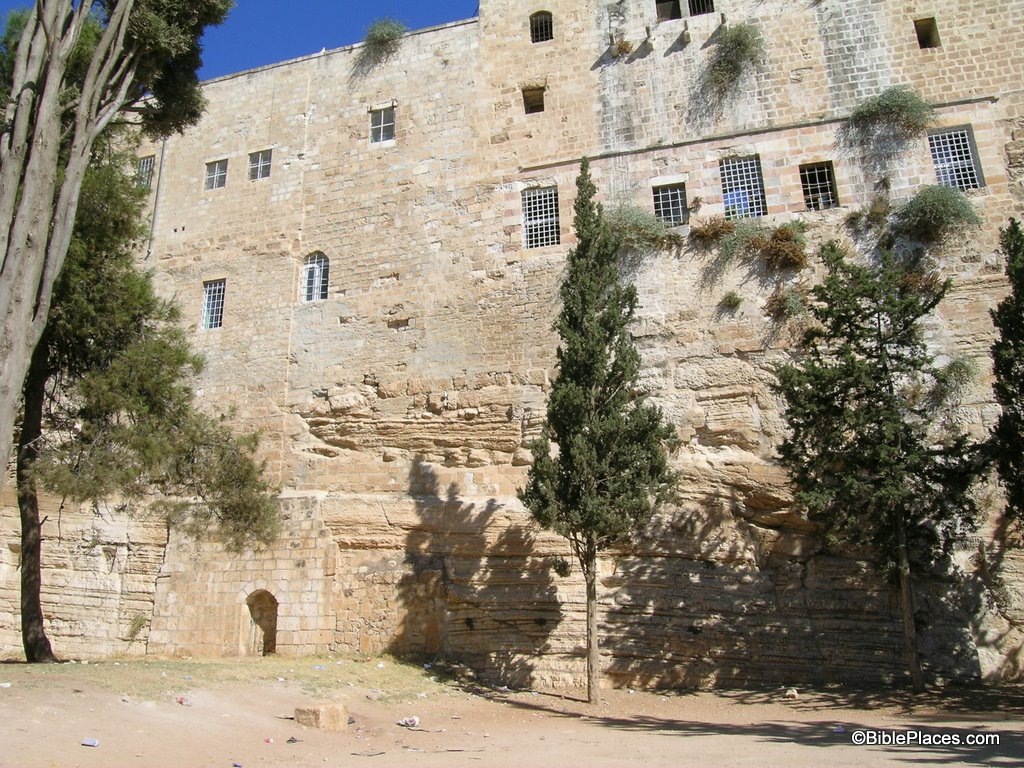
Leen Ritmeyer, a Temple Mount scholar, yesterday posted a response to Netzer’s article on the Antonia Fortress.  Ritmeyer believes that Netzer is mistaken both with regard to the size and shape of the building.  As always, Ritmeyer has beautiful and helpful illustrations.  The second diagram in his post reveals the existing remains of the fortress (in yellow).  The photo below shows the rock scarp and some of the Herodian masonry (on right).

Area of Antonia Fortress with bedrock, tb092103205

Remains of Antonia Fortress, north side of Temple Mount
Share:

After the Israelis captured the Old City in June 1967, significant attention was given to the development of the Western Wall area.  During creation of the large prayer plaza that exists today, the ground level was lowered by about six feet (2 m).  Recently when working with the photographs of David Bivin, I came across this photo.

Wailing Wall with Nadir, db6401182012 Western Wall, January 1964

With the distinctive crack in the rock visible behind the young man’s legs, I set about finding a recent photo of the same rock.  The photo below shows the crack behind the man’s right hand.  In 1964, ground level was located at the position of his left hand.

Man putting prayer in Western Wall, tb092603035 Western Wall, September 2003

Note that he is standing on a chair.  This is the best illustration I know of that shows the change in plaza level after 1967.

You can see a photo taken by Amihai Mazar that shows a bulldozer clearing the area in the excellent book by Leen Ritmeyer, The Quest: Revealing the Temple Mount in Jerusalem, page 22.

Some other “Then and Now” photos from the Views That Have Vanished collection are posted here.

Share:

Many interesting finds have been made from the pile of “trash” that was removed from the Temple Mount and dumped in the Kidron Valley.  The Jerusalem Post reports the latest discovery.

Two ancient coins, one used to pay the Temple tax and another minted by the Greek leader the Jews fought in the story of Hanukka, have been uncovered amid debris from Jerusalem’s Temple Mount, an Israeli archeologist said Thursday.
The two coins were recently found in rubble discarded by Islamic officials from the Temple Mount. It is carefully being sifted by two archeologists and a team of volunteers at a Jerusalem national park.
The first coin, a silver half-shekel, was apparently minted on the Temple Mount itself by Temple authorities in the first year of the Great Revolt against the Romans in 66-67 CE, said Bar-Ilan University Professor Gabriel Barkay, who is leading the sifting operation.
One side of the coin, which was found by a 14-year-old volunteer, shows a branch with three pomegranates, and the inscription “Holy Jerusalem”; the other side bears a chalice from the First Temple and says “Half-Shekel.”
In the Bible, Jews are commanded to contribute half a shekel each for maintaining the Temple in Jerusalem. At the time of the Temple’s construction in the sixth century BCE, every Jew was ordered to make an obligatory symbolic donation of a half-shekel. This consistent yet small payment allowed all Jews, irrespective of socioeconomic position, to participate in building the Temple.

You can read the full story here.

In related news, the archaeologists in charge of this project face a significant funding shortfall.  A recent letter from Gabriel Barkay and Zachi Zweig concludes:

The Temple Mount Sifting Operation is not a project for an elite group of archaeologists. It is now the property of the entire Jewish people, including the tens of thousands of volunteers who have helped us sift through the rubble over the years. Many times throughout history the most important projects are adopted by private donors who have the privilege to make a significant difference well before the state steps in to help. The Temple Mount Sifting Project is just such an opportunity. Please take part in this effort to save the Temple Mount Antiquities and help us to continue the educational programming which is having an immeasurable impact on thousands of visitors from all walks of Jewish life.

You can read more about this important project and learn how to make a contribution here

HT: Joe Lauer

Share:

Leen Ritmeyer mentions that the current (December) issue of National Geographic includes a poster supplement of the Temple Mount.  He includes a picture of the poster and tells a little bit about his role in its creation.  He links to the NG website, but I cannot find a way to buy just a single issue.  My guess is that a newstand copy would not include the poster, and that a subscription ($15/year) ordered now would not include this issue.  But if you already have a subscription, don’t discard the poster insert before realizing what a resource you have.

Share: