While tourism to Israel has been slow recently, many are traveling to Turkey, Greece, Egypt, and elsewhere. I’ve linked to several options in recent roundups, but Tutku Tours has a couple of special offerings this summer I wanted to highlight.

The Global Smyrna Meeting is the most in-depth dive you’ll find anywhere for the seven churches of Revelation. You will not only visit all seven churches, but you’ll enjoy lectures and on-site instruction from the best scholars in the field, including Mark Wilson, Mark Fairchild, and a host of others. This event is being held June 7 to 13 of this year.

This being the 1700th anniversary of the Council of Nicaea, Tutku is offering an extension trip, with visits to Istanbul, Nicaea, and Cappadocia. Nearly a dozen experts will give lectures as part of this tour. The dates are June 12 to 21.

You can get all the details in the Nicaea Program brochure (pdf). I’ve worked with Tutku for a number of years (as have so many educators and educational institutions around the US), and my experiences have always been the very best. I’m thankful for their service and happy to recommend them.

Tutku has a number of other tours scheduled for this year and next, including discounted trips for professors and a Jesus Tour and Conference in Israel in November. This page provides a convenient summary.

Share:

The longest Greek papyrus ever found in the Judean wilderness has been published. “The document is identified as prosecutors’ notes for a trial before Roman officials on the eve of the Bar-Kochba Revolt.” The underlying journal article is here.

“Researchers have deciphered a 2,000-year-old Aramaic inscription on a pottery shard discovered at the Alexandrium Fortress (Sartaba) in the Jordan Valley.”

A rare silver ring discovered at Huqoq in Galilee may depict the temple in Jerusalem. It possibly was one of a group that was a precursor to late-medieval Jewish wedding bands.

The forthcoming “House of David” series on Prime Video takes some liberties.

Steven Notley and Moti Aviam’s lecture about the latest from the Bethsaida/el-Araj excavation is now online. This 87-minute presentation was given at the Museum of the Bible.

Virtual panel discussion on Feb 26: “Debates in the Dust: Seventy Years After the First Dig at Hazor and the Shaping of Biblical Archaeology,” with Igor Kreimerman

Now in Logos Pre-Pub: The Essential Atlas of the Bible: A Visual Experience of the Biblical World (NIV Application Commentary Resources), by Carl G. Rasmussen (HarperCollins, $20)

Nathan Steinmeyer gives a primer on the Shephelah of Judah.

Wayne Stiles has three tours planned, with signups now open:

HT: Agade, Ted Weis, Gordon Franz, Arne Halbakken, Explorator

Share:

“In the ancient city of Metropolis, located in İzmir, Turkey, archaeologists uncovered approximately 2,000 fragmented bronze statues in an area believed to have been used as a junkyard in ancient times.”

A monumental structure excavated at Assos in western Turkey is not a fountain but a tomb. They also uncovered “one of the first mosaics with polygonal tesserae from the Hellenistic period found in Anatolia.”

“A new study published in the journal PLOS One has shed light on the diverse origins of the approximately 2 million pieces that make up the Alexander the Great mosaic from Pompeii.”

The National Museum of Underwater Antiquities in Piraeus, Greece, is under construction and set to open next year.

Carl Rasmussen shares a number of photos taken in the Museum of Anatolian Civilizations in Ankara, Turkey related to the Neo-Hittites at Carchemish and the bull-men and griffin demons of Carchemish.

On a double episode of Digging for Truth, Gary Byers talks about the Amarna Letters and their relationship to the Exodus and Conquest.

On the Biblical World podcast, Chris McKinny and Mark Janzen discuss the sites of Pi-Ramesses, Pithom, and Succoth.

Webinar on Feb 5: “Women’s Work in Abydos: Margaret Murray, Amice Calverley, and Myrtle Broome,” by Kathleen Sheppard

New release: Thutmose III and Hatshepsut, Pharaohs of Egypt Their Lives and Afterlives, by Aidan Dodson (AUC Press, $35)

New article: “Archaeology as Cultural Heritage in the Kurdistan Region of Iraq: Developing an Integrated Approach beyond Narratives of Catastrophe and Emergency Response” (open-access)

Researchers have reconstructed a minute-by-minute account of the eruption of Mount Vesuvius and its destruction of Pompeii. The article includes many graphics. The underlying journal article is available to subscribers.

Carl and Mary Rasmussen are leading an 18-day Bible tour of Turkey and Greece in May.

Ferrell Jenkins has posted photos of Jerusalem, the Horns of Hattin, Hazor from the air, Mount Hermon from Syria, and a sunset over the Suez Canal,

HT: Agade, Gordon Franz, Ted Weis, Arne Halbakken

Share:

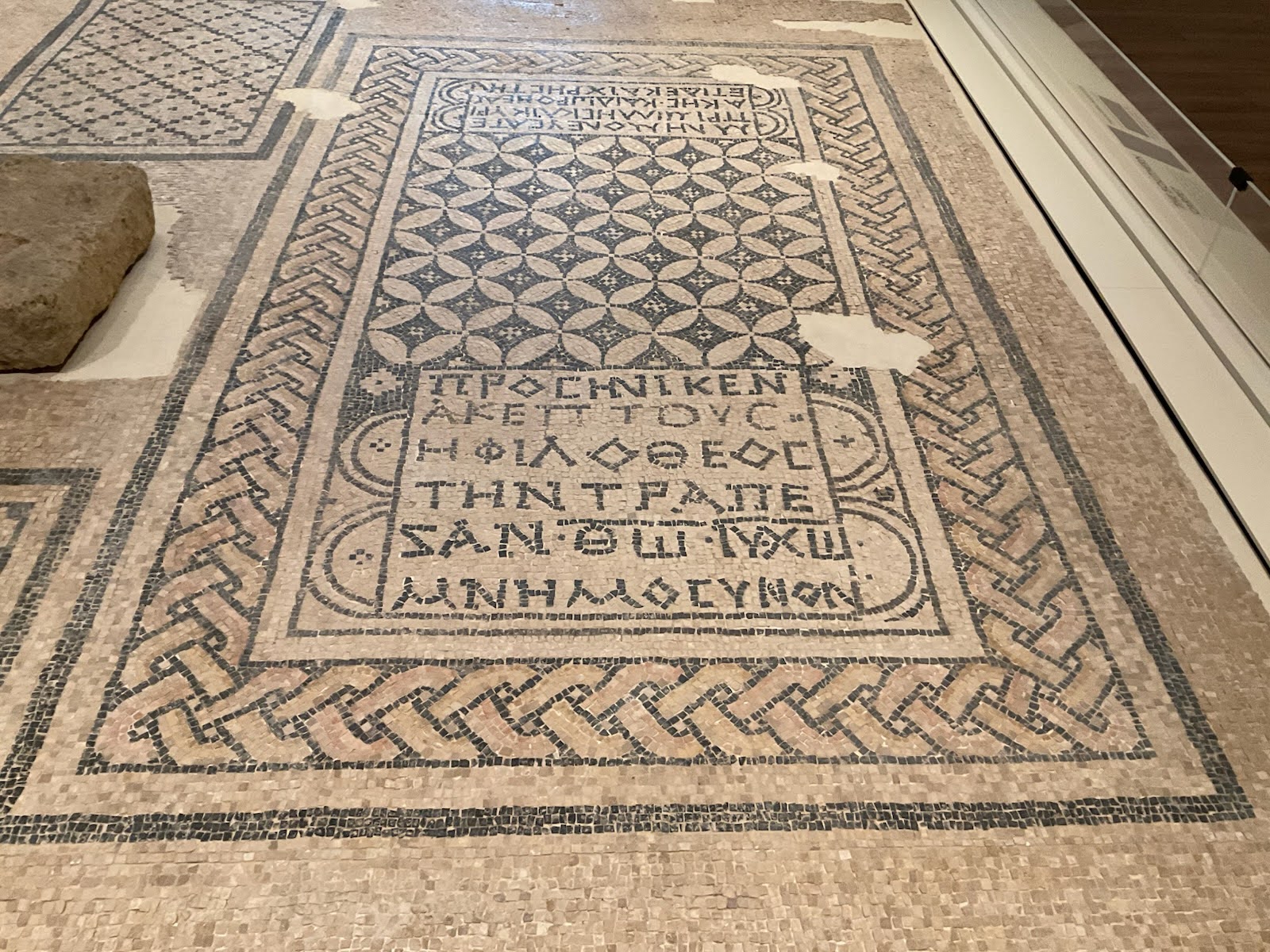
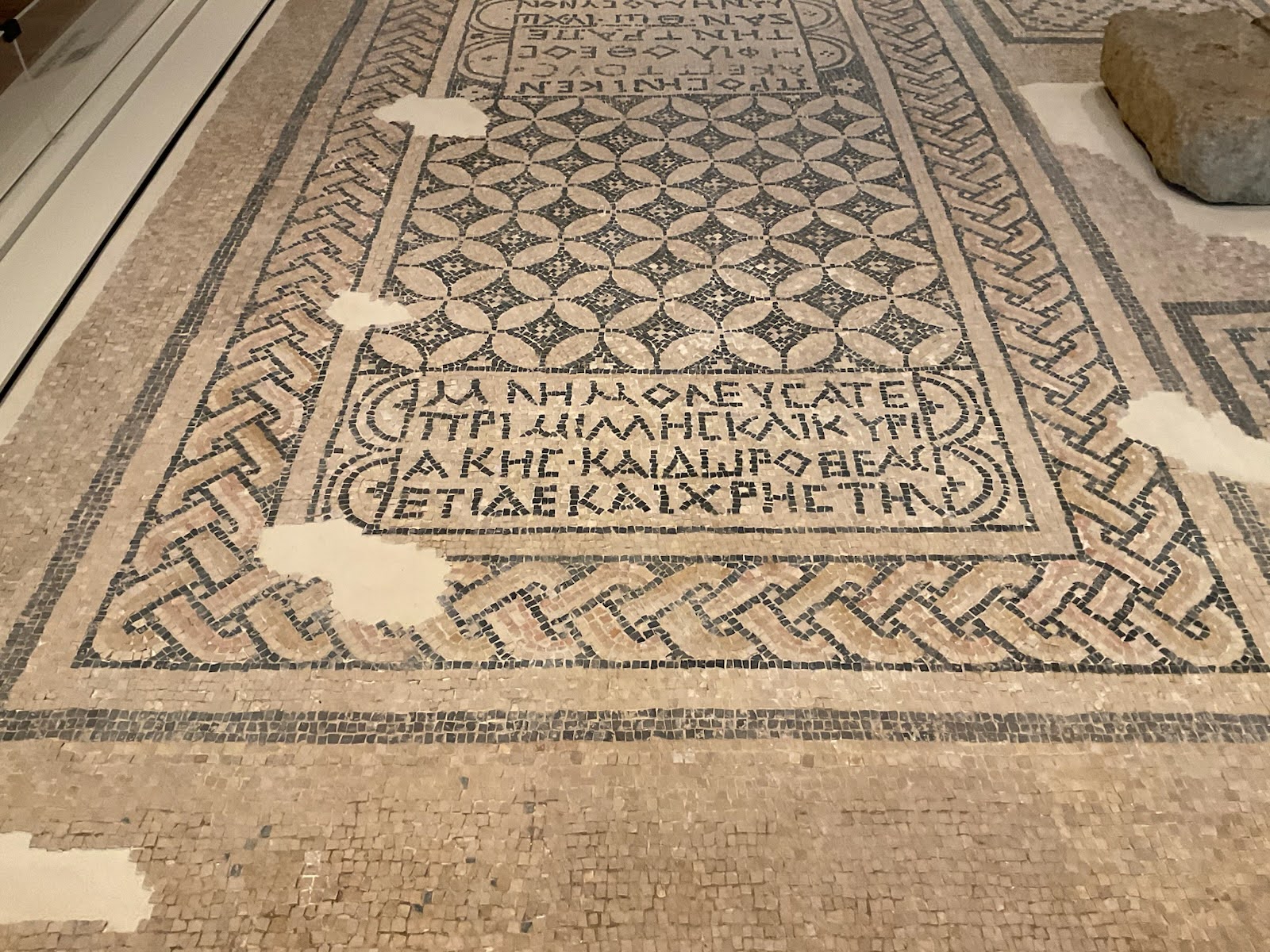
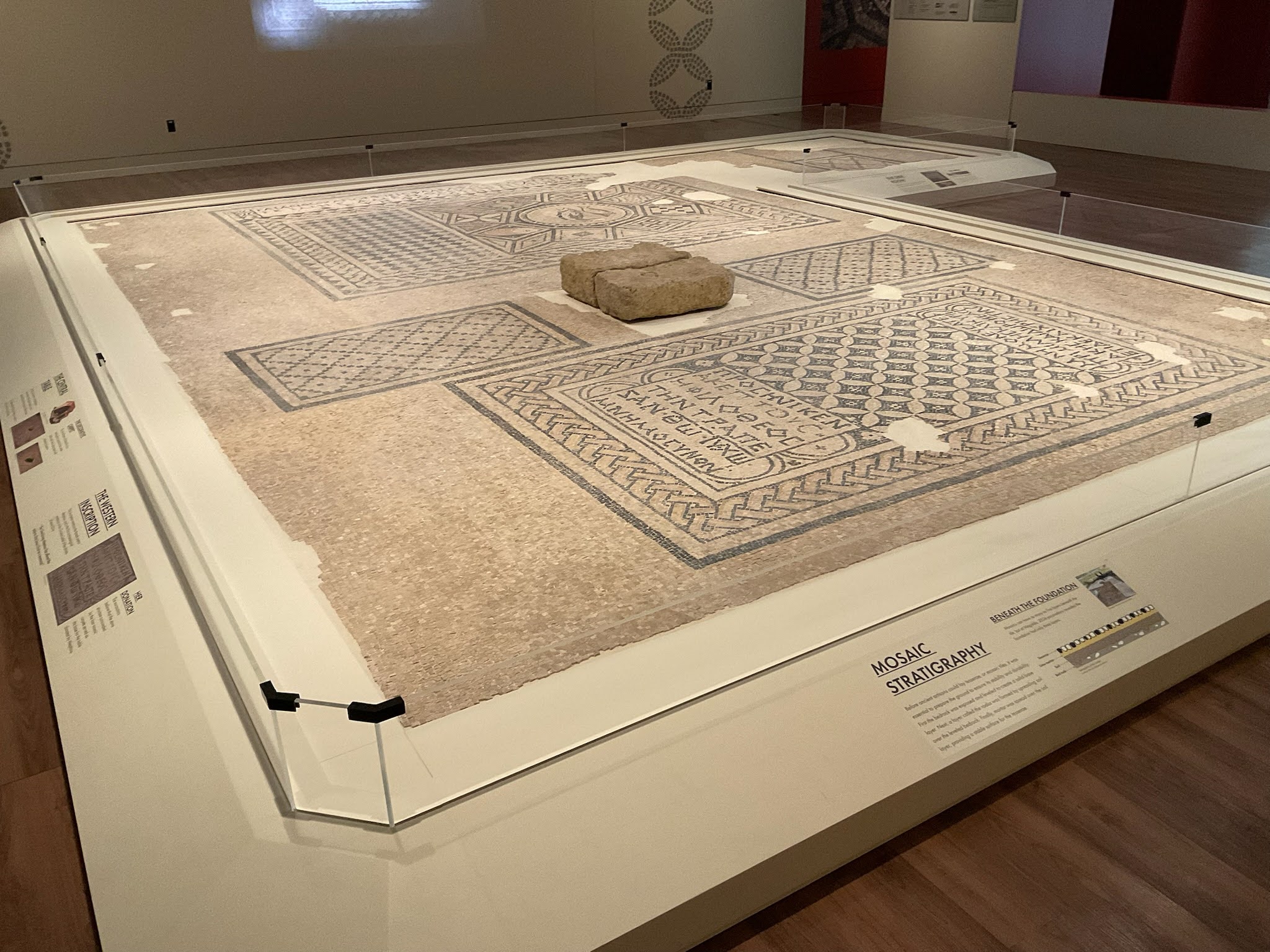
The Megiddo Mosaic is on display for the first time ever at The Museum of the Bible in Washington, DC. A friend visited on Monday and sent photos with permission to share them below.

The mosaic has been heralded because it comes from an early Christian building that dates to about AD 230, nearly a century before the Roman empire became Christian under Constantine. This makes it the earliest known Christian house of prayer (or worship hall or church). Furthermore, one of the three Greek inscriptions mentions “God Jesus Christ,” providing archaeological evidence of the belief in Jesus’s deity. 

You can see translations and explanations of all three inscriptions at the museum’s website. A separate page describes the significance of the designs, including the fish symbol. The museum’s announcement page has more photos and information. Gordon Govier posted a story on the mosaic at Christianity Today yesterday (subscription required). For a much lengthier explanation of the inscriptions, see Christopher Rollston’s website.

All photos are courtesy of Steven Sanchez.

The complete mosaic display

This inscription reads, “The god-loving Akeptous has offered the table to God Jesus Christ as a memorial.” The phrase “God Jesus Christ” is on the right side of the second line from the bottom.

This inscription reads, “Remember Primilla and Cyriaca and Dorothea, and lastly, Chreste.”

The mosaic is on display at the museum until July 6. I’ve posted on this discovery a few times since it was first announced in 2005:

Share:

Excavations began this year at Lystra, the hometown of Timothy and place where Paul was stoned and left for dead. They have already uncovered a third of a Byzantine church.

“An alabaster seal, believed to be from the Assyrian Empire and belonging to a nobleman, was discovered in the ancient Kef Fortress built by the Urartians.”

Archaeologists excavating under a Hellenistic theater in southwestern Turkey have discovered a sewage system large enough to walk in.

The Kestros Fountain at Perga in Turkey is operational after 1,800 years.

“A variety of reliefs, inscriptions, and grave stelae unearthed by archeologists help expand the understanding of gladiator history in the region of ancient Anatolia.”

The Luwian Studies Foundation wants to fill in a gap in the eastern Mediterranean around the year 1200 BC.

A 4-minute BBC video features an island off Turkey’s southern coast with underwater Roman cities, underwater Lycian tombs, and the oldest shipwreck in the world.

Over at BiblicalTurkey.org, Jason Borges describes his three-day visit to the historical sites of Cyprus.

Archaeological discoveries made during the construction of a subway line in Thessaloniki have been put on display at many of the subway stations.

Three books that caught my eye in the exhibit halls at ETS and SBL are:

HT: Agade, Gordon Franz, Arne Halbakken, Ted Weis, Cenk Eronat, Explorator

Share:

“A new study of DNA extracted from the bones inside Pompeii’s famous plaster casts has largely debunked long-held assumptions based solely on the physical appearance and positioning of the casts.”

The Pompeii Archaeological Park is now limiting the number of daily visitors to 20,000 and using timed personalized tickets with the visitors’ full names.

In a new program sponsored by Airbnb, some tourists will be chosen to participate in a mock gladiatorial fight inside Rome’s Colosseum.

An amulet depicting the “prophet Solomon” was discovered in Karabük, Turkey.

The earring holes on King Tut’s famous golden mask indicate that it was originally created for a female or child.

“Scientists at Chicago’s Field Museum are studying Egyptian mummies using a mobile CT scanner.”

Ellie Bennett tells the story of one of the “Queen of the Arabs” mentioned in Assyrian inscriptions.

“On Sunday, November 17, 2024, from 10:00 AM to 4:00 PM, followed by a keynote from 6:00-7:30 PM, the George Washington University Department of Classical and Near Eastern Languages and Civilizations & the Capitol Archaeological Institute will co-host an international symposium focused on the Amarna Letters, a collection of 14th-century BCE diplomatic correspondence which offers a rare insight into the political dynamics of the ancient Near East.” Register here for the full day, or here for the keynote.

Virtual tour on Nov 20: “Rome’s Legendary Emperors: Nero, Hadrian, and Constantine”

Available for preorder on Logos: Archaeology and the Ministry of Paul: A Visual Guide, by David A. deSilva ($28). This is the first of three planned volumes.

New release: The Labors of Idrimi: Inscribing the Past, Shaping the Present at Late Bronze Age Alalah, by Jacob Lauinger (SBL Press, $58-$78; open-access ebook).

New release: The Archaeology of the ‘Margins’: Studies on Ancient West Asia in Honour of Peter M.M.G. Akkermans, edited by Bleda S. Düring and Jo-Hannah Plug (Sidestone, €15+; read online for free)

Barbara Aland, former director of the Institute for New Testament Textual Research, died earlier this week.

Dan Diffendale has posted many thousands of photos, organized by albums on Flickr. He has written a short guide to using them.

“Biblical Field Studies are funded study trips to biblical sites in Turkey for Bible scholars and teachers in the Majority World. The program is designed to equip Christian teachers and professors who work in the Majority World by introducing them to the geographical, historical, and social contexts of early Christianity. The 2025 trip (June 11–18, 2025) will visit the sites related to the Seven Churches of Revelation and the Seven Ecumenical Councils.”

There will be no roundup next weekend. If you will be attending ETS or SBL, stop by the BiblePlaces booth and say hi.

HT: Agade, Gordon Franz, Arne Halbakken, Mark Hoffman, Ted Weis, Wayne Stiles, Paleojudaica
Share: