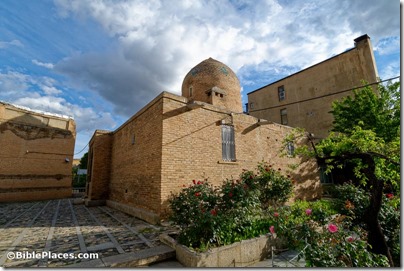
Archaeologists believe that a well-preserved complex at Horvat Tevet, near Afula in the Jezreel Valley, served as a royal estate for Israel’s kings.

Archaeologists working at Tell Damiyah (biblical Adam) are uncovering a religious complex that dates to 700 BC.

Ann Killebrew shares about her experience and discoveries made in the last decade of excavating Tel Akko.

16 tombs from the 26th dynasty have been found at Al-Ghoreifa in Egypt.

New research of the mummified remains of Takabuti, held at the Ulster Museum, reveals the Egyptian had genetic roots to Europe and was likely stabbed to death.

Ueli Bellward explains the complex water collection system of Petra, including how its flash flood system enabled the city to survive.

Archaeologists are concerned about the increasing popularity of Gobekli Tepe.

A story in Discover magazine explains how archaeologists know where to dig.

Archaeologists believe that they have found a second example of crucifixion, discovered near Venice.

The AP has a number of photos of a massive locust invasion in eastern Africa.

Caesarea’s ancient theater stage is undergoing a major renovation.

John DeLancey has just wrapped up another tour of Israel, blogging about each day.

Holly Beers is on The Book and the Spade discussing her new book, A Week in the Life of a Greco-Roman Woman.

Bryan Windle identifies the top three reports in biblical archaeology in the month of January.

BiblePlaces.com celebrated its 20th anniversary this week, and we are thankful for many encouraging words, including reflections from Mark Hoffman, Ferrell Jenkins, Leon Mauldin, and Charles Savelle.

HT: Agade, Ted Weis, Cam von Wahlde, Joseph Lauer

Share:

Israel has announced the creation of seven new nature reserves in the West Bank: Ariel Cave, Wadi Og, Wadi Malha, the Southern Jordan River, Bitronot Creek, Nahal Tirza, and Rotem-Maskiot.

The Mausoleum of Augustus in Rome is set to reopen this spring after being closed for 80 years.

The Grand Egyptian Museum, set to partially open in the coming months, expects more than 5 million visitors annually.

Passages, a Christian version of Birthright Israel, is on track to bring 10,000 students to Israel by the end of this year.

Carl Rasmussen shares his experience in using Global Entry for international travel.

A DNA analysis of the York Gospels was done using DNA extracted by using erasers.

Emily Master of The Friends of Israel Antiquities Authority is the featured guest on The Book and the Spade.

Available for pre-order: The Koren Tanakh of the Land of Israel: Exodus. There are early reviews here and here.

King David is the subject of Bryan Windle’s latest archaeological biography.

Shmuel Browns shares his favorite photos of the year and gives his readers a chance to vote on their favorite.

HT: Agade, Joseph Lauer, Mark Hoffman, Explorator

Share:

Aaron’s tomb in Jordan will re-open to Israeli tourists after the site was closed following a group that allegedly prayed there.

A researcher claims that the world’s oldest chess piece was discovered in Jordan.

Sara Toth Stub explains what happened to Petra after it was abandoned by the Nabateans.

It’s not clear where Egyptians came up with five million African sacred ibises, but a DNA study shows that they were not raised in breeding farms.

Archaeologists have discovered five lion mummies in excavations in Saqqara.

3-D scans of the bust of Nefertiti are now available online.

The Ilisu dam will soon flood Hasankeyf, one of the oldest known and continuously inhabited settlements in the world.

The Central Baths at Pompeii have now been opened to tourists.

A reconstruction of the god Moloch is part of an exhibit on Carthage in Rome.

Cyrus, king of Persia, is the latest subject in Bryan Windle’s series of bioarchaeographies.

Save the date: the annual conference of the Institute of Biblical Context, now redubbed the Infusion Bible Conference, will be held on June 8 to 10, 2020 in west Michigan. The topic is “Paul and His Roman World.”

Gift subscriptions are now available for Walking the Bible Lands.

HT: Agade, Joseph Lauer, Explorator, Keith Keyser

Share:

“Colorful remains of mosaics from a 3rd century synagogue in the ancient town of Majdulia are the earliest evidence of synagogue decoration in the Golan.”

“A group of archaeologists, architects and researchers petitioned the High Court of Justice . . . to stop a controversial plan to build a cable car to the Western Wall in Jerusalem’s Old City.”

The latest in the Life Lessons from Israel video series focuses on the Talmudic Village of Katzrin.

Aviva and Shmuel Bar-Am write about a number of small archaeological sites in Pisgat Zeev, a northern suburb of Jerusalem.

Israel21c: Fabulous photos of 5 picturesque places to visit in Israel. The sites include Banias, En Gedi, Masada, Beth Shean, and Caesarea.

Archaeologists are hoping to continue excavations at el-Ahwat, possibly the biblical Harosheth HaGoyim, before modern construction destroys remains.

Israel’s Good Name visited the Horns of Hattin during a reenactment of the famous battle between the Crusaders and Saladin.

Carl Rasmussen reports on his visit to the “real” Bethsaida.

Luke Chandler, Ferrell Jenkins, Chris McKinny, and BibleX note the release of three new volumes in the Photo Companion to the Bible series.

HT: Agade, Joseph Lauer

Share:

Leen Ritmeyer has written an informative and well-illustrated post on the significance of Shiloh and the recent excavations. Ritmeyer’s reconstruction drawings are available for purchase in his image library, including his new drawing of Shiloh.

A government committee in Jerusalem has authorized the construction of a cable car to the Dung Gate.

A $37 million visitors’ center has been opened at the Huleh Valley Nature Reserve.

Anthony Ferguson shares 5 surprising details about the discovery of the Dead Sea Scrolls from Weston Fields’ history.

“The only project agreed on by Israel and Jordan that could possibly, in the foreseeable future, help save the Dead Sea from further shrinkage is stuck in a byzantine web of politics, bilateral tensions and Israeli foot-dragging.” This is a well-researched article on a subject frequently in the news.

Excavations have resumed at Tell Ziraa in Jordan, with the recent discovery of an Iron Age house with several dozen loom weights.

Colin Cornell considers whether the Jews living in Elephantine worshipped a goddess in addition to Yahweh.

Egyptian authorities have announced the discovery of a cemetery in Ismailia that dates to the Roman, Greek, and pre-dynastic eras.

The October issue of the Newsletter of the Egyptian Ministry of Antiquities is online.

History Magazine has the story of how Howard Carter almost missed King Tut’s tomb.

Two vast reproduction Assyrian statues were unveiled in Iraq on Thursday as part of a project designed to restore the cultural heritage of Mosul.”

Wayne Stiles explains the significance of the Arch of Titus and the relevance of an olive tree planted beside it.

“A team of international scholars versed in culinary history, food chemistry and cuneiform studies has been recreating dishes from the world’s oldest-known recipes.”

In a 10-minute video, David McClister explains who Flavius Josephus was.

On sale for Kindle:

Tim Bulkeley has died. He began his biblioblog in 2004 and was a regular encouragement to me over the years. He will be missed.

HT: Agade, Charles Savelle, Keith Keyser

Share:

We have collected 40 items so far from the last two weeks, and I’ll think we’ll break it up into three parts, going through Monday.

If you’ve prayed at all for those affected by the Saugus High shooting, thank you. My oldest sons graduated from the school, and my two daughters are students there now. They were not on campus at the time, but they have friends who were wounded and traumatized. Our church is a central gathering place for students as they process everything. You can pray that we will be faithful and wise. And now to the stories…

National Geographic is the latest to report on the Siloam Street excavations and the attendant controversy, along with various other recent Jerusalem excavations. They do so, as you would expect, with beautiful photos.

Israel’s Good Name describes a day of excavating in the Mount Zion Archaeological Dig.

I bet you don’t know how many inscriptions we have that may be related to Sergius Paulus, the Roman proconsul when Paul and Barnabas visited Cyprus. Bryan Windle provides photos and details in this well-researched archaeological biography.

Now online: The ACOR Newsletter for Summer 2019

A British scholar explains a little of the history of aerial photography in Jordan.

Bible Mapper has begun a new blog, with a number of helpful maps already posted.

New book: The Canaanites, by Mary Ellen Buck ($15)

An interview with Father Eugene provides some background on the new Terra Sancta Museum in Jerusalem.

A leopard was apparently spotted in Samaria. The video is in Hebrew, and the footage is in infrared(?), but it may be the first sighting in decades.

Jessica Halfin suggests “11 biblical experiences in Israel you’ll never forget.” It’s a good list.

My friend John Black and his wife Doro are leading a more affordable Israel tour in February and they have a few remaining spots.

HT: Agade, Charles Savelle, Keith Keyser

Share: