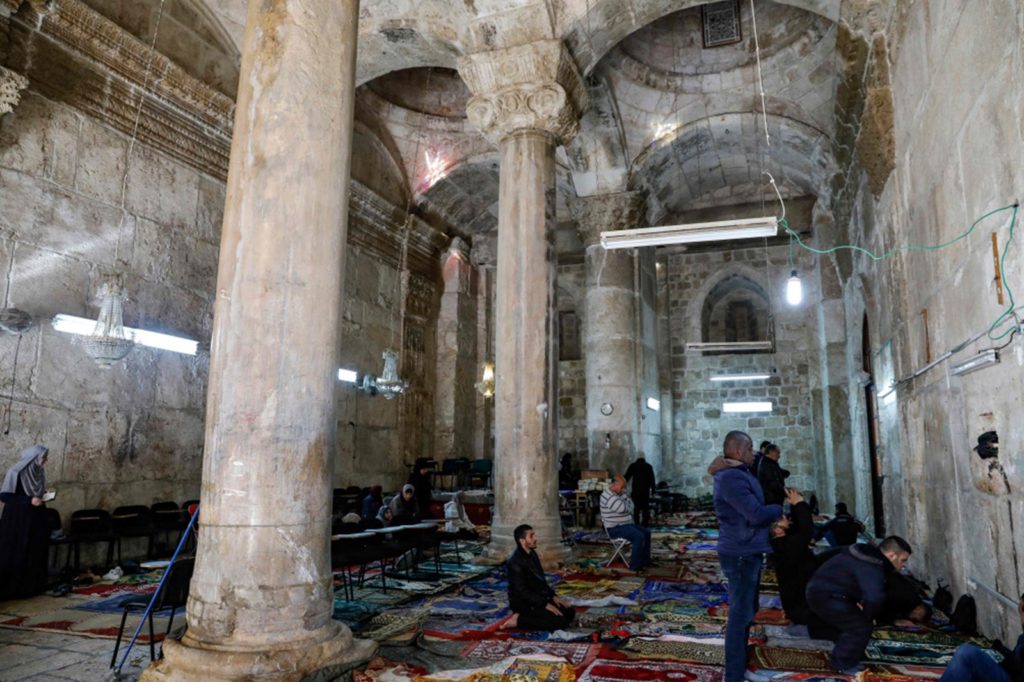
The Ultra-Orthodox are upset that the French government won’t allow entrance into the Tomb of the Kings in Jerusalem. The French claim that they have renovated the site and with the right assurances, they will open it to the public.

A long tunnel has been covertly dug underneath the “Tomb of David” on Mount Zion and now some people are mad.

The large number of tourists visiting the Church of the Nativity in Bethlehem has led to the development of an app that will handle reservations.

“The inauguration ceremony of Egypt’s new Greco-Roman Museum [in Alexandria] will be held by the end of 2019.”

Three ancient cities in Crete are the focus of an exhibit at the Museum of Cycladic Art in Athens, Greece.

Harvey Mudd College is giving its Cypriot artifacts to the University of Cyprus.

Don McNeeley shares a report on the 2018 annual meeting of the Near East Archaeological Society.
You can join the society here.

The video is now online for the 2018 Plenary Address for the ASOR Annual Meeting: “Between Looters, Private Collectors, and Warlords: Does Archaeology Stand a Chance?” by Hélène Sader, Professor of Archaeology, American University of Beirut.

Tali Erickson-Gini is on The Book and the Spade talking about the Timna Park excavations and the opportunity for the public to volunteer.

Wayne Stiles compares Peter’s boast in the Upper Room to his failure in the Garden of Gethsemane to find application today.

That “ark of the covenant” in the church in Ethiopia—it’s a replica.

Rick Lanser believes he has evidence that supports the birth of Jesus on Nisan 1, 6 BC.

Ferrell Jenkins’s favorite photos this week include Hasankef, the Roman road near Saglikli, and Riblah.

Justin Taylor interviews the filmmaker who has created “The Chosen,” the first-ever multi-season drama about the life of Christ.

HT: Joseph Lauer, Agade, Ted Weis

Share:

Archaeologists believe that a public bath excavated in Sepphoris may have been used by Rabbi Judah the Prince.

Archaeologists excavating at the Negev town of Shivta have found a lamp wick dating to the Byzantine period.

Kiriath Jearim has a large platform which must have been cultic and could only have been built by the northern kingdom of Israel. Or so says Israel Finkelstein. (Haaretz premium)

A total of 1,500 landmines have been cleared since the spring near the Jordan River baptismal location of Qasr al-Yahud.

Migdal Aphek, the Crusader castle also known as Mirabel, will soon be open to the public following conservation works.

Dennis Mizzi asks, “What does Qumran have to do with the Mediterranean?”

The Annual Conference on the Excavations of the Institute of Archaeology at the Hebrew University will be held on Thursday.

Israel’s Good Name reports on a university field trip to the Hebron area.

Biblical Byways has a couple of tours to Israel coming up, including a Spanish tour in April.

Tim Frank’s latest book, Household Food Storage in Ancient Israel and Judah, is now available in paperback and as an e-book.

The Lexham Geographic Commentary on the Gospels was chosen as the Best Book in Biblical Studies in Christianity Today’s 2019 book awards. You can read an excerpt about the birthplace of
Jesus here.

HT: Agade, Ted Weis, Joseph Lauer

Share:

In Caesarea, a remarkable Crusader-era cache of 24 gold coins and an earring was found in a small bronze pot, hidden between two stones in the side of a well.

The NY Times has a summary of the Pilate ring discovery. Robert Cargill prefers the theory that the ring belonged to one of Pilate’s papyrus-pushing administrators. Ferrell Jenkins shares a number of related photos.

Archaeologists working at Timna Park opened their excavation to volunteers from the public for three days during Hanukkah.

The second in a series of 12 objects from the Temple Mount Sifting Project is an arrowhead from the 10th century BC.

Jim Davila tries to unravel the latest with the Qumran caves with potential Dead Sea Scroll material (with a follow-up here).

Matthew Adams gives an update on the Jezreel Valley Regional Project on The Book and the Spade.

Israel is on pace to hit a new annual record of 4 million tourists this year.

Episode 1 in Wayne Stiles’s excellent “The Promised That Changed the World” is now available. You can sign up to get free access to all three episodes.

HT: Agade, Ted Weis, Charles Savelle, Joseph Lauer

Share:

The discovery of a cuneiform fragment at Tel Mikhmoret recorded a slave sale and revealed physical evidence of the presence of Babylonians in biblical Samaria.”

Authorities have recovered from antiquities thieves a Neolithic stone ritual mask that comes from the Hebron hills.

Archaeologists have found evidence for trephination in a Late Bronze tomb at Megiddo (Haaretz premium).

“In one of the largest tombs ever found in Luxor, Egypt, archaeologists have discovered a sarcophagus holding the mummy of a woman named Pouyou who lived during the 18th dynasty.”

Egyptian officials announced that treasures from the tomb of Tutankhamun will tour ten cities in the world prior to the 2020 opening of the Grand Egyptian Museum in Giza. The exhibit is currently in Los Angeles and then heads to Paris. The other cities have not yet been announced.

“Inside the Cloak-and-Dagger Search for Sacred Texts” is in this month’s issue of National Geographic. As you would expect, the text is engaging and the photos beautiful.

“National Geographic has commissioned leading British indie production company, Caravan to produce The Bible from Space, a two-part documentary special which reveals the truth behind the biggest, most incredible stories from the Old Testament.” You can be sure that any TV production which promises to “reveal the truth” does not.

Carl Rasmussen is having second thoughts about the route of Paul’s ship from Chios to Miletus.

Luke Chandler is leading a tour of Israel in June, with the option to stay longer and join an archaeological excavation.

SourceFlix has released a 4-minute video about Tel Dibon, including footage of an early-morning fly-over. Ferrell Jenkins writes about the same site and provides some nice photographs.

A board game dating to the time of Abraham, the Royal Game of Ur, is making a comeback in Iraq.

The online Massive Open Online Course (MOOC) entitled “Biblical Archaeology: The Archaeology of Ancient Israel and Judah” begins on Wednesday.

The Institute of Biblical Culture is offering your choice of a free class.

If you’re not a subscriber to the BiblePlaces Newsletter, you can sign up in a few seconds. We send about three issues a year, with one coming next week.

HT: Agade, Ted Weis, Charles Savelle

Share:

The nymphaeum in downtown Amman has reopened to the public.

A Palestinian was caught trying to smuggle 70 ancient coins from Jordan into the West Bank.

Another man was arrested for trying to smuggle two tetradrachm from the time of Alexander the Great out of Gaza.

The Guardian posts a review of the “I am Ashurbanipal” exhibit that opened this week at the British Museum.

The British Museum Shop offers a number of interesting items related to the Ashurbanipal exhibit.

The Vatican Museums are considering putting a daily cap on the number of visitors.

A new festschrift honors Aren Maier: Tell it in Gath: Studies in the History and Archaeology of Israel.

Ada Yardeni’s final book, The National Hebrew Script, is now available for pre-order at Carta.

New from Baylor University Press: Magdala of Galilee: A Jewish City in the Hellenistic and Roman Period, edited by Richard Bauckham.

The Land and the Book audio program visits the Oriental Institute Museum.

Scott Stripling, Scott Lanser, and Henry Smith discuss “Relating the Bible to Archaeology” in the latest episode of Digging for Truth.

Flash floods in Jordan killed 12 and forced the evacuation of 4,000 in Petra. Here’s another video and several more showing the deadly torrent.

HT: Agade, Joseph Lauer, Explorator, Charles Savelle, Ted Weis, Paleojudaica, Alexander Schick

Share:

Archaeologists have discovered engravings of ships and animals on the walls of a Roman-era cistern in Beersheba.

Rami Arav provides a summary of the 2018 excavation of et-Tell (aka Bethsaida). He believes that in the 11th–10th centuries, the site was a “full-fledged urban center, most probably the site of the king of the Geshurites.”

A new era has begun at Gath (Tell es-Safi) with the covering over of excavation areas that will not be conserved for visitors.

The new excavation at Kiriath Jearim and the family providing the financial backing are profiled by the Jewish News of Northern California.

Wayne Stiles recently visited the Gezer boundary inscriptions and he wonders how long it will be before they are no longer legible.

Aviv and Shmuel Bar-Am describe several sites of interest east of Jerusalem, including the Good Samaritan Museum and Ein Fawwar.

Israel’s Good Name shares his experience in volunteering for the Tel Dor excavation.

Israel set a new record with nearly half a million tourists in October.

The Israelite Samaritans Project is a new research venture of Yeshiva University.

Have you seen Carta’s new map bank? Individual digital maps of the biblical world are available for purchase.

HT: Agade, Joseph Lauer, Explorator, Charles Savelle, Ted Weis, Paleojudaica

Share: