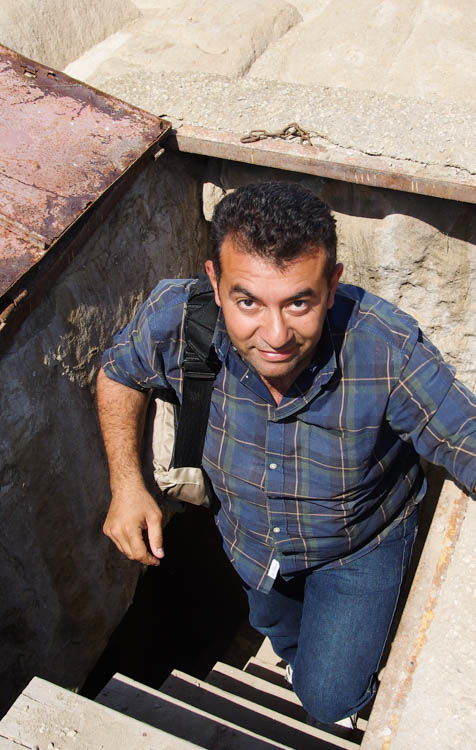
Haaretz (premium) has a story on the Mamertine Prison now that it has been renovated and re-opened. The history of the site goes back to the 8th century BC and was considered to be one step away from hell for its captives.

A refurbishment of the kitchens of Pompeii reveals much about ancient Roman cooking practices.

Continued restoration of the Parthenon now moves to the building’s west side.

Archaeologists working in Hala Sultan Tekke have discovered one of the most magnificent tombs ever found on the island of Cyprus. It dates to the Late Bronze Age and contains Egyptian scarabs, a diadem, and beautiful jewelry.

Egypt’s Ministry of Antiquities will begin offering an annual pass to all of the country’s sites and museums.


The Times of Israel suggests the top five Jewish spots to visit in Saudi Arabia.

“Between 1,300 and 800 BC, large quantities of metal objects, including tools and weapon-like swords, daggers and arrow heads, were produced at Saruq Al Hadid” in modern Dubai. The site and its new museum are profiled in The National.

Iraq is seeking to add Babylon to the World Heritage List.

Logos users can now pre-order Barry Beitzel’s New Moody Atlas of the Bible.

HT: Ted Weis, Joseph Lauer, Agade

Share:

Ferrell Jenkins remembers the events of this weekend with photos related to the crucifixion and resurrection.

Michael Heiser offers some links in response to the perrennial “miracles-are-impossible” stories that surface this time each year.

The battle continues over the size of the Kedem Center in the City of David.

Shmuel Browns’ photo of the week is a beautiful shot of the Judean wilderness.

A number of interesting finds have been made in an excavation of a Byzantine church in Gush Etzion.

If you are an American undergrad looking to excavate in Israel this summer, you should apply for a scholarship to join the Tel Burna team.

Wayne Stiles gives three reasons why you should travel to Israel.

The Tel Al-Amarna Visitors Centre has been inaugurated in Minya. Work on the Aten Museum and
Malawi National Museum is on-going, despite rumors to the contrary.

Archaeologists are learning more about ancient watercraft from an Old Kingdom boat excavated in Abusir.

Reproductions of the 50-foot arch that formed the entrance to Palmyra’s Temple of Baal will be erected in New York City and London next month.

The Syrian army is close to re-capturing Palmyra.

John Brown University has received an anonymous gift of $1 million for their Abila Archaeological Project.

The Torlonia collection, with more than 600 statues and sculptures, will be on display in Rome for the first time in decades. An overseas tour will follow.

Described as one of most important recoveries in decades, 45 crates of archaeological material, dating between the 7th century BC to 2nd century AD, has been returned to Italy after being stolen from sites in the 1970s and 1980s.

“Analysis of Herculaneum papyrus scroll fragments reveals the use of metallic ink in Greco-Roman literary inscription centuries earlier than previously thought.”

Bruce and Ken Zuckerman will be lecturing on “Archaeological Photography” on March 28 at the South Bay Camera Club.

Now online: “The Lenkin Family Collection of Photography at the Penn Libraries, as it is now known, comprises over 5,000 original photographs, primarily of Jerusalem and Palestine taken from 1850 to 1937.”

For a limited time, access to the latest issue of Near Eastern Archaeology is available for free without a login required.

Bible Software Review is looking for a new owner-editor.

Going Places with God, by Wayne Stiles, is on sale for Kindle right now for $0.99. It’s at the same price on Vyrso/Logos. The sale won’t last. I recommend it!

Happy 13th Anniversary to Paleojudaica! And Aren Maeir recently celebrated his birthday.

For photos recalling the momentous events of this week nearly 2,000 years ago, check out our posts this week on Facebook and Twitter.

HT: Jared Clark, G. M. Grena, Agade, Ted Weis, Charles Savelle

Share:

The Mountain to Valley Relay is a 215 km relay race in northern Israel. Registration opens in January.

A beautiful mosaic from the Roman and Byzantine periods excavated in Lod went on display this week.

A hoard of 3rd century Roman coins has been found in Switzerland.

You can now visit every gallery in the British Museum with Google Street View.

Reuters revisits Rujm el-Hiri in the Golan Heights.

Wayne Stiles observes the irony that a “seat of Moses” was discovered at Chorazin.

An ornately decorated 1st century A.D. basilica once used by a pagan cult is now open to tourists in Rome.

Now on pre-pub pricing for Logos: AR151 Archaeology in Action: Jesus and Archaeology, with Craig Evans.

The Ancient Semitic Languages Youtube Channel has a reading of the Mesha Stele in Moabite.

Urban Legends of the New Testament is on sale for $4.99 for Kindle.

Ferrell Jenkins has announced his 50th Anniversary Tour to Israel.

I’ve never heard of a modern-day “tour of Palestine,” but Felicity Cobbing reports on her annual tour to sites in the West Bank.

Leen Ritmeyer responds to the recent Popular Archaeology claim that the Jewish people are praying
at the wrong wall.

HT: Ted Weis, Vik Menon

Share:
by Chris McKinny

I am excited to announce that Seeking a Homeland is planning a study tour of Israel for this upcoming summer! See here for details/registration and below for a discussion of the uniqueness of the planned tour.

Dates: June 10-19, 2016


Leader: Chris McKinny

Brief Itinerary (10 field days): 
June 10 Arrival/Coastal Plain, June 11 Shephelah and Negev, June 12 Dead Sea, June 13-14 Jerusalem, June 15 Jordan Valley, June 16 Jezreel Valley, June 17-18 Galilee, June 19 Coastal Plain, June 20 Departure or Tel Burna Archaeological Project (see below)

Focus: Geographical, historical, biblical, and archaeological background of Israel, the land of the Bible

Level of Difficulty: Moderate, a lot of walking and several difficult hikes


Availability: 15-30 people


Price: $2,300/person (excluding airfare and lunches)


Add-on: Tel Burna Archaeological Project June 19-July 15, 2016 (1-4 weeks); a $150 discount will be applied to a participant who joins the project (minimum one week).


Deadline: March 31, 2016

Description: 

This study tour is not for everyone. During this tour, there will be very little time for relaxation and even less time for shopping, but we will find time to swim in the Mediterranean, Sea of Galilee and Dead Sea.

This tour is built on the IBEX (The Master’s College) model – where I have taught/led study tours since 2010. This type of study tour will be much different than your standard “church” or religious tour of Israel that often devote equal amounts of time to the hotel’s swimming pool as they do at biblical sites.

While intensive study tours are much less common than the typical tour described above, there are other good options. So what makes Seeking a Homeland’s tour unique?

Two things:

First, this tour will be led by an experienced teacher who also is a trained and active biblical archaeologist (in the field, classroom, and the academy).

Second, participants will have the opportunity to excavate at Tel Burna (Libnah), a major archaeological site, immediately following the tour. In my opinion, an archaeological excavation is the natural “follow-up experience” to an intensive geographical study of Israel. This is born out by the fact that many people who visit Israel develop an interest in biblical archaeology and attempt to follow current discourse through such means as Biblical Archaeological Review and this blog. On the other hand, there are some who have only taken part in an archaeological excavation in Israel and have not had the opportunity to travel throughout Israel and, subsequently, gain a working knowledge of the country’s geography and history. Planning the field tour in connection with the archaeological project allows for participants to experience both the broad scope of biblical geography while also participating and helping recover the “nuts and bolts” (or “weapons and pottery”) of individuals who actually lived during the time of the Bible. This combination makes Seeking a Homeland’s tour unique and a good opportunity for those who have never been to Israel or returnees who would like to refresh their past geographical knowledge and gain new insight by participating in an important archaeological investigation of a biblical site.

Our goals for the field tour will be three-fold:
1) to observe as much of the country as possible.
2) to illustrate and contextualize the Old and New Testament narratives against the backdrop of Israel’s geography, archaeology and history.
3) to internalize the landscape, background, and worldview of the biblical authors and audiences, in order to achieve better and more nuanced interpretations and, thereby, applications of the biblical text.

For those who decide to join the Tel Burna Archaeological project following the tour, an additional goal will be for participants to “experience the physical culture (cooking/eating, religious, military, administration, etc.) of the Canaanite and Israelite world” through a first-hand experience of archaeological excavation. Imagine yourself finding a Canaanite figurine depicting Asherah (Judges 2:13)  or a LMLK seal impression from the time of King Hezekiah (2 Kings 19:8) – both from the town of Libnah, which the Bible says was defeated by Joshua (Joshua 10:31-32) and Sennacherib (2 Kings 19:8). These are the types of finds that are waiting for us at ancient Libnah.

Canaanite Plaque Figurine

Interactive Map of Tour Itinerary:

Share:

Israel’s Ministry of Foreign Affairs has posted an initial list of excavations in 2016. There are a couple of options if you’d prefer to avoid the hot temperatures and high airfares of the summer.


WSJ: A Boy’s Discovery Rebuts Temple Mount Revisionism

The Temple Mount Sifting Project provides an update on their crowd funding campaign. Even a small contribution would be appreciated.

Omer Eshel takes a look at “The Hidden Gems of Israel” on The Land and the Book radio program with Charlie Dyer.

If you’re an American non-tenured faculty member, you may qualify to apply for a $7,000 travel award to experience archaeology in Israel.

The Book and the Spade remembers Adam Zertal with the re-broadcast of a 1993 interview (mp3).

Available now via Luke Chandler: “King David’s City at Khirbet Qeiyafa: Results of the Second
Radiocarbon Dating Project,” by Yosef Garfinkel, Katharina Streit, Saar Ganor, and Paula J. Reimer.

The samples date to ~1000 BC.

A Byzantine winepress was discovered on the Sharon Plain following a severe rainstorm.

“You tithe mint, dill and cumin…but neglect…justice, mercy, and faithfulness.” Ferrell Jenkins explains and illustrates.

Alexander Schick will be lecturing on November 4, 6:30 pm for the University of the Holy Land in

Room 211 of the Rothberg Institute. The title: “Genius or Thief? Constantine Tischendorf turns two hundred – the life of the famous Bible hunter and the case of the Codex Sinaiticus in the light of newly discovered documents from his personal archives.” For more on this subject, see here.

Share:

A new study claims that an Egyptian text is the oldest known abecedary.

Haaretz‘s report on Gabriel Barkay’s Temple Mount sifting project include several pictures of findings.

A UNESCO resolution that claimed the Western Wall prayer plaza as an Islamic shrine has made some people unhappy.

German experts are restoring the golden mask of King Tut after its beard was broken off and clumsily repaired.

The Journal of Near Eastern Archaeology reports that there are groups other than the Islamic State who are destroying and plundering antiquities in Syria.

The Getty Villa in Los Angeles is exhibiting 1800’s era watercolor paintings of Greece, many offering insight into how ancient sites looked in the early 19th century.

Emily Corrigan shares her experience of a summer on the Jezreel Expedition.

Egyptian authorities are investigating the embezzlement of $20 million from construction funds for the Grand Egyptian Museum.

Zahi Hawass throws cold water on the proposal that Nefertiti’s tomb has finally been located.

Ferrell Jenkins shares a photo he took of a fishing boat on the Sea of Galilee as the sun was rising.

The newly renovated Waldorf-Astoria in Jerusalem has been ranked the top hotel in the Middle East in a survey by Condé Nast Traveler.

Test your knowledge about Petra with 10 questions at the ASOR Blog.

The newly released NIV Zondervan Study Bible, edited by D. A. Carson, is on sale now for Kindle for $7.99. (I wrote the notes for 2 Kings.)

Chris McKinny has made available on Academia his presentation on “Kiriath-Jearim (Deir el-‘Azhar): Archaeological Investigations of a Biblical Town in the Judean Hill Country.”

Conference at Hebrew U on Oct 29: “I Know What You Did Last Summer: A Glimpse at the Excavations and Surveys of the Institute of Archaeology, 2015 Season.”

Adam Zertal died on Sunday at the age of 79. He was best known for his survey of the hill country of Samaria and his identification of a structure on Mount Ebal as the altar of Joshua.

Thomas Schaub died on Monday at the age of 82. Schaub excavated Bab edh-Dhra.

HT: Ted Weis, Charles Savelle, Joseph Lauer, Agade, Paleojudaica

Share: