A new study reveals that ancient Egyptian mummified bodies smelled “woody,” “spicy,” and “sweet.”

Archaeologists working in Egypt have completed the excavation and relocation of a gold processing complex in use for a millennium beginning circa 1000 BC.

Archaeologists working in central Turkey have found evidence of ironmaking dating to 2200 BC.

A new study has been released describing the “production and use of obsidian mirrors found at Tepecik Çiftlik” in central Turkey.

“Archaeologists excavating Göbekli Tepe have uncovered evidence that challenges previous theories about the site’s purpose.”

“Authorities in Turkey have sealed off a luxury spa that was set up by illegally modifying a 1,500-year-old cistern near Hagia Sophia in Istanbul.”

A headless bronze statue believed to depict Marcus Aurelius is being returned by The Cleveland Museum of Art to Turkey.

Archaeologists in Pompeii have unearthed a rare depiction of initiation rites into a secret female cult that centred on Dionysus.”

A new theory has been proposed to explain how the brains of a man who died in the Mount Vesuvius explosion turned to glass.

“A close look at Pompeii’s stone-paved streets has shown how traffic through the ancient city changed dramatically after it was incorporated into the Roman world.” (subscription)

Hybrid lecture on March 12 at ISAC: “Epigraphy and Exploration at Beni Hassan, Egypt,” by Anna-Latifa Mourad Cizek

The Jerusalem Post explains why mummies are disappearing from museums.

The palace of Knossos set a new record in 2024 with more than one million visitors.

Howard Carter’s lost suitcase has been found and will be auctioned.

HT: Agade, Explorator, Gordon Franz, Ted Weis, Paleojudaica
Bryan Windle summarizes the top three reports in biblical archaeology in the month of January.

Turkish Archaeological News rounds up the top stories for the month of January.

Zuzana Chovanec explains how Organic Residue Analysis makes it possible to understand the use of the opium poppy in history.

The Grand Egyptian Museum will reportedly have its grand opening on July 3.

BibleTelling is planning 2 “seminars”—where the participants tell Bible stories on Bible land locations where they occurred:

New release: How to Eat: An Ancient Guide for Healthy Living, translated with commentary by Claire Bubb (Ancient Wisdom for Modern Readers, Princeton University Press, $13-$18; Amazon)

New release: The Akkadian Great Hymns and Prayers: A Critical Edition of the Nabû and Ištar Prayers and a Study of the Corpus, by Geraldina Rozzi. Free download.

Webinar on Feb 19: “The Archaeology of Psychotropic Substances in the Ancient Eastern Mediterranean and Western Asia,” by David Ilan

The World of Abraham exhibit opened recently at The Bible Seminary’s Joshua, Judges, and Jesus Museum in Katy, Texas.

Lipscomb University offers M.A. and Ph.D. degrees in biblical and ANE archaeology, with six current projects in four Middle Eastern countries.

Leon Mauldin has posted a number of photos of Amarna Tablets now in the British Museum.

Charles A. Burney died in November. He excavated in Libya, Egypt, Iran, Turkey, and with Kenyon at Jericho.

HT: Agade, Gordon Franz, Arne Halbakken, Explorator

A newly discovered burial site in the Negev Highlands is shedding light on trade networks in Arabia, Egypt, and beyond circa 500 BC. There are more photos here.

A cache of 26 bronze coins discovered at a Hellenistic site west of Arbel in 2016 provides insights into the Galilean military campaign of Jonathan Maccabee.

Archaeologists have deciphered a Phoenician inscription from an amphora sunk in a shipwreck off the coast of Tel Achziv around 400 BC. The inscription mentions the Sidonians. The underlying journal article is here.

According to a new study, the inability of the southern Levant to support sheep herding in the Early Bronze Age slowed the area’s advancement in agriculture and herding. The underlying journal article is here.

Excavations at Motza uncovered the Neolithic tomb of a woman with six fingers on her left hand.

The Temple Mount Sifting Project has received financial support, so they are reducing availability and increasing participation fees. They have made some new discoveries, including a Second Temple period seal and a rare Late Bronze pottery sherd.

Nathan Steinmeyer provides a brief introduction to the Negev of Israel.

A new exhibit in the departure hall of Ben Gurion airport entitled “Eternity of Israel” will include archaeological finds, some of which have never been publicly displayed before.

Bible Passages has recently begun a new blog as well as a podcast. Recent episodes have highlighted Rhodes, Cyprus, and Ephesus.

Available for pre-order: The Bible’s First Kings: Uncovering the Story of Saul, David, and Solomon, by Abraham Faust and Zeev I. Farber (Cambridge University Press, $50; Amazon). Use code TBFK2024 for a discount at the publisher’s website.

Now online: The Samaritan Pentateuch: An English Translation with a Parallel Annotated Hebrew Text, by Moshe Florentin and Abraham Tal (Open Book Publishers; free download)

Haaretz (premium) has a story about the 70-year-old Israeli reserve officer and antiquities dealer who was killed in Lebanon.

Bible Mapper Atlas has created a poster map of the tribe of Benjamin circa 1200 BC.

Kenneth Kitchen, renowned Egyptologist, died this week. Peter J. Williams’s reflections reveal what an extraordinary man he was.

HT: Agade, Gordon Franz, Arne Halbakken, A.D. Riddle

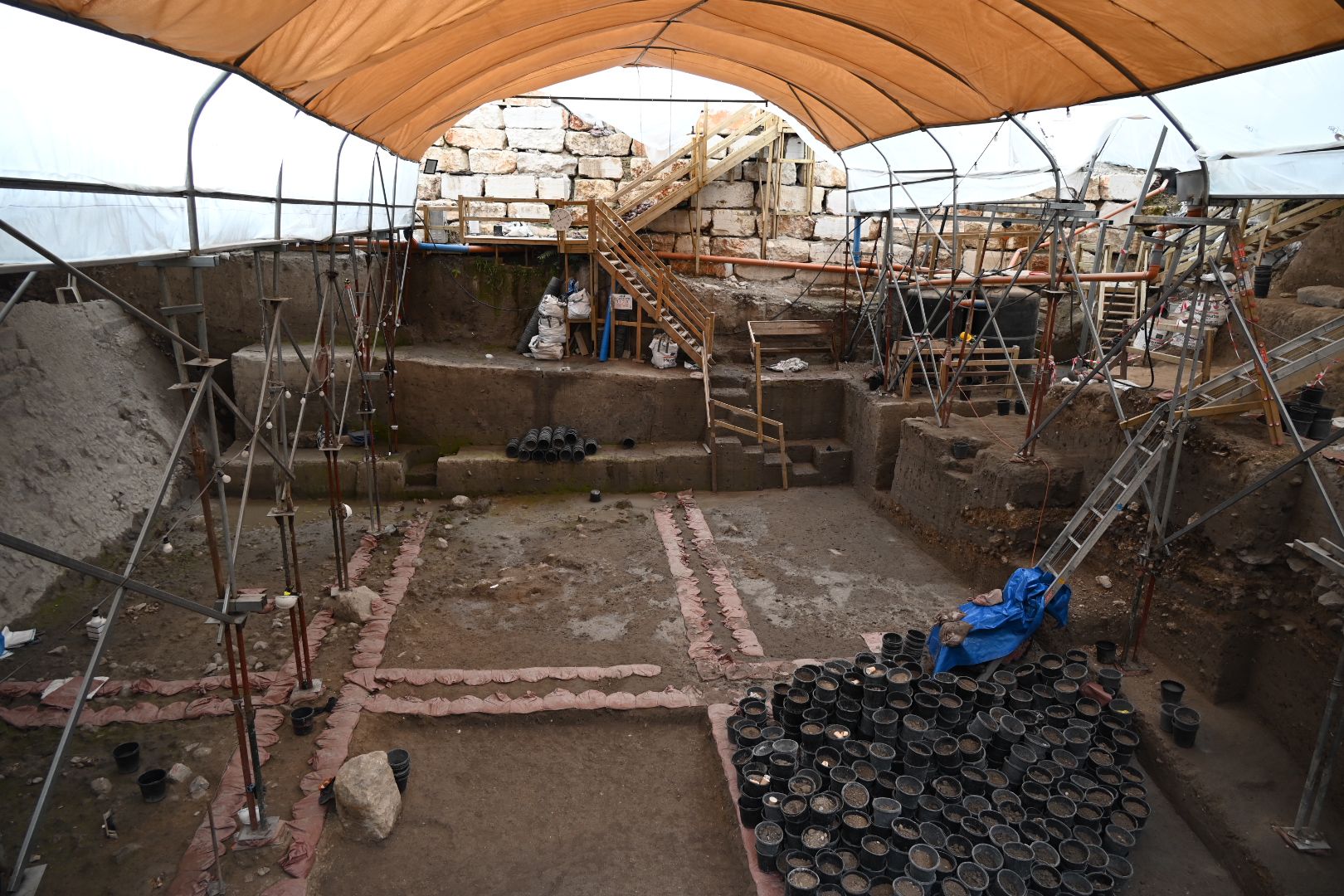
This is how the excavations at the Pool of Siloam looked yesterday. Photo by Bethany Bolen.

While tourism to Israel has been slow recently, many are traveling to Turkey, Greece, Egypt, and elsewhere. I’ve linked to several options in recent roundups, but Tutku Tours has a couple of special offerings this summer I wanted to highlight.

The Global Smyrna Meeting is the most in-depth dive you’ll find anywhere for the seven churches of Revelation. You will not only visit all seven churches, but you’ll enjoy lectures and on-site instruction from the best scholars in the field, including Mark Wilson, Mark Fairchild, and a host of others. This event is being held June 7 to 13 of this year.

This being the 1700th anniversary of the Council of Nicaea, Tutku is offering an extension trip, with visits to Istanbul, Nicaea, and Cappadocia. Nearly a dozen experts will give lectures as part of this tour. The dates are June 12 to 21.

You can get all the details in the Nicaea Program brochure (pdf). I’ve worked with Tutku for a number of years (as have so many educators and educational institutions around the US), and my experiences have always been the very best. I’m thankful for their service and happy to recommend them.

Tutku has a number of other tours scheduled for this year and next, including discounted trips for professors and a Jesus Tour and Conference in Israel in November. This page provides a convenient summary.

The longest Greek papyrus ever found in the Judean wilderness has been published. “The document is identified as prosecutors’ notes for a trial before Roman officials on the eve of the Bar-Kochba Revolt.” The underlying journal article is here.

“Researchers have deciphered a 2,000-year-old Aramaic inscription on a pottery shard discovered at the Alexandrium Fortress (Sartaba) in the Jordan Valley.”

A rare silver ring discovered at Huqoq in Galilee may depict the temple in Jerusalem. It possibly was one of a group that was a precursor to late-medieval Jewish wedding bands.

The forthcoming “House of David” series on Prime Video takes some liberties.

Steven Notley and Moti Aviam’s lecture about the latest from the Bethsaida/el-Araj excavation is now online. This 87-minute presentation was given at the Museum of the Bible.

Virtual panel discussion on Feb 26: “Debates in the Dust: Seventy Years After the First Dig at Hazor and the Shaping of Biblical Archaeology,” with Igor Kreimerman

Now in Logos Pre-Pub: The Essential Atlas of the Bible: A Visual Experience of the Biblical World (NIV Application Commentary Resources), by Carl G. Rasmussen (HarperCollins, $20)

Nathan Steinmeyer gives a primer on the Shephelah of Judah.

Wayne Stiles has three tours planned, with signups now open:

HT: Agade, Ted Weis, Gordon Franz, Arne Halbakken, Explorator

“In the ancient city of Metropolis, located in İzmir, Turkey, archaeologists uncovered approximately 2,000 fragmented bronze statues in an area believed to have been used as a junkyard in ancient times.”

A monumental structure excavated at Assos in western Turkey is not a fountain but a tomb. They also uncovered “one of the first mosaics with polygonal tesserae from the Hellenistic period found in Anatolia.”

“A new study published in the journal PLOS One has shed light on the diverse origins of the approximately 2 million pieces that make up the Alexander the Great mosaic from Pompeii.”

The National Museum of Underwater Antiquities in Piraeus, Greece, is under construction and set to open next year.

Carl Rasmussen shares a number of photos taken in the Museum of Anatolian Civilizations in Ankara, Turkey related to the Neo-Hittites at Carchemish and the bull-men and griffin demons of Carchemish.

On a double episode of Digging for Truth, Gary Byers talks about the Amarna Letters and their relationship to the Exodus and Conquest.

On the Biblical World podcast, Chris McKinny and Mark Janzen discuss the sites of Pi-Ramesses, Pithom, and Succoth.

Webinar on Feb 5: “Women’s Work in Abydos: Margaret Murray, Amice Calverley, and Myrtle Broome,” by Kathleen Sheppard

New release: Thutmose III and Hatshepsut, Pharaohs of Egypt Their Lives and Afterlives, by Aidan Dodson (AUC Press, $35)

New article: “Archaeology as Cultural Heritage in the Kurdistan Region of Iraq: Developing an Integrated Approach beyond Narratives of Catastrophe and Emergency Response” (open-access)

Researchers have reconstructed a minute-by-minute account of the eruption of Mount Vesuvius and its destruction of Pompeii. The article includes many graphics. The underlying journal article is available to subscribers.

Carl and Mary Rasmussen are leading an 18-day Bible tour of Turkey and Greece in May.

Ferrell Jenkins has posted photos of Jerusalem, the Horns of HattinHazor from the air, Mount Hermon from Syria, and a sunset over the Suez Canal,

HT: Agade, Gordon Franz, Ted Weis, Arne Halbakken