A new book on Pompeii by classics scholar Mary Beard of Cambridge University is considered in a travel article in the Globe and Mail.  Beard believes that most of those who died were either slaves or those who intentionally chose to take their chances. 

Beard argues that Pompeii’s population was smaller than previously thought, about 12,000, and that most escaped the volcanic eruption, taking the bulk of their possessions with them.
That would explain why relatively few corpses (1,100) and household effects were later found. Some citizens and slaves – half the population were slaves, many of them Jews brought from Israel after the Roman destruction of the temple in Jerusalem in 70 AD – must have been stranded or chosen to stay. There were, after all, remains of 21 fresh bread loaves found in Pompeii’s ovens, when excavations began in the mid-18th century.
Beard’s book is too new to have changed the way local tour guides and historians treat the Pompeii saga, but for anyone contemplating a visit to one of the world’s greatest archeological sites, it’s a useful read.

The article continues with a look at the nearby ruins of Herculaneum and the modern city of Naples. 

It ends with advice that I wish someone had given me: do not even think about driving a car in Naples.

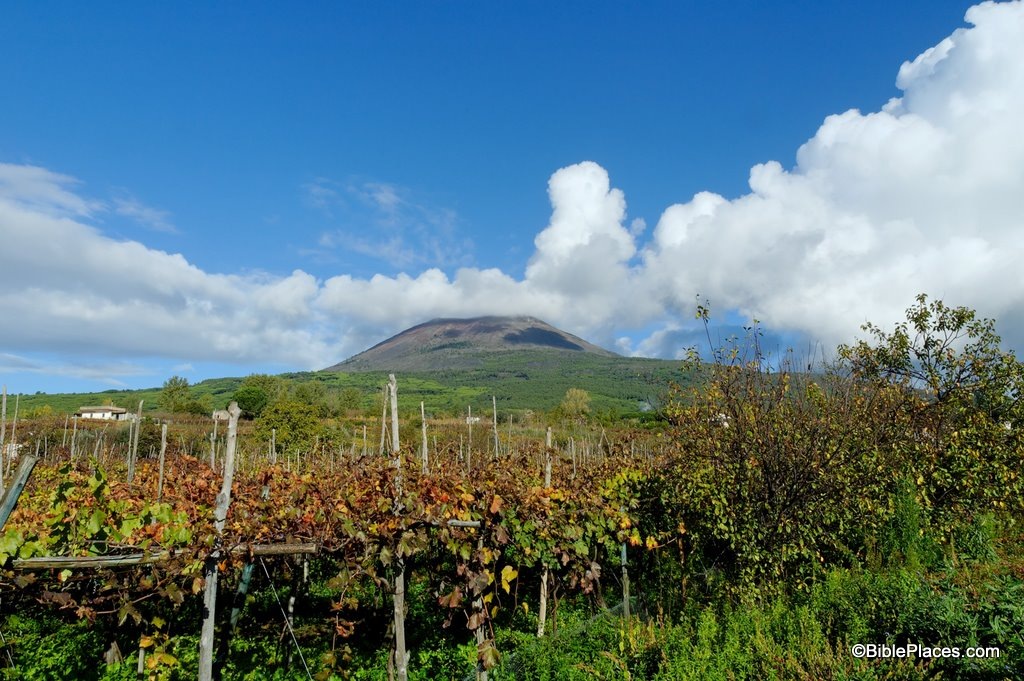
Mt Vesuvius from south, tb111705547ddd Mount Vesuvius from the south

HT: Explorator

Share:

This article will set some to thinking about how their tour itineraries will change.  Others will wonder how this might play into the fulfillment of the “battle of Armageddon.”  From the Jerusalem Post:

A battle is raging over the pending construction of a new international airport in Megiddo, in the Jezreel Valley.
According to the Transportation Ministry, the number of people flying to and from Israel annually is expected to double, from 15 million to 30 million, in the next 20 years, creating urgent necessity for a new airport. The regional council in Megiddo, however, vehemently opposes the initiative.
“It [the airport] is absolutely absurd and does not serve the national interest of the State of Israel, which is the preservation of open areas, including the preservation of the significant agricultural land reserves of the Jezreel Valley, tourism development and rural areas with ecological environmental sensitivity,” the Megiddo regional council said in a statement this week.
Though officials say the airport would undoubtedly increase tourism to the area, local authorities, residents and environmental organizations are actively opposing its construction. Yoel Sigal, the strategic planner for the Megiddo Municipality, is leading the campaign against the project.
“The selling of the Jezreel Valley” represents one of the worst elements of Israeli development policy, he said on Tuesday. Under the National Development Plan, the valley is defined as an area for farming. If the region became an urban center, it would effectively merge Afula, Nazareth and Haifa and would destroy one of the most important agricultural zones of the country, he said.
Furthermore, the airport project would reduce agricultural output and add to the country’s increasing dependency on imported field crops.
Previous transportation minister Shaul Mofaz appointed former OC air force Maj.-Gen. (res.) Herzl Bodinger to head a committee on the future of air transport in Israel. The Bodinger Committee’s recommendation to build an international airport in Megiddo was approved by the cabinet on February 1.
The 400-dunam (40 hectare) airport site, which is 60 km. away from Ben-Gurion Airport, is projected to cost $35 million. It is not at the same location as the existing Megiddo Airport, which handles local traffic.

Continue reading here.

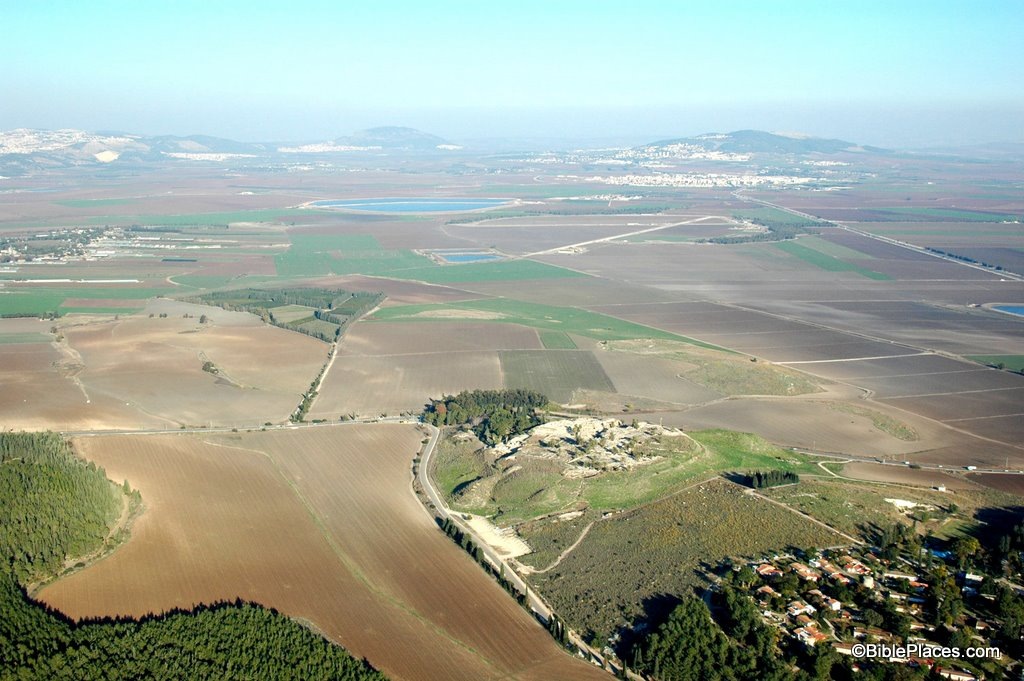
Megiddo and Jezreel Valley aerial from west, tb121704968

Megiddo and Jezreel Valley, view to northeast
Share:

Logos is set to release a new product entitled “1,000 Bible Images.”  The projected ship date is June 2, which means that the pre-publication price of $20 will soon expire.  From the screenshots, it appears that the illustrations are all black-and-white line drawings.  The collection’s description begins:

Now you can literally see the people, places, and events of the Bible text—right in front of your eyes! Bring your study of the Bible to life with this collection of 1,000 images, drawings, and illustrations—all produced by professional artists under the supervision of biblical scholars, in association with the German Bible Society. This vivid artwork shows the biblical sites, religious objects, plants and animals, archaeological findings, scenes from daily life in the Bible, and much more! As reliable documentation of biblical life, these images often give a better illustration and explanation than the text itself can give.

If you’ve ever considered a trip to Israel with young children, this NY Times article provides some ideas for what to do.  Depending on the length of your visit and where you call home, I would make a few more suggestions: Hai Bar Animal Reserve, Timna Park with the Tabernacle Model, snorkeling in Eilat, the Armored Corps Museum at Latrun, Mini-Israel, a canoe ride on the Jordan River, a beach on the Mediterranean such as Ashkelon, and yes, Yad VaShem.

Hiking in the Judean wilderness can be great fun, but if you do it, take all precautions.  Every year someone loses their life, and this weekend it was a 22-year-old hiking all alone.

Share:

The Pope has begun a week-long visit to Jordan and Israel with words of respect for Islam.  From the JPost:

“My visit to Jordan gives me a welcome opportunity to speak of my deep respect for the Muslim community, and to pay tribute to the leadership shown by his majesty the king in promoting a better understanding of the virtues proclaimed by Islam,” Benedict said shortly after landing in Amman.

A traveler sends along photos from Nazareth of Muslim preparations for the Pope’s visit.  The large building in the background is the Church of the Annunciation, which the Pope is scheduled to visit on Thursday.

nazareth_welcome
nazareth_welcome2

Share:

The New York Times reports on the reopening of the ruins of Babylon to the public.

BABYLON, Iraq — After decades of dictatorship and disrepair, Iraq is celebrating its renewed sovereignty over the Babylon archaeological site — by fighting over the place, over its past and future and, of course, over its spoils. Time long ago eroded the sun-dried bricks that shaped ancient Babylon, the city of Hammurabi and Nebuchadnezzar, where Daniel read the writing on the wall and Alexander the Great died. Colonial archaeologists packed off its treasures to Europe a century ago. Saddam Hussein rebuilt the site in his own megalomaniacal image. American and Polish troops turned it into a military camp, digging trenches and filling barricades with soil peppered with fragments of a biblical-era civilization. Now, the provincial government in Babil has seized control of much of Babylon — unlawfully, according to the State Board of Antiquities and Heritage — and opened a park beside a branch of the Euphrates River, a place that draws visitors by the busload…. Now with the support of some officials in Baghdad, the local government has reopened the excavated ruins of Babylon’s ancient core, shuttered ever since the American invasion in 2003. It has done so despite warnings by archaeologists that the reopening threatens to damage further what remains of one of the world’s first great cities before the site can be adequately protected.

The full story is here.

Share: