“Researchers have revealed a hidden manuscript on a recycled piece of parchment, believed to have been written by the Greek mathematician, astronomer and geographer from the ancient Roman Empire: Claudius Ptolemy.”

“Archaeologists in Egypt have discovered broken statues of ancient royalty at a sun temple in Heliopolis.”

Gorgeous zodiac paintings decorating the roof and walls of the 2,200-year-old Temple of Esna in southern Egypt have been revealed during a restoration project that’s clearing away two millennia’s worth of grime, soot and bird poop.”

“The American Research Center in Egypt (ARCE) has launched the Valley of the Queens and the Western Wadis on the Theban Mapping Project website.”

Mattias Karlsson attempts to explain why a king of Moab was called “the Egyptian,” if indeed he was.

Jason Borges provides a first-person account of the destruction in Antakya (biblical Antioch on the Orontes).

Turkish authorities have begun to “strengthen” historic buildings in Istanbul with “Khorasan mortar,” an ancient method that provides buildings with elasticity during an earthquake.

The Vatican gave to Greece three marble statue heads that once adorned the Parthenon.

The Greek mafia is beating up archaeologists on the island of Mykonos.

“A growing number of researchers now want to reconstruct ancient aromas and use them to learn more about how we used to live.”

Archaeologists are using AI to protect ancient sites, improve dating methods, and analyze old rock art.

The Pergamon Museum in Berlin will be completely closed beginning in October for three and a half years, with the southern wing not reopening until 2037 (!).

Bryan Windle reports on the top three stories in biblical archaeology in the month of March.

HT: Agade, Arne Halbakken, Alexander Schick, Explorator

Share:

Archaeologists have discovered the oldest pearling town on an island in the Persian Gulf.

Writing for Christianity Today, Mark Wilson recounts the history of Antioch on the Orontes, including its significant place in the early church and the numerous earthquakes it has suffered.

Jason Borges provides some essential information for visiting Antalya, a beautiful city on the southern coast of Turkey. I would add a day-trip recommendation for Termessos.

This 10-minute video explains the ancient craft of parchment-making, in the city which gave its name to parchment (Pergamum).

“The coveted metal copper and a sheltered location turned the Cypriot village of Hala Sultan Tekke into one of the most important trade hubs of the Late Bronze Age.”

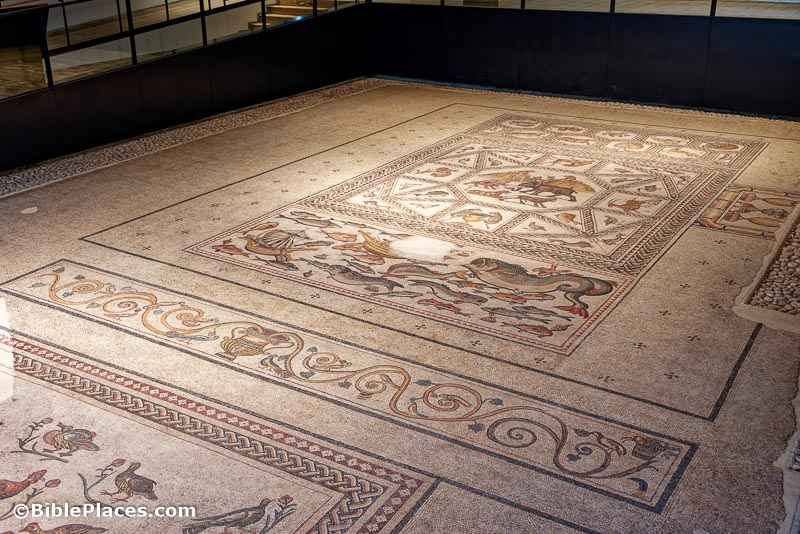
“The exhibition ‘The colours of the Romans. Mosaics from the Capitoline Collections,’ on show in Rome’s Montemartini Museum, has been expanded to include a new section presenting 16 newly restored works dating from the late Roman period and never before shown in public.”

Entrance to the Pantheon in Rome will no longer be free.

The most expensive coin ever sold at auction was sold using false provenance and the owner of the auction house has been arrested.

“Governments, law enforcement officials and researchers have linked a mounting number of the Met’s relics to looters and traffickers.”

New release: The Public Lives of Ancient Women (500 BCE-650 CE), edited by Lucinda Dirven, Martijn Icks, and Sofie Remijsen (Brill, $143).

HT: Agade, Arne Halbakken, Explorator

Share:

Researchers have launched a global contest with $250,000 in prizes for teams to use AI for decoding unrolled scrolls from Herculaneum.

The Moabite king Mesha is the latest subject of Bryan Windle’s archaeological biography series.

Nathan Steinmeyer explains the significance of the Cyrus Cylinder and its relevance to the Bible.

Jason Borges tracked down the Istanbul Airport Museum and explains how to find it.

“In a new study, genetics and archaeology combine to reveal the ancient origins of humanity’s first beast of burden,” the donkey.

The Codex Sassoon, to be auctioned off on May 16, will be displayed in Tel Aviv, Dallas, Los Angeles, and New York over the next two months.

Chris McKinny, Amy Balogh, and Kyle Keimer discuss “Biblical Geography—The Missing Ingredient” on the Biblical World podcast.

On This Week in the Ancient Near East podcast, “The Archaeology of Ancient Fingerprints, or Profiling Potters for Fun and Profit.”

HT: Agade

Share:

Archaeologists working in the temple of Dendera discovered a Sphinx-like statue that may depict Emperor Claudius.

“Egyptian officials have released photos of an ancient scroll, the 52-foot-long (16 meters) Book of the Dead papyrus recently discovered in Saqqara. The 10 images show ancient illustrations of gods and scenes from the afterlife, as well as text on the document, which is more than 2,000 years old.” The released photos were first posted on the government’s Facebook page.

The British Museum’s Curator’s Corner provides a lesson in how to read ancient Egyptian hieroglyphs (27 min).

New release: Ancient Egypt, New Technology: The Present and Future of Computer Visualization, Virtual Reality and Other Digital Humanities in Egyptology, edited by Rita Lucarelli, Joshua A. Roberson, and Steve Vinson. (Brill, $174; free download)

The first-ever detailed study of the theater at Pergamum reveals that it is larger than the theaters at Smyrna, Ephesus, Miletus, or Aspendos. An aerial photo shows the locations of the theater, stadium, and amphitheater in relation to the acropolis.

Turkish Archaeological News has a roundup of major stories for the month of February. They also provide a damage assessment of cultural properties one month after the earthquake.

“The revamped archaeological museum of Argos in the Peloponnese and its upgraded display collection will soon reopen to the public.”

Archaeologists have discovered for the first time wooden stakes described by Julius Caesar and used as a kind of ancient barbed wire.

New research suggests that humans may have first begun riding horses around 3000 BC.

New exhibition at the San Antonio Museum of Art: “Roman Landscapes: Visions of Nature and Myth from Rome and Pompeii”

The Global Smyrna Meeting on the Seven Churches of Revelation will be held June 4 to 10, featuring many scholars in the field including Mark Wilson, Mark Fairchild, James Hoffmeier, David deSilva, and Ben Witherington.

HT: Agade, Arne Halbakken, Ted Weis, Mark Hoffman, Explorator

Pool of Siloam excavations in late February. Photo courtesy of John DeLancey.

Share:

Scholars have long wondered if an Amorite language existed, until the discovery of two tablets written at least partially in the language.

“An archeological site at Girsu, in modern-day south-central Iraq, a major city in the ancient Mesopotamian civilization of Sumer, has been unearthed revealing a palace and a temple that date back over 4000 years.”

Egyptian police discovered a fake tomb created to defraud antiquities traffickers.

Kim Phillips addresses questions of what’s real and what’s hype in the sale of Codex Sassoon.

Eric Cline explains how the recently discovered evidence of a drought in 1198-1196 adds to our knowledge of the collapse of the Hittite Empire and other societies.

France 24 shows drone footage of the earthquake damage to Turkey’s Gaziantep castle.

“It’s still an open question among scholars whether Mycenaeans participated in long-distance metallurgical trade in the Bronze Age. The mythological narratives found in Greek literary tradition suggest they did.”

“The UK is working on a new arrangement with Greece through which the Parthenon Sculptures could be seen both in London and in Athens.”

Greece has announced a four-year renovation project of the National Archaeological Museum in Athens.

Online lecture on Feb 28, 10am: “Excavations at Nineveh and Nimrud in 2022.” Join by Zoom here, or watch the recording a few days later here.

New York tells the story of Michael Steinhardt and the investigation of his antiquities collection.

New release: The Most Extraordinary Life: Discovering the Real Jesus, by Bob Rognlien. Also on Kindle.

My colleague William Varner has just published his latest work, The Preacher and the Song: A Fresh Look at Ecclesiastes & Song of Songs.

HT: Agade, Explorator, Arne Halbakken, Gordon Dickson, Alexander Schick, Ted Weis

Share:

Gobekli Tepe and Arslantepe Mound suffered little or no damage in the recent earthquake in southern Turkey. Other sites did not fare as well.

With the death of their leader and the destruction of their synagogue, the Jewish community in Antakya (biblical Antioch), Turkey, may be coming to an end after 2,500 years of continuous presence.

A new exhibition, “Late Ottoman Turkey in Princeton’s Forgotten Maps, 1883-1923,” has been created by the Princeton University Library’s Maps and Geospatial Information Center in collaboration with Richard Talbert, Research Professor of History at the University of North Carolina, Chapel Hill.

“A research project headed by Dr. Michael Hölscher of Johannes Gutenberg University Mainz (JGU), has uncovered that the Book of Revelation has some descriptions and phrases similar to ancient curse tablets.”

Aeon: “Some 3,700 years ago, an enslaved girl, a barber, and a king crossed paths in a city by the Euphrates. This is their story.”

“The historiography of cuneiform mathematics has been enormously fruitful in analyzing the surviving texts, such that countless aspects of the outstanding Mesopotamian mathematical techniques are known today.”

“The Database of Religious History, based at the University of British Columbia, is a digital, open access, and queryable repository of quantitative and qualitative information with the goal of covering the breadth of human religious experience.”

New from Princeton University Press: Flying Snakes and Griffin Claws: And Other Classical Myths, Historical Oddities, and Scientific Curiosities, by Adrienne Mayor

Carl Rasmussen explains “slip-strike tectonic movement” in the Jordan Rift and in the recent earthquake in Turkey.

I traveled last month in Turkey with Mark Wilson and Jason Borges. Jason’s new website on Biblical Turkey is worth checking out.

HT: Agade, Arne Halbakken

Share: