“A marble statue of Hermes from the Roman Imperial Period was found during the 2024 excavation season in the ancient city of Aspendos.”

Smithsonian Magazine runs a feature article from a forthcoming book by Joshua Hammer about the four-way mid-19th-century race to decode the Akkadian language.

Researchers at Cornell University and Tel Aviv University are developing methods to use AI in the deciphering of cuneiform tablets.

A. Bernard Knapp explores the relationship between Cyprus and Ugarit in the Late Bronze Age. His recent book on the subject is free to read online.

“The 2,000-year-old water channels of the ancient city of Smyrna in Izmir continue to function as they did centuries ago.”

“The British Museum has just unveiled the winning design in an international architectural competition for the substantial revamp of the so-called Western Range of the museum.” This article in the Greek City Times wonders whether this renovation includes a space for the Parthenon Marbles.

An archaeological display of 50 artifacts sponsored by the Associates for Biblical Research will be exhibited over Easter weekend at the Creation Museum in Kentucky.

Available next month: Archaeology and the Ministry of the Apostle Paul: A Visual Guide, by David A. deSilva (Baker Academic, $33)

Zoom lecture on March 17: “From Online Auction to JTS Special Collections: How Two Historic Bibles Were Reunited in the JTS Library,” by David Moster

Hybrid lecture at Harvard on March 26: “Murder, Poetry, and Scribes in Ancient Egypt,” by Margaret Geoga

Michael Danti and John MacGinnis are guests on Thin End of the Wedge to discuss “Nimrud: Post-conflict Archaeology in the Heartland of Assyria.”

“The Institute of Classical Studies, in collaboration with the Faculty of Linguistics and the Centre for Hebrew and Jewish Studies at the University of Oxford, will offer two free, online semi-intensive courses in Phoenician.” One course is at the elementary level, the second is intermediate, and both are on Zoom.

Turkish Archaeological News reviews the most important discoveries in the month of February.

Paul L. Maier, ancient history scholar and author of Pontius Pilate, The Flames of Rome, and numerous other works, died last month.

HT: Agade, Joseph Lauer, Keith Keyser, Gordon Franz, Arne Halbakken, Ted Weis
A new study reveals that ancient Egyptian mummified bodies smelled “woody,” “spicy,” and “sweet.”

Archaeologists working in Egypt have completed the excavation and relocation of a gold processing complex in use for a millennium beginning circa 1000 BC.

Archaeologists working in central Turkey have found evidence of ironmaking dating to 2200 BC.

A new study has been released describing the “production and use of obsidian mirrors found at Tepecik Çiftlik” in central Turkey.

“Archaeologists excavating Göbekli Tepe have uncovered evidence that challenges previous theories about the site’s purpose.”

“Authorities in Turkey have sealed off a luxury spa that was set up by illegally modifying a 1,500-year-old cistern near Hagia Sophia in Istanbul.”

A headless bronze statue believed to depict Marcus Aurelius is being returned by The Cleveland Museum of Art to Turkey.

Archaeologists in Pompeii have unearthed a rare depiction of initiation rites into a secret female cult that centred on Dionysus.”

A new theory has been proposed to explain how the brains of a man who died in the Mount Vesuvius explosion turned to glass.

“A close look at Pompeii’s stone-paved streets has shown how traffic through the ancient city changed dramatically after it was incorporated into the Roman world.” (subscription)

Hybrid lecture on March 12 at ISAC: “Epigraphy and Exploration at Beni Hassan, Egypt,” by Anna-Latifa Mourad Cizek

The Jerusalem Post explains why mummies are disappearing from museums.

The palace of Knossos set a new record in 2024 with more than one million visitors.

Howard Carter’s lost suitcase has been found and will be auctioned.

HT: Agade, Explorator, Gordon Franz, Ted Weis, Paleojudaica

Archaeologists have discovered the tomb of Thutmose II, the first royal tomb found in Egypt since King Tut’s tomb in 1922.

A previously unknown pyramid from circa 2000 BC was discovered by quarry workers in the Dahshur area.

“A devastating new report reveals the extent of destruction in Syria’s legendary city of Palmyra, where eight out of ten buildings now lie in ruins or on the verge of collapse.”

James Gold explains his work as an archaeological illustrator and why it is important.

Carl Rasmussen has posted photos from Yesemek, the largest stone masonry workshop in the ancient Near East.

Lead pollution in ancient Rome was so high that it dropped the population’s IQ by around 3 points, if not more.”

“Malta is home to some of the oldest and arguably most mysterious megalithic structures known to man, older than the Pyramids and Stonehenge.”

Archaeology Magazine has published a well-illustrated story about the restoration of the Temple of Knum in Esna.

Kara Cooney explains when it is OK to recycle an ancient Egyptian coffin.

Zoom lecture on March 5: “Why is Alexander on the Alexander Sarcophagus? Rethinking a Funerary Monument from Sidon,” by Jessica Nitschke

Hybrid lecture on March 13: “The Amman Citadel in Light of Recent Archaeological Work,” by Katharina Schmidt

Bible Archaeology Report has posted an archaeological biography of Merodach-Baladan, the king of Babylon during the days of Hezekiah.

Correction: The notice last week about a third bridge being discovered in Jerash was a false report caused by a local reporter’s misunderstanding. There are only two bridges.

HT: Agade, Ted Weis, Gordon Franz, Keith Keyser

The ancient harbor of Adramyttium, mentioned on Paul’s voyage to Rome (Acts 27:2), became visible when the Aegean sea receded. Photos are posted in the Turkish article.

Recent excavations in Perga have uncovered five statues.

Egypt has begun restoring the Ramesseum in Luxor.

MrBeast spent 100 hours inside the Giza pyramids, including visiting areas not open to the general public.

Mark V. Hoffman notes a temporary exhibition entitled “In the Footsteps of Paul” that is at the Archaeological Museum of Thessaloniki through April and then will be in Athens.

Mark V. Hoffman also gives an introduction to MARBLE (Modular Aggregation of Resources on the Bible), a UBS project that includes biblical texts, semantic dictionaries, images, and videos.

New release: Tel Dover (Khirbet ed-Duweir) on the Yarmuk River: The Late Bronze and Iron Age Levels, by Amir Golani and Samuel R. Wolff (Ägypten und Altes Testament 130; Zaphon; €75).

New release: Slavery and Servitude in Late Period Egypt (c. 900–330 BC), by Ella Karev (Ägypten und Altes Testament, €70)

New release: Scribes and Language Use in the Graeco-Roman World, edited by Sonja Dahlgren, Martti Leiwo, and Marja Vierros (The Finnish Society of Sciences and Letters, free pdf).

Color paintings made by Joseph Lindon Smith in an Egyptian tomb remain valuable today.

An archaeological exhibition entitled “From Sharjah to Rome via the Spice Route” is currently on display at the Colosseum in Rome.

Lawrence Schiffman is giving two lectures on the Dead Sea Scrolls at Penn State University on February 19:

  • 12:15 to 1:30 pm: “Temple City: Jerusalem and its Temple in the Urban Planning of the Dead Sea Scrolls” (register for Zoom here)
  • 6:00 to 7:30 pm: “The Dead Sea Scrolls and the History of Judaism” (register for Zoom here)

The Itinerarium, written by the anonymous Piacenza Pilgrim circa 570 and translated by Andrew S. Jacobs, is now available online.

Colleen Morgan explains how AI imagery could be used to develop fake archaeology.

Chris McKinny and Kyle Keimer discuss the best archaeological finds of 2024 on the Biblical World podcast.

HT: Agade, Gordon Franz, Arne Halbakken, Explorator, Paleojudaica

Bryan Windle summarizes the top three reports in biblical archaeology in the month of January.

Turkish Archaeological News rounds up the top stories for the month of January.

Zuzana Chovanec explains how Organic Residue Analysis makes it possible to understand the use of the opium poppy in history.

The Grand Egyptian Museum will reportedly have its grand opening on July 3.

BibleTelling is planning 2 “seminars”—where the participants tell Bible stories on Bible land locations where they occurred:

New release: How to Eat: An Ancient Guide for Healthy Living, translated with commentary by Claire Bubb (Ancient Wisdom for Modern Readers, Princeton University Press, $13-$18; Amazon)

New release: The Akkadian Great Hymns and Prayers: A Critical Edition of the Nabû and Ištar Prayers and a Study of the Corpus, by Geraldina Rozzi. Free download.

Webinar on Feb 19: “The Archaeology of Psychotropic Substances in the Ancient Eastern Mediterranean and Western Asia,” by David Ilan

The World of Abraham exhibit opened recently at The Bible Seminary’s Joshua, Judges, and Jesus Museum in Katy, Texas.

Lipscomb University offers M.A. and Ph.D. degrees in biblical and ANE archaeology, with six current projects in four Middle Eastern countries.

Leon Mauldin has posted a number of photos of Amarna Tablets now in the British Museum.

Charles A. Burney died in November. He excavated in Libya, Egypt, Iran, Turkey, and with Kenyon at Jericho.

HT: Agade, Gordon Franz, Arne Halbakken, Explorator

(Post by A.D. Riddle)

Earlier this week, Todd drew attention to Tutku’s new tour “The 1700th Anniversary of the Council of Nicaea in 2025.” In connection to this tour, Tutku hosted an online seminar a few weeks back with the same title. The presentation was given by Glen Thompson, and moderated by Mark Wilson. I found it really interesting and informative. For those who missed it, a recording of the seminar is now ready to watch on YouTube.

If anyone wants to learn more about the Nicaean Council, the same Glen Thompson founded a website named Fourth Century Christianity. There one will find a whole host of things to explore about the council. The site contains a historical synthesis covering events leading up to the council and the council itself, primary source documents giving descriptions of the council (in both Greek and English translation), documents concerning the Arian controversy, a map of Arian’s supporters, and more.

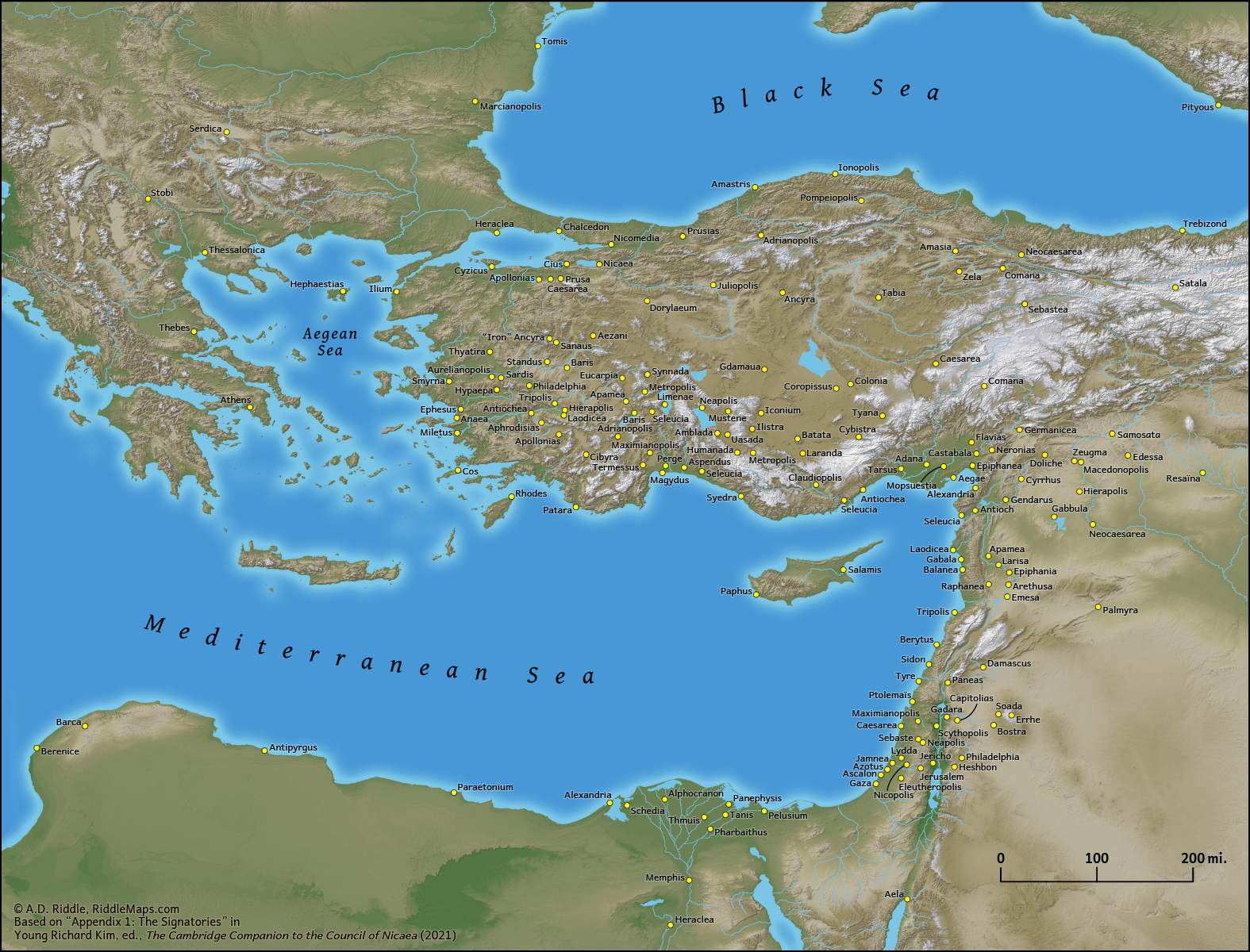
At the beginning of this year, I made three maps to show the council’s geographical background for a class on the Nicaean Creed. It is a large PDF file (120MB) which can be downloaded here. The first map includes the entire Mediterranean and Near East, showing the furthest geographic extent of the creed’s signatories, from Cordoba in Spain to Persia (Persis). There is a black rectangle around Nicaea which corresponds to the extent of the second map. The second map shows the immediate region around Nicaea, including the Eastern capital at Nicomedia and the future capital at Constantinople. The third map zooms into the area of Anatolia, Syria, Palestine, and Egypt so that nearly all of the dots could be labeled. My work on these maps was based on an appendix in the volume edited by Young Richard Kim, The Cambridge Companion to the Council of Nicaea (2021). I wish I had known about Glen Thompson’s website at the time, because I would have instead used the list of names he has compiled. (Maybe some day I will update my map to reflect Glen’s research, today is not that day).