“An impressive section of Jerusalem’s fortification wall from the second century BCE has been uncovered on the grounds of the Tower of David complex in the Old City.” About 130 feet of the “First Wall” has been uncovered in the Kishle.

Archaeologists have found evidence for the famous battle at Bet Zecharia described in 1 Maccabees. “It is the first time we have possible archaeological evidence from one of Judah Maccabee’s battlefields.”

A scholar believes that he has cracked Cryptic B, a rare alphabet known only from two uses in the Dead Sea Scrolls.

Coins previously believed to sloppy versions of coins minted by Alexander Jannaeus should instead be understood as coming from the economically weak era of the Hasmonean civil war between 60 and 40 BC.

Hartebeests went extinct in Israel not in the Iron Age but in the Byzantine period.

Doron Spielman spoke about some of his experiences in the City of David at a recent event in Jerusalem.

On Digging for Truth, Scott Stripling explains the archaeology that is related to Hanukkah.

On the Biblical World podcast, Kyle Keimer talks with David deSilva about his two new archaeology books.

Dig has released a 27-minute video about Labayu of Shechem.

The foundation stone of the Pontifical Biblical Institute in Jerusalem was laid 100 years ago.

A powerful winter storm caused death and destruction all over Israel this week.

New release: The Archaeology of the Kingdom of Judah, by Yosef Garfinkel (SBL Press, $75)

You can now purchase soil from the Temple Mount.

Jerusalem University College will be presenting its 6th annual online seminar on January 10. The “Geography and the Bible” seminar is free and will include four sessions:

  • “Road Systems from Egypt through Sinai,” by James Hoffmeier
  • “Trekking from the Desert to the Land of Milk and Honey,” by Hélène Dallaire
  • “What Does it Mean that Jerusalem was ‘Built as a City which is Compact Together?’ A Geographical and Archaeological Reading of Psalm 122:3,” by Chandler Collins
  • “The Early Church’s Encounter with the Roman Imperial Cult,” by Carl Rasmussen

There is no hat tip (HT) below to Gordon Franz, because Gordon died on November 22. I met Gordon when studying at IHLS in the early 90s, and we stayed in touch over the years, including a tour he gave my family of NYC. Gordon taught for various schools over the years, including the Israel and Turkey/Greece/Rome programs for the Talbot School of Theology.  Most recently Gordon sent me stories for these roundups, and in the last email he wrote me, he said he was on his way to buy Rabbi Landy’s latest book. He was quite the book connoisseur. And he had much yet he planned to accomplish. Some of Gordon’s writings are still available on his website. A recording of his celebration of life service is online. He will be missed.
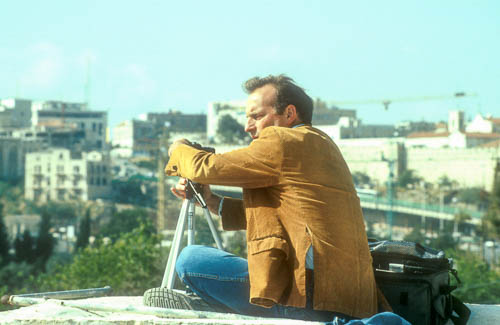
Gordon Franz taking photos from the rooftop of the Institute of Holy Land Studies in Jerusalem, 1993

HT: Agade, Ted Weis, Keith Keyser, Arne Halbakken, Alexander Schick, Explorator

Share:

Archaeologists working at Knossos, Crete, have discovered the longest known inscription in Linear A script.

Archaeologists have discovered defensive structures and military housing at Tell Abu Saifi in northern Sinai.

Scholars have confirmed that one of the Herculaneum papyri as a work written by the Greek philosopher Philodemus.

A scholar claims that he has discovered previously unidentified hieroglyphics on an Egyptian obelisk located in Paris.

A treasure hunter claims to have discovered the actual location of the Council of Nicaea and is willing to disclose it for payment of $50 million.

“The painstaking restoration of glass and ceramic artifacts from the Hatay Museum damaged during the devastating earthquakes in February 2023 earthquake in Turkey is underway.”

“Starry paintings found on ancient Egyptian coffins and tombs indicate that the sky goddess Nut was closely associated with the Milky Way galaxy, according to a new study by an astronomer.”

“Jordanian authorities evacuated hundreds of tourists from the ancient city of Petra on Sunday after heavy rains caused flash floods.” Here’s another video.

“A National Endowment for the Humanities grant to create the first scholarly edition of one of the great classics of biblical literature, the Psalms” has been cancelled.

Turkish Archaeological News surveys major stories from the month of April, including:

HT: Agade, Gordon Franz, Explorator

Share:

“Israel on Monday began long-delayed renovation and maintenance work at the Little Western Wall, a lesser-known section of the Western Wall located in the Muslim Quarter of Jerusalem’s Old City.”

A flash flood on Sunday caused severe damage to the Ein Gedi Nature Reserve. The park is now closed for restoration.

Also on Sunday, a brushfire broke out at Tell es-Safi/Gath.

Ruth Schuster has written a lengthy article about the excavations at Chorazin, including the “pay to dig” opportunity that’s been running there for more than a decade now.

Newly released: Bet Shean V: Hellenistic Nysa-Scythopolis Part 1: Stratigraphy and Architectureand Part 2: The Finds and Conclusion (IAA Reports; free download)

Hybrid lecture at the Albright on July 2: “Amorites, Their Origins, and Their Legacy,” by Aaron A. Burke

“A leading archaeology journal [Palestine Exploration Quarterly] has effectively barred submissions by Israelis on Judea and Samaria unless they ‘have cooperated with the relevant Palestinian authorities.’”

Bryan Windle interviews Joan Taylor in the latest installment of the “Scholar’s Chair” series. Among other things, she discusses her new book, Boy Jesus.

The Biblical Museum of Natural History sells archaeology-themed board games and a kosher box of locusts.

HT: Agade, Gordon Franz, Explorator

Share:

“A farmer in eastern Turkey discovered a rare, largely intact late Roman mosaic while planting a cherry orchard. Spanning almost 1,000 square feet, the mosaic is thought by archaeologists to be the largest example of its kind unearthed in the country.”

Archaeologists working in Pompeii uncovered “one of the largest private thermal complexes” found in the city to date.

“In Libya’s ancient city of Ptolemais on the Mediterranean coast, Polish archaeologists have uncovered a dwelling equipped with an advanced drinking water collection system, and a mysterious mask.”

“The 4,100-year-old tomb of a doctor who ‘treated the pharaoh himself’ has been discovered at the site of Saqqara in Egypt.”

The Yale Ancient Pharmacology Program is working at a site outside Rome “to unlock the chemical signature of what might be in the amphorae by conducting organic residue analysis.”

The Egyptian government denies that it is planning to sell the Grand Egyptian Museum.

The Damascus Museum has reopened, one month after Assad left town.

“Jordan: Dawn of Christianity” is a one-month long special exhibit to be hosted by the Vatican beginning on January 31.

Bryan Windle has written an archaeological biography for Evil-Merodach, the Babylonian king best known for releasing Jehoiachin from prison and giving him a place of honor at the king’s table.

Glenn J. Corbett writes about the $12 million project to renovate the mausoleum of Augustus, slated to reopen next year.

The LA Times has a play-by-play account of how the Getty Villa was spared from the Palisade fire.

HT: Agade, Gordon Franz, Andy Cook, Ted Weis, Arne Halbakken, Explorator

Share:

Excavations have uncovered an ancient farming system from the Middle Ages in the sand dunes next to Caesarea.

The Washington Post reviews the archaeological evidence for crucifixion.

In reporting on the recently published inscription from Jerusalem with possible ties to the Queen of Sheba, Bible History Daily notes some resistance by Christopher Rollston to the interpretation.

A new paper argues that Jews in the Roman army could have kept kosher.

Chandler Collins reviews proposed locations for Jerusalem’s Gennath Gate, often connected with the place of Jesus’s crucifixion and tomb.

A spring storm dropped snow on Mount Hermon and caused flooding that nearly cut off Eilat from the rest of the country.

In its Summer Institute this year, Jerusalem University College is offering three courses:

  • The Dead Sea Scrolls: Myth and Reality, taught by Adolfo Roitman, Curator and Director of The Shrine of the Book
  • Genesis 1-3 in its Ancient Near Eastern Context, taught by Oliver Hersey, President of Jerusalem University College
  • The Zionist Idea, taught by Jonathan Kaplan, Former Vice Provost of the Rothberg International School, Hebrew University of Jerusalem

This month only, Accordance Bible Software is offering the full version of Accordance 13 to everyone for free.

New resource: 14 Fresh Ways to Enjoy the Bible, by James F. Coakley. Though only one chapter is directly about Bible geography, the whole of this book looks like an excellent guide to better reading (Moody, 208 pages; $15).

HT: Agade, Arne Halbakken, Ted Weis, Alexander Schick, Explorator

Share:

“A 6,000-year-old copper fishing hook, possibly used for catching sharks or other large fish, has been discovered during an Israel Antiquities Authority excavation in Ashkelon.”

Andy Cook posts a short video he just filmed in the drainage channel underneath the City of David.

Sussita National Park is now open to the public. The site, also known as Hippos, overlooks the Sea of Galilee on its eastern side.

Bible History Daily addresses the question of who lived in the ancient city of Hazor: commoners, elites, or a mix of the two. This issue is explored further in an article by Shlomit Bechar in the latest issue of Biblical Archaeology Review.

Several dozen articles on the topic of “The Ancient Written Wor(l)d” have been published in the latest issue of ‘Atiqot (open access). One of the articles challenges the identification of the signet ring of Pilate.

“Jerusalem was named one of TIME magazine’s 50 most extraordinary travel destinations, as part of the publication’s third annual list of the World’s Greatest Places.”

“Caesarea was given awarded the ACTA Archeological and Cultural Award for the best foreign archeological site by GIST, Italy’s foremost tourism press agency.”

Chandler Collins will now be posting information about excavations and publications about Jerusalem on Facebook, Twitter, and Instagram.

As Emily Master steps down after five years as Executive Director of the Friends of the Israel Antiquities Authority, she identifies three milestone projects completed in this time: a renovated Davidson Center, the Shelby White and Leon Levy Lod Mosaic Archaeological Center, and the Jay and Jeanie Schottenstein National Campus for the Archaeology of Israel.

Aren Maeir’s latest publication is in a volume dedicated to Indiana Jones. (Despite the date of its posting, the book appears legitimate.)

New release: In the Shadow of the Wall: The Life and Death of Jerusalem’s Maghrebi Quarter, 1187–1967, by Vincent Lemire (Stanford University Press, $32; Amazon).

ASOR webinar on April 13: “New Perspectives on Jerusalem’s 7th Century BCE Elite,” by Yuval Gadot

Online lecture on April 27: “The Archaeology of Mount Zion in Jerusalem – Past, Present, and Future,” by Shimon Gibson. Registration is free and required.

On YouTube: “The Jewishness of the New Testament: An Interview with R. Steven Notley” (17 min)

Israeli authorities are forecasting severe heat waves this summer, with temperatures possibly reaching 120 degrees F (49 C).

The Infusion Bible Conference digital download of all 42 videos of “The Last Days of Jesus” is now on sale for $30 off. Purchase includes the pdf notebook with 170 pages of notes, resources, and recommendations.

Focus on the Family is celebrating Passion Week with a series of devotionals by Will Varner, illustrated with photos from BiblePlaces.com.

HT: Agade, Arne Halbakken, Alexander Schick, Explorator

Share: