Land of the Bible has created a flight tour of the area destroyed in the Mount Carmel blaze.  The imagery is from Google Earth and does not show the damage, but you get a good sense for the area affected.  The map showing the burned region is the best I’ve seen.

Leen Ritmeyer has an excellent illustrated discussion on the identification of the “Beautiful Gate” at the Temple where Peter healed the lame man (Acts 3).  He discusses the options and proposes that the Beautiful Gate should be identified with the Double Gate.

Jeff Chadwick will be lecturing on the 8th century at Philistine Gath (Tell es-Safi) at the Albright Institute in Jerusalem tomorrow (12/16). 

Randall Price says that he has verified that the discovery of Noah’s Ark reported some months ago is a fabrication.

An intact, sealed jar discovered at Qumran in 2004 has been opened and analyzed.

Ferrell Jenkins has a link to a series of 162 historic photos posted online by the Palestine Exploration Fund.

The big storm in the Middle East revealed some archaeological treasures, including a Roman statue of a woman that fell into the Mediterranean at Ashkelon.  Ferrell Jenkins has posted some photos of the cliffs of Ashkelon.

Joe Lauer sends along word of a note to journalists about the storm damage in Caesarea:

Tomorrow (Wednesday) the director of the Israel Antiquities Authority, Mr. Shuka Dorfman, the director-general of the Caesarea Development Company, Mr. Michael Carasenti and representatives of the Nature and Parks Authority will tour the national park and the surrounding area in order to assess the storm damage. The tour will begin at 10:30 in Caesarea harbor and will be open to media coverage. The Israel Antiquities Authority estimates it will cost millions of shekels to rehabilitate the antiquities that were damaged by the storm throughout the country, some of which have suffered enormous and irreversible damage.

Expect a story and photos in the media later today.  Earlier reports about the damage are posted at Arutz-7, ShalomLife, and the Vancouver Sun.

Share:

Sand, rain, snow, and high winds have created a very unusual weekend of weather in Israel, Jordan, Lebanon, Syria, and Egypt.  Several individual reports I’ve heard have stated that they’ve never seen anything like it.  Snow has fallen in Jerusalem, Amman, and Damascus.  Precipitation levels are as high as 8 inches (209 mm) in Upper Galilee and there’s nearly 8 feet (240 cm) of snow on the Mount Hermon ski slopes.  Wind gusts were reported at up to 70 mph (120 kph). Israel’s ambulance services responded to 129 accidents on Sunday alone.  Egypt and Syria each closed their largest ports and 28 buildings collapsed or partially collapsed in Alexandria, Egypt.  Haaretz reports that an ancient port at Caesarea was destroyed.  There were many injuries and at least 19 related deaths.

This AP story does the best job of covering the effects around the Middle East.  The Jerusalem Post and Haaretz stories include photos. 

Share:

From the Jerusalem Post:

Many roads in the South were closed down following floods and a storm which has been raging since Sunday night.
Four tourists became trapped in their car in Arava Monday due to intense flooding.
Rescue units, including a helicopter, were working to evacuate them from the vehicle.
Route 90, leading from the Dead Sea hotels to the Center, Route 40 and Route 211 in the Negev were closed for traffic. The Nitzana Bridge collapsed due to heavy rainfalls.
The Nitzana, Tzin, Revivim Besor Haroe’h and Beersheba streams were overflowing.
A vehicle drifted away near the Revivim quarry and was still being sought on Monday morning. Two trucks with three travelers were swept into the Paran stream near Eilat and the travelers needed assistance from the local rescue unit and IDF helicopters.
All schools in the Ramat Hanegev Local Council were closed because of the floods. Schools in Kadesh Barne’a, Ezuz, Kmehin, Nitzana, Revivim, Mashabe Sadeh, Telalim and Retamim were closed.
Significant downpours swept the land, especially in the Negev and northern Negev, where 49 millimeters were registered during the night.

This reminds one of Psalm 126:4: “Restore our fortunes, O LORD, like streams in the Negev.”

UPDATE: Arutz-7 reports:

One tourist was killed in the Arava area north of Eilat Monday morning when he and two friends tried to drive their jeep through a raging river bed, powered by rare heavy rainfall. The roaring stream crushed the vehicle against rocks, and army helicopters manage to rescue two accompanying tourists. It was not known if they are from Israel or from outside the country.
Earlier on Monday, IDF helicopter rescue crews saved three people trapped in two trucks in flash floods in the central Negev and others near Eilat as the torrential but badly needed winter rains head north.
More than one inch of rain fell in Eilat, more than the normal rainfall for several years, and schools were closed throughout the region. Eilat also suffered electricity blackouts….
Nearly two inches of rain flooded Be’er Sheva, where a raging river bed was filled with water for the first time in years.

Share:

Since April 3 this year, the Sea of Galilee has dropped 6.4 feet (2.0 m), a new record for the size of drop in this amount of time.  Israel has had four years of below average rainfall.  If the water level drops another 2.6 feet (0.82 m), all pumping from the lake will cease.  The Jerusalem Post reports:

The water level in Lake Kinneret dropped two meters this year, the Water Authority said Thursday, a steeper annual drop than in any previous year.
The hydrological year ended on September 30 with the Kinneret at 214.05 meters below sea level, down from its height of 212.05 meters below sea level reached on April 3.
The Kinneret’s “black line,” newly coined this year, is 214.87 meters below sea level. When the black line is reached, the pumps in the lake are exposed to the air, and they can no longer send water into the National Water Carrier.
In July, the lake dropped below the “red line,” at which the concentration of pollutants rises to undesirable levels.
Since spring 2004 the Kinneret has lost 5.13 meters, which is equivalent to 850 million cubic meters of water, the authority said. That is roughly equivalent to an entire year’s worth of household water use.
This was the fourth consecutive year of dwindling rainfall and the forecast for the next couple of years is just as bleak.

You can read the rest here.

Sea of Galilee at dusk, tb040306012ddd

Share:

From the JPost:

“This is the worst crisis since records started being kept 80 years ago,” Water Authority head Uri Shani declared Tuesday morning at a special press conference in Tel Aviv. “Like most countries, Israel is dependent on rainfall and the amount of rainfall is decreasing. There is a drop of 100 million cubic meters per year.”
Shani described a situation of increasing damage to Israel’s main natural water sources. The Coastal Aquifer “has dropped below its black line,” which means that it will suffer rapid damage, possibly irreversible damage, Shani said.
The water level in the Mountain Aquifer was currently a meter above its Lower Red Line, but was also expected to reach its bottom limit – the Black Line – by this year. He added that water levels in the aquifers had never been this low.
Shani predicted that Lake Kinneret [Sea of Galilee] would reach its Black Line by December 2008. The Kinneret dropped below its bottom limit on Monday, 213 meters below sea level. The lake’s Black Line is 214.87 meters below sea level.

The story continues here.

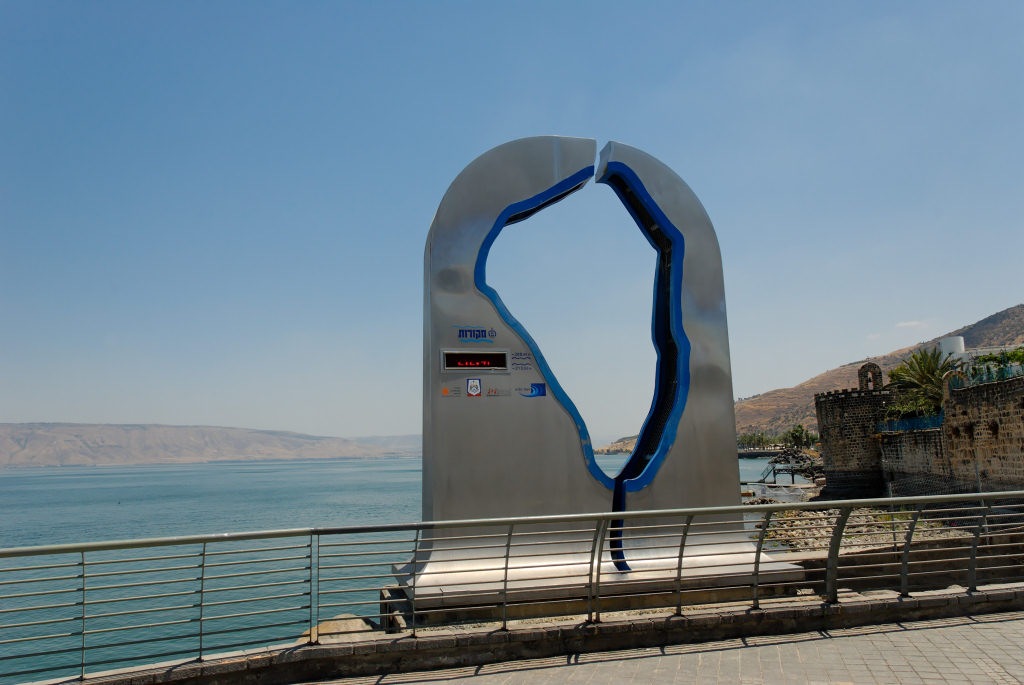
Sea of Galilee water level sign, tb052808512
New sign in Tiberias displays the present water level in the Sea of Galilee, a main source of fresh water for Israel today
Share: