Michael S. Heiser, at the Paleobabble blog, shares an article on limestone quarrying in Spain that may shed light on how similar activity was carried out in Israel. From the abstract:

It appears that one of the quarrying methods used was based on the chemical dissociation by fire of standing stone blocks at their  attachment points,a technique hitherto unknown or unreported in the literature.

Israel has its first crocodiles in the wild since the last one was shot in 1912. Fortunately the 50 escapees from the crocodile farm in the Jordan Rift have now been captured. Bonus question: where is the Crocodile River located in Israel?

Paul’s first preaching stop in what is today Turkey was at Perga (Acts 13:13). Archaeologists there are now celebrating 65 years of excavation.

An archaeological park has opened at Claros (Klaros), not far from Smyrna (Izmir).

The Jordan Times is reporting an uptick in the number of visitors to the “Bethany Beyond the Jordan” baptismal site.

Archaeological sites in Syria are apparently not faring well in the current bloodletting. The danger to Mari is noted in a recent story.

The Dead Sea Scrolls: A Full History, by Weston W. Fields, is reviewed by Jaqueline Du Toit. She writes,

“In conclusion, volume 1 of The Dead Sea Scrolls: A Full History is an inestimable contribution to scrolls historiography. It will appeal to scholars and students of biblical scholarship, but also to academia in general and a popular audience. Despite its price, which curtails its mass appeal, it is highly recommended. And, based on the riveting narrative still unfolding, volume 2 is awaited with great anticipation.”

Joe Yudin takes readers on a tour of part of the Old City of Jerusalem, focusing on remains of the Tenth Roman Legion. He gives a good tour but he makes a significant mistake in dating the Cardo to the Roman period. While the northern portion (beginning at Damascus Gate) was constructed by Hadrian, the southern portion was only built in the time of Justinian in the Byzantine period.

(Excavator Nahman Avigad was surprised to make this discovery in his excavations; he discusses it at length on pages 225-27 of the excellent Discovering Jerusalem. I was about to write this is a very difficult work to find, for indeed it was for many years, but now Amazon has used copies starting at $4.63. I’ve bought several over the years for $60.)

Wouldn’t it be nice to have a camera that lets you focus after you’ve taken the shot?

Answer to the crocodile question: the Nahal Taninim (Crocodile River) runs on the northern end of the Sharon Plain, just below Mount Carmel.

HT: Explorator, Joseph Lauer, G. M. Grena

Nahal-Taninim-from-Mount-Carmel-ppt-screenshot

Nahal Taninim and Sharon Plain from Mount Carmel

A 600-lb metal anchor from the Byzantine period has been discovered off the coast south of Tel Aviv. The find led investigators to two others in the area. Photos are available from the IAA in a zip file. The Sound the Shofar exhibition opened last week in Jerusalem with more than 140 of the horns on display at the Bible Lands Museum. The story includes a two-minute video. The Jerusalem Post has more information about Google Street View in Jerusalem, Tel Aviv, and Haifa. Wayne Stiles takes readers on a visit to Shiloh, the longtime home of the tabernacle. The Archaeology of Libya is discussed in this week’s radio program at the Book and the Spade. (Here’s the direct link to the mp3 file). ATS Pro Terra Sancta has plans to renovate “the Holy Place of Sebastia.” I certainly support improving the conditions at the ancient city of Samaria, though it strikes me as odd to consider as holy the place where Ahab built a temple for Baal worship and Herod built another for the worship of the Roman emperor. An inscription in Aramaic and Greek on a stone lintel has been discovered in the area of ancient Sepphoris. The report is in Hebrew and includes a photograph. A Roman-era style bathhouse was constructed in the middle of a Early Islamic period fortress, say archaeologists excavating at Yavneh-Yam on Israel’s coast. HT: Joseph Lauer, Jack Sasson Yavneh-Yam aerial from west, tb121704859 Yavneh-Yam

The Jordan Lead Codices are fake, fake, fake. This video by Tom Verenna explains why.
JPost’s weekly column “Off the Beaten Track” is inaptly titled this week, but you still may enjoy the tour of Jaffa Gate and the Old City wall running south to Mount Zion.
Less satisfying is Yoni Cohen’s story describing the trails at Ramat Hanadiv (but little about the site!).

In “Archaeology in Israel Update—August 2011,” Stephen Gabriel Rosenberg writes about the “Boundary stone found in Lower Galilee, “Ancient Shechem to be opened to the Public,” “Jerusalem sewage ditch yields up more treasures,” “Phaesalis [sic] City Unvovered” [sic], and “Bathhouse Hercules in the Jezre’el Valley.”

“Seventy-five archaeological missions will resume excavation projects in Egypt as of Monday.”

It is being reported that Egypt will require visitors to acquire a visa before arriving. If it happens, it will no doubt reduce the number of tourists.

Gertrude Bell is remembered in the Jerusalem Post 85 years after her death.

USA Today has named the Glo Bible the #1 coolest book app for the fall. They are impressed with the “700 images of religious art, 2,300 full-color photos and 500 virtual tours of Biblical sites, 140 interactive maps and study tools.” An Android version is coming for all of those with iPhobia.

HT: Joseph Lauer, Jack Sasson

Old City western wall, tb122006005

Western Wall of the Old City of Jerusalem

Last week I lamented that Joe Yudin’s tour of Jerusalem tombs would have benefited from some photos. Shmuel Browns has fulfilled that need with pictures and a map.

In the heart of Mea Shearim in Jerusalem, the Ultra-Orthodox have held the first conference on “Torah archaeology.” This is a welcome change for a group known for its vocal, and sometimes violent, opposition to archaeology.

The editors at Bible and Interpretation reflect on how they have scooped Biblical Archaeology Review multiple times this year.

A couple of stories about the 12th Annual City of David Archaeology Conference were widely circulated this week. I held off posting, preferring a story that described what happened rather than predicted what might happen. What “newest research and discoveries” was revealed? Did the conference “overturn popular theories”? So far I have seen no reports.

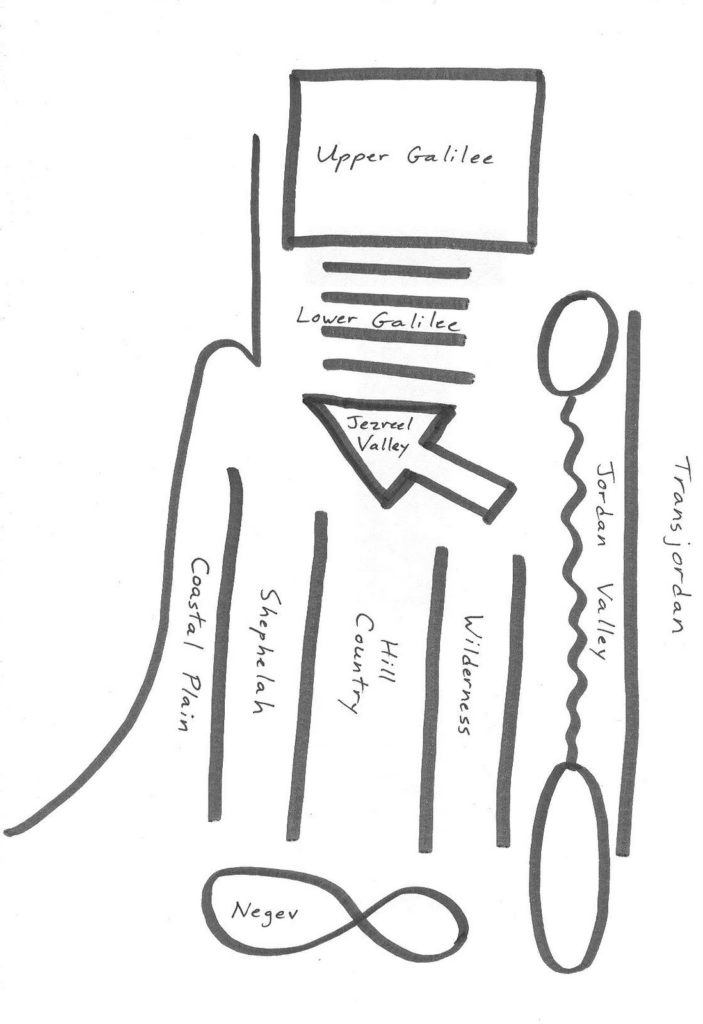
Seth Rodriquez has written and illustrated a simple way to teach people how to “draw the map” of Israel with its major geographic features.

Illustration from Seth Rodriquez’s “Biblical Geography: Drawing the Map

Timna Park, 20 miles (32 km) north of Eilat, has benefitted from a multi-million dollar spending spree, resulting in the creation of four new bicycle paths, hundreds of shade trees, and talk of a new hotel. The article says not a word about the best attraction of the park: the life-size model of the tabernacle.

In a BAR editorial, Aaron A. Burke describes how his detective work in the records of a deceased archaeologist revealed more about the city of Joppa (Jaffa) and cleared the archaeologist of claims of misdeeds.

At the Bible and Interpretation, Paul V. M. Flesher describes what a synagogue of Jesus’ time looked like.

CITYsights takes viewers on a one-minute video tour of Solomon’s Quarries (Zedekiah’s Cave) in
Jerusalem. The audio track consists of music only and if you turn the volume off, you’ll enjoy it more.

The Jerusalem Post has more details of Jerusalem: IMAX 3D, slated for release in 2013.

The headline of this Arutz-7 story would lead you to believe that it is about Ein Gedi, but it is primarily about the synagogue at the site.

BibleX notes that the Biblical Archaeology Society has 17 free e-books (with login/registration).

A group in Jordan is threatening to sue Israel over its opening of a baptismal site on the Jordan River.

They claim that the Israeli site is located in Jordan.

A story about ancient graffiti in caves in Israel is accompanied by a six-minute video.

Wayne Stiles in the Jerusalem Post: “There’s much to see in the area of Tel Maresha and Beit Guvrin.

Remnants of pottery, war, industry, entertainment, and tombs—all gifts of archaeology.”

Bet Guvrin cave with staircase, tb022807547

Cave at Maresha/Beit Guvrin with ancient staircase

There is so much going on that I need to make an early start on the Weekend Roundup. There will be more tomorrow.

Ferrell Jenkins and Leon Mauldin are now traveling in Israel, with the goal of visiting places they have never seen before. Ferrell’s first post shows a well-preserved Roman road in the western hills of
Judah and Leon’s features a Roman milestone.

Shmuel Browns posts his list of “Top Ten” Jerusalem Sites. You might bring this list on your next visit to Jerusalem (or hire Shmuel to guide you around).

Joe Yudin guides his readers on a tour of significant tombs in Jerusalem, including “King David’s tomb,” the so-called family tomb of King Herod, the Muslim cemetery in Mamilla, and Jason’s
Tomb. I think an illustration or two would enhance the article.

A group of archaeologists and students in Israel have submitted a petition to lawmakers to drop support for a law that would allow the continuation of excavations in the City of David that are funded by Elad.

If you missed the “Office Hours” interview with Carol and Eric Meyers on Thursday, you may watch the video online. In the 50-minute interview, they discuss both professional and personal aspects of their lives in archaeology, including vandalism of sites, their children’s presence on digs, middle-of-the-night excavations, how to get a start in archaeology, and forthcoming books.

Reuters has a brief story about tunnel systems carved by rebels during the first and second Jewish
revolts.

Jason's Tomb through entrance arch, tb100102

Jason’s Tomb in Jerusalem