(Post by A.D. Riddle)

Beginning at 9am on Friday, March 7, and running through 1:30pm on Saturday, the Oriental Institute of the University of Chicago will be hosting its annual symposium. This year’s topic is “The Early/Middle Bronze Age Transition in the Ancient Near East: Chronology, C14, and Climate Change.” The symposium is free and open to the public; no registration is required.

During the late third millennium BC one of the biggest transformations of the ancient Near East took place, affecting almost all regions from Egypt to Anatolia and from the Mediterranean Sea to the Iranian plateau. This period not only saw the collapse of urbanization in the southern Levant at the end of the Early Bronze Age III and the following pastoral Intermediate Bronze, and the rise and decline of the Akkad empire in the Upper Euphrates region, but also the end of the Egyptian Old Kingdom in the Nile valley. In recent years it has been argued that climatic reasons, especially rapid climate change in the late third millennium BC (the so-called 4.2 ka BP event) might have triggered this supra-regional collapse in western Asia and Egypt, linking it to a period of aridification and cooling.
This seminar brings together specialists working in different fields of the ancient Near East, including Egypt, Israel, Lebanon, and Syria, as well as scholars working on radiocarbon dating and climate data. Three major topics will be discussed: The radiocarbon evidence for the mid- to late third-millennium BC Near East, the chronological implications of new dates and how historical/archaeological chronologies should/could be adapted, and — based on this evidence — if and how climate change can be related to transitions in the late Early Bronze Age. Furthermore, written sources concerning late Early Bronze Age Near Eastern interrelations and/or transformation and collapse from Egypt to Syria/Mesopotamia will be taken into account.

Here is the list of presenters and topics. Several of them look very interesting. See the website for additional information. The schedule for sessions is located here.

Elisabetta Boaretto and Johanna Regev
“High Resolution Early Bronze Age C14 Chronology from the Southern Levant: Micro-archaeological Approach for Context Characterization and Archaeological Interpretation”
Aaron Burke
“Amorites and Climate Change: The Negotiation of Amorite Identity during the Transition from the Early to the Middle Bronze Ages”
Michael W. Dee
“Comparing Climatic Signals from the Blue Nile Catchment with the Decline of Old Kingdom Egypt Using High-precision Radiocarbon Dating”
Aron Dornauer
“Bioclimatic and Agro-ecologic Properties of Crop Taxa: A Survey of the Cuneiform Evidence Concerning Climatic Change and the Early/Middle Bronze Age Transition”
Hermann Genz
“The Transition from the Early to the Middle Bronze Age on the Lebanese Coast”
Raphael Greenberg
“No Collapse: Reimagining the Demise of EBA Urbanism in the Southern Levant”
Roman Gundacker
“On the Significance of some Old Kingdom Toponyms and Ethnonyms”
Felix Höflmayer
“A New Chronology for the Late Early Bronze Age Levant and Its Implications for the Collapse of the First Urbanization”
Sturt Manning
“The Chronology and Complications of Climate-related Change ca. 2200 BC in the East Mediterranean/Southwest Asia”
Nadine Moeller
“The Early / Middle Bronze Age Transition in View of Evidence from Egypt during the Old Kingdom and First Intermediate Period: A New Evaluation”
Peter Pfälzner
“The EBA to MBA Transition in the Syrian Jezireh: A Multi-tracked Passage?”
David Schloen
“Economic and Political Implications of Raising the Date for the Collapse of Urbanism in the Early Bronze Age Southern Levant”
Thomas Schneider
“Walking on Shaky Ground: The History of the First Intermediate Period from an Epistemological Perspective”
Glenn Schwartz
“Western Syria and the Early/Middle Bronze Age Transition”
Harvey Weiss, Alexia Smith, Wilma Wetterstrom, R. Meadow, A. K. Patel, D. Reese
“‘Seventeen Kings Who Lived in Tents’: Shubat Enlil before Shamshi-Adad”
Bernhard Weninger
“Archaeological and Palaeoclimatological Data to Evaluate the Potential Impact of the 4.2 ka calBP event in the Aegean and Southeast Europe”
Share:
(Post by A.D. Riddle)

The University of Chicago’s Martin Marty Center for the Advanced Study of Religion is sponsoring a three-part lecture series on “Assyria in Israel, Judea, and the Levant.”

The first lecture presented by Irene Winter (Harvard University, emerita) is on February 11 (Tuesday). No title is yet provided for this lecture.

The second lecture by David Wright (Brandeis University) on “The Covenant Code Appendix (Exodus 23:20–33) and Assyrian Royal Inscriptions” will be given on February 26 (Wednesday).

The last lecture by Elizabeth Bloch-Smith (Saint Joseph’s University) will address “The Assyrian Military Impact on the Ground and in Biblical Texts” on March 13 (Thursday).

The series will take place in the Divinity School’s Swift Hall Common Room on the 1st floor. Lectures begin at 5:00pm and end at 6:30pm. The website for the lectures is here.

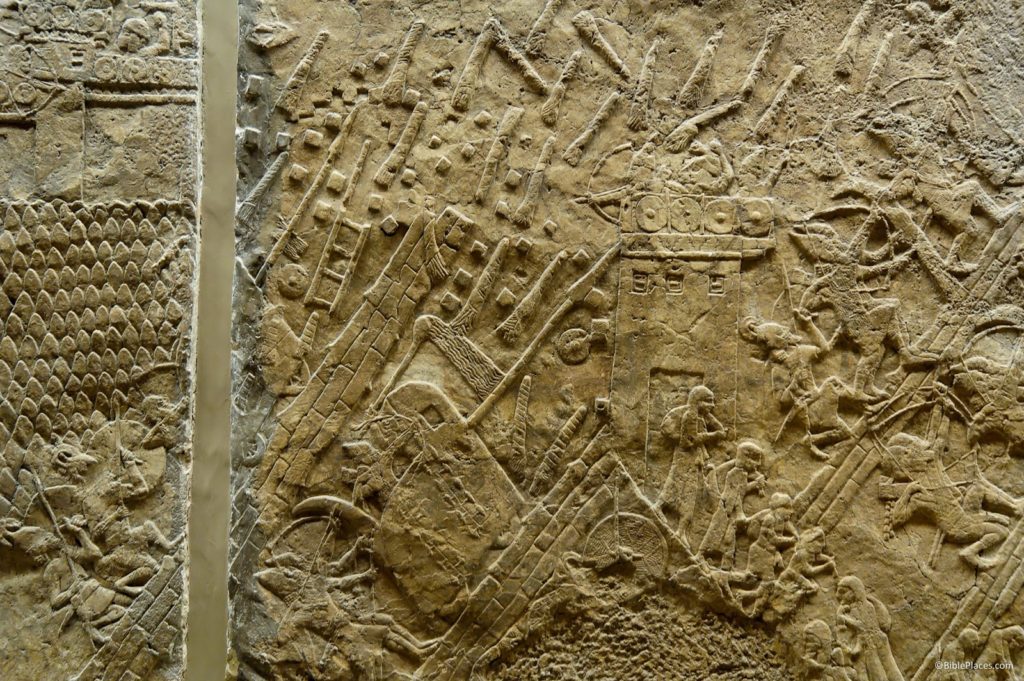
Relief from Sennacherib’s palace in Nineveh depicting
the Assyrian siege of Lachish in the reign of Hezekiah.
Share:
(Post by A.D. Riddle)

We have been following the journey of the “Roads of Arabia” exhibition since its opening in 2011. (Previous posts can be seen here, here, and here.) It is now being shown at the Museum of Fine Arts, Houston, TX, until March 9. An article in the Houston Chronicle describes the exhibit and provides hi-resolution images of some of the highlights. Further information can be found at the Museum of Fine Arts website and at the Roads of Arabia exhibition website.

Roads of Arabia: Archaeology and History of the Kingdom of Saudi Arabia examines the impact of ancient trade routes that traversed the Arabian Peninsula, carrying precious frankincense and myrrh to Mesopotamia and the Greco-Roman world and allowing for a vibrant exchange of both objects and ideas. With the later rise of Islam, pilgrimage roads converged on Mecca and gradually replaced the well-traveled incense roads.

This unparalleled exhibition features objects excavated from more than 10 archaeological sites throughout the peninsula. Among the works on view are alabaster bowls and fragile glassware, heavy gold earrings, and monumental statues. These objects testify to the lively mercantile and cultural exchange between the Arabs and their neighbors, including the Egyptians, Syrians, Babylonians, and Greco-Romans.

The surprising discoveries on display in Roads of Arabia open a new window onto the culture and economy of this ancient civilization. The unprecedented assembly made its U.S. debut at the Smithsonian Institution’s Arthur M. Sackler Gallery in 2012 before traveling to the Carnegie Museum of Natural History in Pittsburgh. An earlier version of the show was exhibited in Barcelona, Berlin, Paris, and Saint Petersburg.

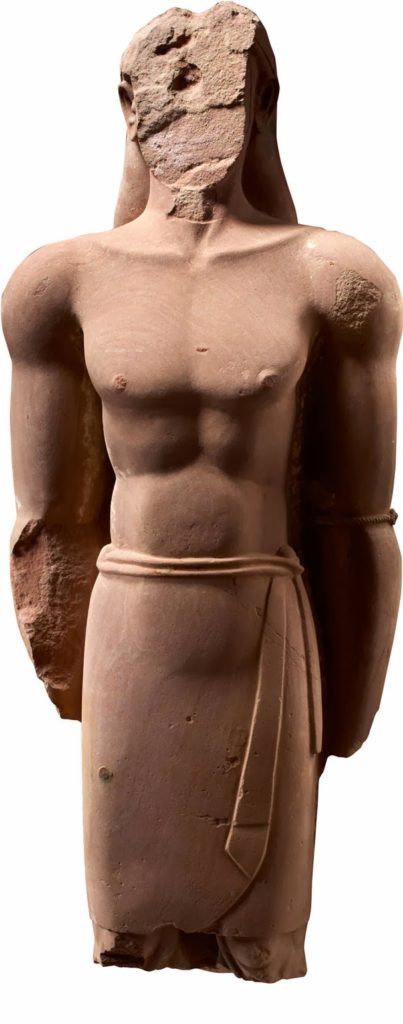
 Sandstone statue of Lihyanite ruler from Al-Ula.
4th-3rd centuries B.C.
Share:
(Post by A.D. Riddle)

January 8, Wednesday, 7:00 pm

The Oriental Institute of the University of Chicago presents a lecture by Hartmut Kühn on “The Collapse of the Assyrian Empire and the Evidence of Dur-Katlimmu.” The event begins at 7:00pm. Registration is free and can be completed here.

The collapse of the Assyrian Empire was the prelude to the end of the Mesopotamian domination of the Ancient Near East in 539 BC to be followed by the Persian hegemony. The metropolitan core region of Assyria laid waste, as is known from extensive excavations in the Assyrian capitals; neither the Babylonian nor the Median successors cared for a reconstruction program. But how did the Assyrian home provinces survive the collapse? This poorly known chapter of history is now elucidated by the long term excavations at Tell Sheikh Hamad (Syria), the Assyrian provincial centre of Dur-Katlimmu. In historiography long thought to have vanished, the Assyrians prove to have lived on, as the archaeological evidence unmistakably demonstrates.

January 18, Saturday, 7:00 pm

The Lanier Theological Library is hosting a lecture by James K. Hoffmeier and Stephen O. Moshier on “Moses Did Not Sleep Here! A Critical Look at Some Sensational Exodus and Mt. Sinai Theories.” Go here for more information and to register for the free event.

Over the past 10-15 years there have been a number of sensational ideas advanced for where and how the Red Sea crossing occurred as the Hebrews departed Egypt and where Mt. Sinai is located. Many of these are known from popular TV programs on the History, Learning, Discovery and National Geographic Channels. Some of these theories, such as the one that has the Israelites crossing the Gulf of Aqaba and landing in Saudi Arabia will be examined biblically, archaeologically (Hoffmeier) and geologically (Moshier). Was Mt. Sinai a volcano? Is there any basis for identifying Mt. Sinai with the traditional site, Gebel Musa? These and other questions will be treated, using film clips, slides and maps.

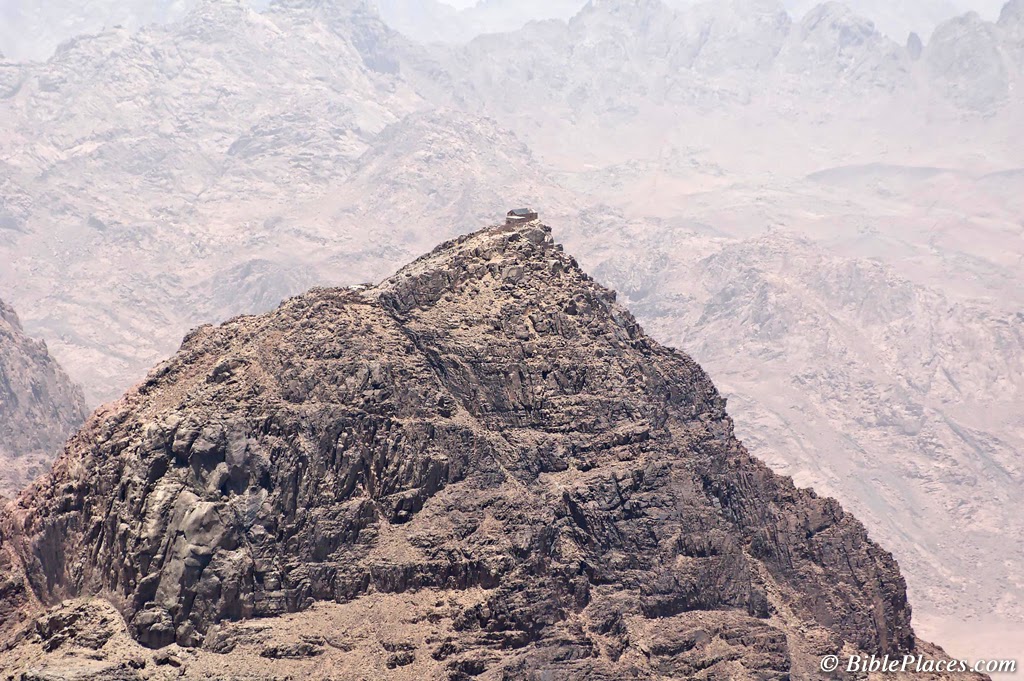
 Jebel Musa, traditional Mt. Sinai.


Share:
(Post by A.D. Riddle)

About four years ago, we were happy to see the arrival of Barry Beitzel’s revised atlas, The New Moody Atlas of the Bible.

And now, this year, the atlas has been translated into Dutch, Italian, and German—for those who know a missionary, a mother-in-law who does not speak English, an overseas pen-pal, or a graduate student who has to learn foreign languages. (This list is not exhaustive. Some humor is intended.)

The newest translation which just appeared is the German Großer Atlas zur Bibel for €49,95. (Note that the link is to Amazon Germany, not Amazon USA.)

For the Dutch speaker/reader in your life, there is De grote Bijbelatlas for €35,28. (Note that the link is to Amazon Germany, not Amazon USA.)

For those seeking Italian, there is Nuovo atlante biblico (we could not find a link for ordering).

In the coming months, we have heard that the atlas will also be translated into Spanish, Portuguese, Korean, and Chinese.

Share:
(Post by A.D. Riddle)

Accordance Bible Software has been one of the best Bible software packages for Mac users for almost 20 years. Today, Accordance announced the release of Accordance for Windows.

Native Code 

Accordance for Windows is fully native and does not require the use of an emulator. Our developers also chose not to use a compatibility layer, even though this would make it much easier to code for multiple platforms. Instead, Accordance for Windows is based entirely on native Windows code to ensure that Windows users experience the same speed and reliability that Mac users have enjoyed for almost 20 years. 

Fast & Efficient 

While we are on the topic of speed, Accordance for Windows is fast. Really fast. Even complex Greek and Hebrew searches deliver results that feel instantaneous. Even better, you do not need to buy a brand new computer with maxed out specs in order to experience this speed because Accordance for Windows is an efficient program that will not bog down your system. 

Backwards Compatible 

Accordance runs on many different versions of Windows. The full compatibility list includes Windows 8 (including the Surface Pro tablet), Windows 7, Windows Vista, and Windows XP. 

Universal License 

All you need is one Accordance 10 license to run Accordance on up to five separate Windows, Mac, or iOS devices. If you already own Accordance 10 for Mac, no additional purchase is necessary to run Accordance 10 on your Windows PC. Just download the app, enter your user name and password, and begin downloading your Accordance modules.

The link takes you to videos about the Windows software and its features, as well as a FAQ.

Accordance offers six packages (Starter, Bible Study, Original Languages, Essential, Advanced, and Ultimate) which range in price from $49.99 up to $1,999.99.

We take advantage of this opportunity also to remind readers that two volumes from the Historic Views of the Holy Land collection are available in Accordance: “Views That Have Vanished: The Photographs of David Bivin” and “The American Colony Collection.”

Share: