(Post by A.D. Riddle)

We are a little late getting to this, but it might be of interest to some. Back on September 18, 2014, Trinity Evangelical Divinity School held a dedication service for a Torah scroll that was gifted to the school. The scroll originated in Germany and dates to the late 1400s or early 1500s. The sign presently displayed with the Torah states:

The Trinity Ashkenazi Torah Scroll
An extraordinary, generous gift from the Ken and Barbara Larson Family

This spectacular Ashkenazi Torah from Germany dates between the late 15th and early 16th century A.D. (roughly around the time of Martin Luther). The scroll’s pagination and orthography clearly indicate this date, while its style, the preparation of its skins and its ink all clearly indicate a German provenance. Such a date makes it among the earliest 2% of surviving German Torah scrolls. It has been used continuously for nearly 500 years and survived the Nazi Holocaust, the most horrific chapter in Jewish history.
It is approximately 100 feet long and is written in columns of 59 lines throughout. It contains numerous fascinating orthographic features encountered in medieval scrolls that were repressed by the rabbis around 1600 A.D. The Torah is filled with elegant magna letters, small or raised letters, dotted letters and inverted nuns—all related to early Jewish scribal traditions.

The official announcement of the dedication contains a few more details about the scroll, and a report written afterwards includes even more description as well as photos of the event.

  • The scroll is valued at over $400,000.
  • The scroll has indented punch marks (tropes) above words and letters to aid in pronunciation and cantillation. This feature is more typical of Yemeni Jewish scrolls.
  • The scroll was constructed from over 60 calf skins.
  • It contains corrections, crossed-out words, and later repairs to the parchment.
  • The scroll was copied and used in Germany, survived the Nazi Holocaust, and was later transported to Israel.
  • There are plans to create a digital replica of the scroll. 

Here are two photos of the Trinity Ashkenazi Torah Scroll.


The scroll is open to Deuteronomy 5. The lines that are spaced differently near the top of the center column are the 10 Commandments.


Close-up of Deuteronomy 6:4 in the Trinity Ashkenazi Torah Scroll. Notice the extra large letters which mark the first and last words of the verse. The white patch is newer parchment used to repair the original.

Bethel University received a similar gift earlier in the year (herehere, and here).

UPDATE (December 20, 2015): As of early December 2015, Ken and Barbara Larson have donated Torah scrolls to 16 schools. The list below is as complete as I could make it, but it is missing two schools.

  1. Bethel University (March 31, 2014)
  2. Multnomah University (September 4, 2014)
  3. Trinity Evangelical Divinity School (September 18, 2014)
  4. The Master’s Seminary (September 30, 2014)
  5. Veritas Evangelical Seminary (November 8, 2014)
  6. Wheaton College (November 18, 2014)
  7. Southwestern Baptist Theological Seminary (December 3, 2014)
  8. Dallas Theological Seminary (December 5, 2014)
  9. Trinity Western University (February 2, 2015)
  10. Western Seminary, Portland (February 6, 2015)
  11. Denver Seminary (April 20, 2015)
  12. Liberty University School of Divinity (September 28, 2015)
  13. Baptist Missionary Association Theological Seminary – Arkansas (October 30, 2015; the announcement said BMATS was the 15th school to receive a Torah scroll)
  14. Moody Bible Institute (December 2, 2015; the announcement said 15 other schools had received Torah scrolls)
Share:
(Post by A.D. Riddle)


The “Roads of Arabia” exhibition ends its U.S. tour on January 18, 2015, at the Asian Art Museum in San Francisco. The website does not indicate any further venues for the exhibition, so this might be the last chance to see it. Here are some of our posts about it on this blog (from most recent to earliest):

Roads of Arabia Volume in PDF (July 02, 2014) [The pdf is still available as far as we can tell]
Roads of Arabia Exhibition (June 24, 2014)
Roads of Arabia in Houston (January 08, 2014)
Roads of Arabia Exhibition: Update (April 23, 2013)
Museums and Cultural Heritage (April 05, 2011)
Archaeology of Saudi Arabia (February 27, 2011)

The official website of the “Roads of Arabia” exhibition is online here. I did not notice before that the site has a downloadable “Roads of Arabia Bibliography” at the bottom of this page (direct link). This looks like a helpful resource to have on hand. The first two items of the bibliography are exhibition catalogs. The first of these can be downloaded at the link given above. The second one looks very similar to the first catalog, but it is not exactly the same. Poking around online, I was able to locate a few of the individual chapters. These appear to have better quality images than the full-volume pdf.

The Nelson-Atkins Museum of Art also has a downloadable bibliography related to the exhibition. 
Share:
(Post by A.D. Riddle)


I recently discovered a mapping resource hosted by the University of Arkansas, the CORONA Atlas of the Middle East. The CORONA Atlas is not a brand new website (it was reviewed in 2012), but it says it is still in BETA stage. Simply put, the CORONA Atlas of the Middle East overlays CORONA satellite imagery over Google Earth imagery.

What is CORONA imagery?

During the Cold War, CORONA was a codename for one of the United States’ top-secret satellite missions created to capture high-resolution imagery. The first mission was launched into space in 1960, and the program continued until 1972. The imagery was declassified in 1995, making it available to the public.

What is the value of CORONA imagery?

From the CORONA Atlas of the Middle East:

In regions like the Middle East, CORONA imagery is particularly important for archaeology because urban development, agricultural intensification, and reservoir construction over the past several decades have obscured or destroyed countless archaeological sites and other ancient features such as roads and canals. These sites are often clearly visible on CORONA imagery, enabling researchers to map sites that have been lost and to discover many that have never before been documented. 

For example, in 1998, James Hoffmeier and his team were able to locate additional sections of Egypt’s east frontier canal in northern Sinai thanks to CORONA imagery.


What has the University of Arkansas done with the imagery?

First, even though CORONA imagery is in the public domain, there are costs associated with digitization of the original film and acquisition of the files. The University of Arkansas has purchased much of this imagery and made it available for researchers. Second, the University of Arkansas corrected the spatial geometry of the photos for distortion (orthorectification) and has positioned the imagery in real geographic space (georectification). This allows the CORONA Atlas to overlay the CORONA imagery on top of other imagery that is positioned in the same geographic space.

How can the CORONA Atlas of the Middle East be used?

Recently, I was trying to locate the site of Samsat in Turkey. Samsat is believed to be ancient Kummuḫ, capital of a Neo-Hittite kingdom by the same name. (In the Hellenistic period, it was replaced by the kingdom of Commagene.) The problem with finding Samsat today, however, is that it now lies at that bottom of Lake Atatürk Dam. It is very hard to find a tell in a lake. The Atatürk Dam was built on the Euphrates River and was completed in 1990. The reservoir flooded the valley of the Euphrates River and its tributaries, and the lake today covers approximately 320 square miles. The CORONA Atlas of the Middle East allows me to see Samsat (and the Euphrates River) before it was submerged, and to locate it with precision in Google Earth, because you can adjust the transparency of the CORONA imagery. The CORONA atlas also has tools for measuring, obtaining coordinates, and capturing imagery for other uses.

Here is a comparison of images taken from the CORONA Atlas of the Middle East. On the left is the Google Earth imagery, in the center is the CORONA imagery with some transparency over Google Earth, and on the right is the CORONA imagery.

The tell of Samsat is located in the center of the right photograph. Here is a close-up.

Head on over and poke around. It took my internet service several moments to load imagery, so it may require you to have a little patience.

Share:
(Post by A.D. Riddle)


On Tuesday, September 16, Trinity Evangelical Divinity School in Deerfield, IL will present the fall lecture in its “Trinity Biblical and Ancient Near Eastern Archaeology Lecture Series.” William M. Schniedewind (UCLA) will speak on the topic “Early Hebrew Scribes — When Israel Began to Write.” The lecture begins at 7:00 p.m. and will take place in Hinkson Hall, Rodine Building. The event is free and open to the public.
Share:
(Post by A.D. Riddle)

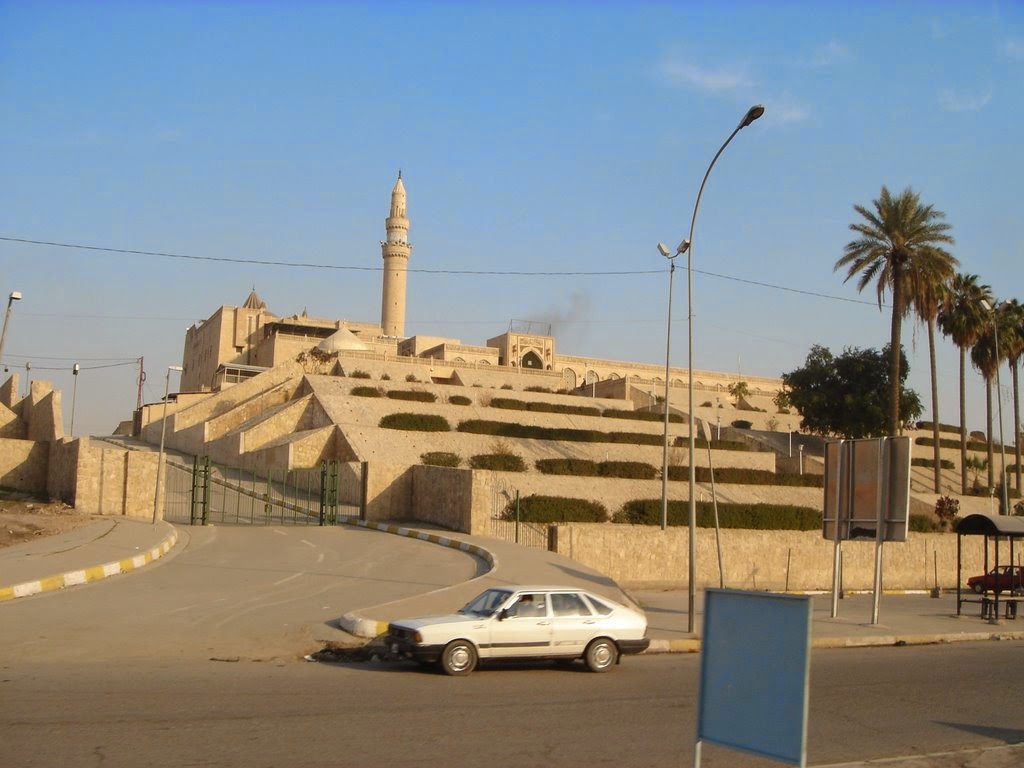
According to Iraqi News, ISIL/ISIS terrorists destroyed what is believed by some to be the tomb of the prophet Jonah. The mosque and tomb are located in modern Mosul, Iraq on Tell Nebi Yunus (Arabic for Prophet Jonah).

The elements of ISIL controlled the mosque of the Prophet Younis in Mosul since they invaded the city…there is almost certain information stating the fact that the elements of ISIL dug up the grave of the Prophet Younis.


That is not the only thing they have destroyed…

They torched 11 churches and monasteries out of 35 scattered across the city of Mosul, and hours later destroyed statues of poets, literary and historical figures of which Mosul has long been proud.


The full article with photographs and video is here.
Tell Nebi Yunis in Mosul, Iraq.
(Photo from Panoramio).
About 50 years or so after Jonah, Sennacherib (704-681 B.C.) enlarged Nineveh and made it his capital. The walls were 7.5 miles in circumference, had 15 gates, and enclosed two mounds: Tell Kuyunjik and Tell Nebi Yunus. Here is a map of the Assyrian heartland, and here is a map of Nineveh in the time of Sennacherib.
We wrote another piece about a shrine in Lebanon which commemorates the location where the fish spit Jonah out. You can read that here.
Share:
(Post by A.D. Riddle)

In response to a post last week in which we mentioned the book Roads of Arabia: Archaeology and History of the Kingdom of Saudi Arabia, Harry Orenstein has alerted us to the existence of a pdf of the volume. The file (22.2 MB) can be downloaded from the website of the Saudi Commission for Tourism and Antiquities using the last link on this page. It is a pdf of the English version of Roads of Arabia. The quality of the images has been degraded, so the pdf does not replace the printed book, but it does make the volume searchable and much easier to move around.

There are a few other documents as well. Here are direct links to each:

Share: