In the summer excavations of Eilat Mazar south of the Temple Mount, two collections of gold and silver were discovered, including one golden medallion depicting a menorah, shofar and Torah scroll.
From the press release:
A third-generation archaeologist working at the Hebrew University’s Institute of Archaeology, Dr. Mazar directs excavations on the City of David’s summit and at the Temple Mount’s southern wall. Calling the find “a breathtaking, once-in-a-lifetime discovery,” Dr. Mazar said: “We have been making significant finds from the First Temple Period in this area, a much earlier time in Jerusalem’s history, so discovering a golden seven-branched Menorah from the seventh century CE at the foot of the Temple Mount was a complete surprise.”
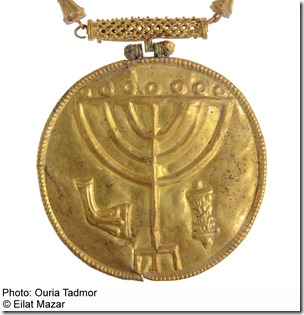
Golden medallion with depiction of menorah, shofar, and Torah scroll
The discovery was unearthed just five days into Mazar’s latest phase of the Ophel excavations, and can be dated to the late Byzantine period (early seventh century CE).
The gold treasure was discovered in a ruined Byzantine public structure a mere 50 meters from the Temple Mount’s southern wall.
The menorah, a candelabrum with seven branches that was used in the Temple, is the national symbol of the state of Israel and reflects the historical presence of Jews in the area. The position of the items as they were discovered indicates that one bundle was carefully hidden underground while the second bundle was apparently abandoned in haste and scattered across the floor.
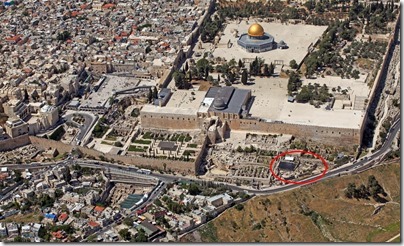
View of Jerusalem’s Temple Mount from the south, with area of discovery marked. Photo by Ouria Tadmor.
Given the date of the items and the manner in which they were found, Mazar estimates they were abandoned in the context of the Persian conquest of Jerusalem in 614 CE.
After the Persians conquered Jerusalem, many Jews returned to the city and formed the majority of its population, hoping for political and religious freedom. But as Persian power waned, instead of forming an alliance with the Jews, the Persians sought the support of Christians and ultimately allowed them to expel the Jews from Jerusalem.
Hanging from a gold chain, the menorah medallion is most likely an ornament for a Torah scroll. In that case it is the earliest Torah scroll ornament found in archaeological excavations to date. It was buried in a small depression in the floor, along with a smaller gold medallion, two pendants, a gold coil and a silver clasp, all of which are believed to be Torah scroll ornamentations.
“It would appear that the most likely explanation is that the Ophel cache was earmarked as a contribution toward the building of a new synagogue, at a location that is near the Temple Mount,” said Dr. Mazar. “What is certain is that their mission, whatever it was, was unsuccessful. The treasure was abandoned, and its owners could never return to collect it.”
The Ophel cache is only the third collection of gold coins to be found in archaeological excavations in Jerusalem, said Lior Sandberg, numismatics specialist at the Institute of Archaeology. “The thirty-six gold coins can be dated to the reigns of different Byzantine emperors, ranging from the middle of the fourth century CE to the early seventh century CE,” said Sandberg.
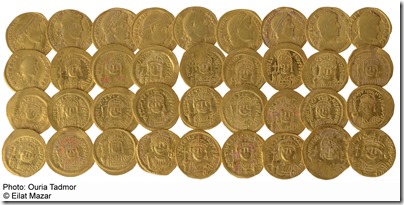
36 gold coins from the Byzantine period
Found with the coins were a pair of large gold earrings, a gold-plated silver hexagonal prism and a silver ingot. Remnants of fabric indicated that these items were once packaged in a cloth purse similar to the bundle that contained the menorah medallion.
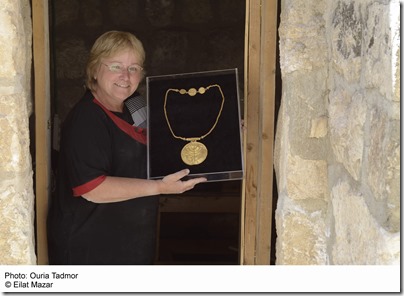
Archaeologist Eilat Mazar holding medallion affixed to necklace
The finds are also announced on a rather dramatic 2-minute video.
The story is reported by the Jerusalem Post, Haaretz, Ynetnews, and many others.
The Trumpet has an exclusive interview with Eilat Mazar.


