“An impressive section of Jerusalem’s fortification wall from the second century BCE has been uncovered on the grounds of the Tower of David complex in the Old City.” About 130 feet of the “First Wall” has been uncovered in the Kishle.

Archaeologists have found evidence for the famous battle at Bet Zecharia described in 1 Maccabees. “It is the first time we have possible archaeological evidence from one of Judah Maccabee’s battlefields.”

A scholar believes that he has cracked Cryptic B, a rare alphabet known only from two uses in the Dead Sea Scrolls.

Coins previously believed to sloppy versions of coins minted by Alexander Jannaeus should instead be understood as coming from the economically weak era of the Hasmonean civil war between 60 and 40 BC.

Hartebeests went extinct in Israel not in the Iron Age but in the Byzantine period.

Doron Spielman spoke about some of his experiences in the City of David at a recent event in Jerusalem.

On Digging for Truth, Scott Stripling explains the archaeology that is related to Hanukkah.

On the Biblical World podcast, Kyle Keimer talks with David deSilva about his two new archaeology books.

Dig has released a 27-minute video about Labayu of Shechem.

The foundation stone of the Pontifical Biblical Institute in Jerusalem was laid 100 years ago.

A powerful winter storm caused death and destruction all over Israel this week.

New release: The Archaeology of the Kingdom of Judah, by Yosef Garfinkel (SBL Press, $75)

You can now purchase soil from the Temple Mount.

Jerusalem University College will be presenting its 6th annual online seminar on January 10. The “Geography and the Bible” seminar is free and will include four sessions:

  • “Road Systems from Egypt through Sinai,” by James Hoffmeier
  • “Trekking from the Desert to the Land of Milk and Honey,” by Hélène Dallaire
  • “What Does it Mean that Jerusalem was ‘Built as a City which is Compact Together?’ A Geographical and Archaeological Reading of Psalm 122:3,” by Chandler Collins
  • “The Early Church’s Encounter with the Roman Imperial Cult,” by Carl Rasmussen

There is no hat tip (HT) below to Gordon Franz, because Gordon died on November 22. I met Gordon when studying at IHLS in the early 90s, and we stayed in touch over the years, including a tour he gave my family of NYC. Gordon taught for various schools over the years, including the Israel and Turkey/Greece/Rome programs for the Talbot School of Theology.  Most recently Gordon sent me stories for these roundups, and in the last email he wrote me, he said he was on his way to buy Rabbi Landy’s latest book. He was quite the book connoisseur. And he had much yet he planned to accomplish. Some of Gordon’s writings are still available on his website. A recording of his celebration of life service is online. He will be missed.
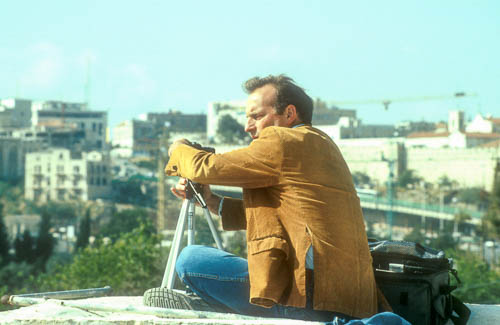
Gordon Franz taking photos from the rooftop of the Institute of Holy Land Studies in Jerusalem, 1993

HT: Agade, Ted Weis, Keith Keyser, Arne Halbakken, Alexander Schick, Explorator

Share:

A new study using two radiocarbon dates puts Ahmose’s reign later than previously believed and places the Thera eruption 60-90 years earlier.

New excavations in Pompeii reveal that some slaves ate better than ordinary people.

A cuneiform tablet dating to the end of the 4th millennium BC was discovered at the Sumerian city of Niĝin (Tell Zurghul).

Archaeologists working at Blaundus in western Turkey have discovered a Roman stadium, temple, and more.

The Luwian Studies Foundation has published an up-to-date map of Luwian sites from the Middle and Late Bronze Ages.

“A pioneering robotic system is set to revolutionise the painstaking task of reassembling Pompeii’s ancient Roman frescoes.”

Iraq is planning a $14 million renovation of the ancient city of Ur.

New release in open-access: The Social Context of Writing Practices in Late Bronze Age Ugarit, by Philip J. Boyes (Oxbow, £50; open-access)

A one-minute BBC video explains that the reason why Roman buildings last for millennia is the type of concrete they used.

Tickets to the Louvre are increasing sharply for non-Europeans.

HT: Agade, Joseph Lauer, Explorator, Baruch Kvasnica, Paleojudaica, Wayne Stiles

Share:

Archaeologists have found remains of a royal palace on the northwestern slope of Alexandrium (Sartaba).

“Israel’s Civil Administration says it seized dozens of archaeological artifacts from a site north of Ramallah in Area B today and transferred them to the Museum of the Good Samaritan archaeological site in Area C.”

The top three reports in biblical archaeology last month were “about an Early Bronze Age winepress, a Late Bronze Age site, and Iron Age trade.”

Bryan Windle is on Digging for Truth to discuss the identity of the Magi.

Josephus Christianus is a new research project devoted “to studying the reception of Flavius Josephus’ works within the Greek Christian tradition from the second to fifteenth centuries CE.”

Online course from the Biblical Archaeology Society: “The Arameans and the Bible,” taught by K. Lawson Younger Jr., Feb 3 to March 12 ($319)

Westminster Books is the first I’ve seen to have available the Lexham Geographic Commentary on the Historical Books, Volume 1: Joshua-Ruth, edited by Barry J. Beitzel ($34). They also have the set of the four available volumes on sale ($130). Amazon will have the book next week ($38).

HT: Agade, Alexander Schick, Ted Weis

Share:

A discovery at Tanis indicates that Shoshenq III was buried not in his own tomb but in an unmarked sarcophagus in Osorkon II’s tomb.

“Researchers in Istanbul have confirmed the existence of an underwater copper mine near Heybeliada (Greek: Χάλκη, Latinized: Halki) island, providing rare archaeological evidence for a description recorded by Aristotle more than 2,300 years ago.”

Excavations in Tunisia have uncovered the second largest Roman olive oil mill in the Roman empire.

A monumental staircase leading to nowhere may give evidence that a large villa in Pompeii had a viewing tower.

Alex Joffe writes about the use of animal dung as fuel in ancient Mesopotamia.

Zoom lecture on Dec 9: “From Pasargadae to Neyrīz, ca. 500 BCE: The View from the Persepolis Fortification Archive,” by Rhyne King

Students who climbed onto the roof of a temple of Apollo in Cyprus have been criticized.

Mick Boersma, a longtime professor at Talbot School of Theology and faithful friend to me and this ministry, is with the Savior he loved so much and served so well.

HT: Agade, Explorator, Paleojudaica

Share:

“A new geological and archaeological study has mapped dozens of ancient stone quarries hidden beneath today’s Jerusalem.” You can find the underlying article and map here.

Aren Maeir notes that more announcements are forthcoming related to the Pool of Siloam excavations.

An elaborate Byzantine mosaic discovered west of Beersheba has been conserved and relocated and is now on public display.

In part 3 of his series on the latest research on Jericho, Bryan Windle shows that the pottery discovered at the site indicates that Jericho was inhabited at the time of Joshua’s conquest.

“The ancient Jewish prutah of Hasmonean Judaea and the modern American penny share far more than their diminutive size and copper heritage; they reflect timeless tensions between intrinsic value, symbolic meaning, and practical utility.”

Hybrid lecture at the Museum of the Bible on Dec 7: “Explore the Sacred Symbolism of the Magdala Stone,” by Marcela Zapata-Meza ($15-40)

Hybrid lecture at the Albright on Dec 15: “Our Life in Light: Ancient Lamps, Faith, and Festivals of Illumination,” by Benyamin Storchan

Zoom lecture on Dec 10: “Building God’s House: Synagogues, Churches, and Intercommunal Relations in Late Antique Palestine,” by Zeev Weiss

“A new initiative using the National Library of Israel’s digital Hebrew manuscript database will enable automatic transcription of the entire Cairo Genizah, making the world’s largest trove of medieval Jewish texts searchable and accessible worldwide.”

“The Lord’s Prayer” feature film released this week. This new website has links to the trailer, the movie, the book, and how you can get involved. (I watched it last night, and it is one jaw-dropping scene after another.)

William Varner, a long-time colleague, and David Hegg, the senior pastor at the church where both Will and I serve, have just released Matthew’s Messiah: His Jewish Life and Ministry, an exposition of the Gospel with special focus on the Jewish backgrounds. This study has been a passion of Dr. Varner’s for many years, and the full-color volume is illustrated with many of my photographs. I haven’t seen it yet, but I’m told the book is beautiful. Here is a link to the book on Amazon, but the publisher has a lower price right now.

HT: Agade, Joseph Lauer, Andy Cook, Explorator

Share:

A Roman sarcophagus was discovered in Hungary, “untouched by looters and sealed for centuries … with its stone lid still fixed in place, secured by metal clamps and molten lead.”

Five theatrical mask reliefs have been discovered during excavations in the theater area of Kastabala, an ancient city in Osmaniye, southern Türkiye.”

Excavations at Ugarit have resumed after a 14-year hiatus.

Remember the Jordan Lead Codices? A new scientific analysis provides some answers about their dating. (James Davila gives some background.)

“A stunning replica of an ancient trireme will be displayed as the centerpiece of the new Greek Underwater Archaeology Museum” in Piraeus, opening next year.

The Dead Sea Scrolls exhibition opens at The Museum of the Bible this weekend. “The exhibition will feature biblical texts and scrolls from the community at Qumran, as well as hundreds of artifacts that reveal details about life and Judaism during the Second Temple period.”

“More than 40 precious artifacts from the Church of the Holy Sepulchre in Jerusalem are currently on display at the Frick in New York City.”

The Metropolitan Museum of Art just launched a virtual reality tour of the 1st-century BC Egyptian Temple of Dendur.

New release: Assur 2024: Continuing the Excavations in the New Town and Other Research across the Site, edited by Karen Radner and Andrea Squitieri. Exploring Assur 2. (PeWe-Verlag; 59 €; open-access)

New release: Excavating Ancient Egypt: Fifty Years of Archaeological Memories, by Jeffrey Spencer (Archaeopress; £16-£32)

In the latest episode on the Biblical World podcast, Mary Buck explains the importance of the Achaemenid Empire, including figures like Cyrus and Darius.

HT: Agade, Arne Halbakken, Alexander Schick, Gordon Franz, Ted Weis, Explorator

Share: