A rare cache of gold and silver items dated to 3,600 years ago has been found at Tel Gezer, including figurines of the Canaanite counterparts of the Akkadian deities Ishtar, goddess of fertility, sex, love and war; and Sin, god of the moon.”

An arsonist apparently set the fire that damaged Absalom’s Pillar and the Cave of Jehoshaphat in Jerusalem’s Kidron Valley. Ynetnews has a brief video.

Nir Hasson reports on the recent study that dates the Gihon Spring fortifications to the 9th century instead of the Middle Bronze Age.

A group of swimmers swam across the Dead Sea to draw attention to the lake’s declining condition.

A unique Chalcolithic wall painting with an 8-pointed star is on display in Jerusalem for the first time since it was discovered at Teleilat Ghassul in the 1930s.

The Israel Antiquities Authority is launching a three-year expedition to discover more Dead Sea Scrolls.

A Jerusalem shopkeeper is clashing with the IAA over 12th-century antiquities discovered in his store’s expansion.

A Byzantine arch has been discovered near the Cardo of Jerusalem.

Authorities working in Jerusalem’s Cardo plan to recreate 9 Byzantine-era shops and display a number of mosaics reflecting life in that time.

Ferrell Jenkins takes his readers on a tour of the Kishle excavations.

Michael Langlois provides a convenient summary of the Jerusalem Papyrus and why it’s controversial.

Wayne Stiles’s post will convince you that En Gedi is worth a (prolonged) visit.

After ten years away, Guy Stiebel is returning to excavate Masada.

Peter Flint, a Dead Sea Scrolls scholar, has died.

HT: Joseph Lauer, Charles Savelle, Agade, Ted Weis

Share:
(Post by A.D. Riddle)

Ralph Hawkins has announced a new excavation to be undertaken at the site of Khirbet el-Mastarah in the Jordan River Valley. The inaugural season will be June 3-30, 2017, and they are looking for volunteers. The dig is part of the newly launched Jordan Valley Excavation Project, co-directed by Ralph Hawkins and David Ben-Shlomo. The project’s website provides further information along with this description.

The Jordan Valley Excavation Project (JVEP) was launched in 2016 to investigate the ancient history and archaeology of the region of the southern Jordan Valley, with a particular focus on the Iron Age. This period is traditionally connected with a period of tribal settlement in the region, followed by the rise of ethnic states. A thorough survey of the region, conducted by Adam Zertal, revealed a dramatic population shift in this region during the transition from the Late Bronze Age to the beginning of the Iron Age (around 1200 B.C.E.). Whereas there were only seven sites in the region in the Late Bronze Age (1550-1200 B.C.E.), fifty-four new sites were founded at the beginning of the Iron Age. Zertal proposed that the eastern sites are slightly earlier than the western ones, a phenomenon he attributed to the movements of peoples, whom he identified with the Tribe of Manasseh, from the Transjordan westwards. JVEP’s goals are to test the date and character of some of the sites in the region, as well as Zertal’s interpretations, through archaeological excavation and research. JVEP will conduct excavations at two sample sites, beginning with Khirbet el-Mastarah, in the eastern part of the region, where at least three years of excavation will be conducted. After that, an additional site will be chosen in the western part of the region, which will likewise be excavated for several seasons. The evidence from these (possibly) single-period sites may shed a great deal of light on the settlement of the tribal peoples living in the region during the Iron Age.
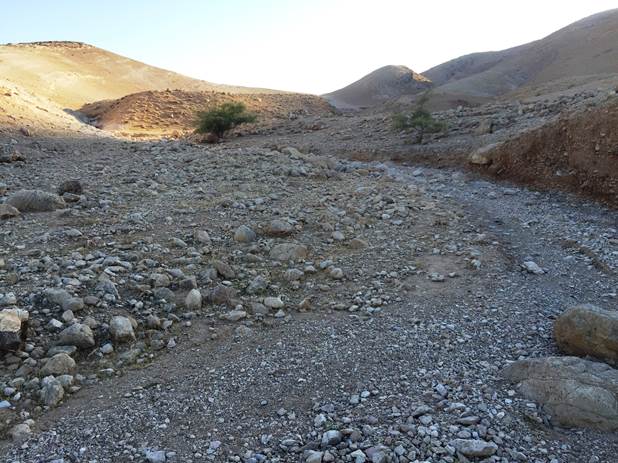
Khirbet el-Mastarah is the low mound illuminated by sunlight behind the tree.
Photo from jvep.org.

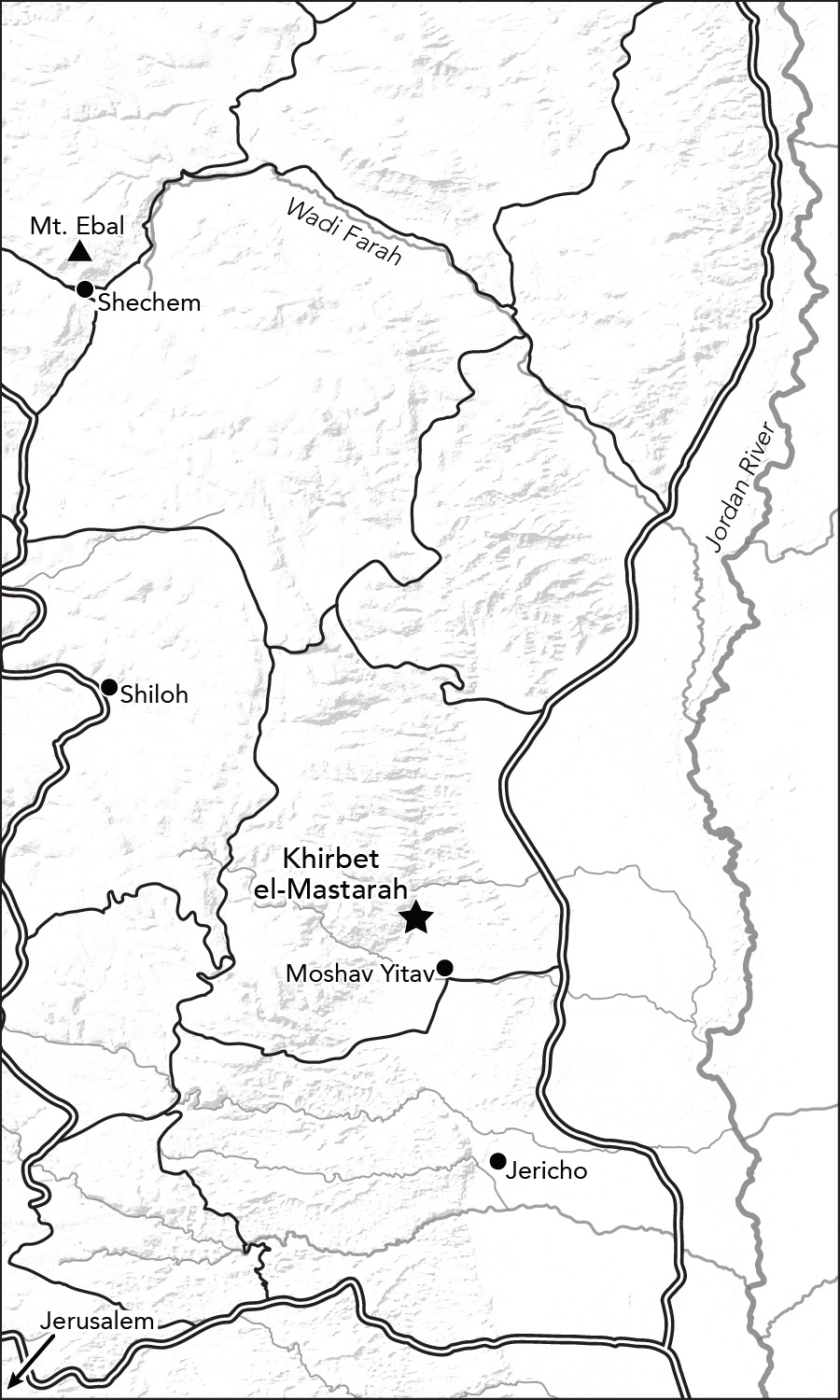
Map showing location of Khirbet el-Mastarah relative to Jericho and Shechem.

As mentioned in the project description, this region was surveyed by Adam Zertal. Four out of five planned volumes of the survey were published in Hebrew before his death just over one year ago, and three of these have been translated into English:

Zertal, Adam.
  2004  The Manasseh Hill Country Survey, Volume 1: The Shechem Syncline. Culture and History of the Ancient Near East 21.1. Leiden: Brill.
  2007 The Manasseh Hill Country Survey, Volume 2: The Eastern Valleys and the Fringes of the Desert. Culture and History of the Ancient Near East 21.2. Leiden: Brill.

Zertal, Adam, and Nivi Mirkam.
  2016  The Manasseh Hill Country Survey, Volume 3: From Nahal ʿIron to Nahal Shechem. Culture and History of the Ancient Near East 21.3. Leiden: Brill.

Some preliminary reports on two Iron Age sites were published by Zertal in the below articles.
Zertal, Adam, and Dror Ben-Yosef.
2009     “Bedhat esh-Shaʿab: An Iron Age I Enclosure in the Jordan Valley.” Pp. 517-529 in Exploring the Longue Durée: Essays in Honor of Lawrence E. Stager. Ed. J. D. Schloen. Winona Lake: Eisenbrauns.

Zertal, Adam; Dror Ben-Yosef; Oren Cohen; and Ron Beʾeri.
2009 “Kh. ʿAujah el-Foqa (North) — An Iron Age Fortified City in the Jordan Valley.” Palestine Exploration Quarterly 141/2: 104–123.

UPDATE: The Jordan Valley Excavation Project also has a Facebook page.
Share:

Teenagers working in an excavation in Galilee discovered a rare gold coin from the 8th century.


The New York Times has a story on the recent exposure of the burial bed inside Church of the Holy Sepulcher. Carl Rasmussen found some unique photos of the excavations here.

With the release of the editio princeps, Christopher Rollston has posted some more thoughts on the (possibly forged) Jerusalem Papyrus. The IAA is defending the inscription’s authenticity. Shmuel Ahituv is interviewed on Rejuvenation podcast.

Israel HaYom looks at early Muslim sources that acknowledge the Jewish history of the Temple Mount.

Shem Tov Sasson shares his experience of the first day of a new excavation at Tel Kedesh.

Ynet runs a story on the Qeiyafa exhibition at the Bible Lands Museum in Jerusalem. Haaretz has a similar story.

King University in Tennessee is hosting a conference on Nov 13-14 entitled, “What’s Going on with Biblical Archaeology?

Timothy P. Harrison shares an appreciation of the life and work of John S. Holladay Jr.

TouristIsrael recommends five unique places to stay in Israel.

Wayne Stiles provides an interesting overview of Nazareth past and present.

Excavations on Mount Zion this summer uncovered a destruction layer from a Crusader battle in Jerusalem in AD 1153.

Accordance 12 was released this week, along with a new free version called Accordance Lite.

Upgrades are also very affordable.

HT: Joseph Lauer, Agade, Charles Savelle, Mark Hoffman

Share:

National Geographic has posted a new article on the continuing excavation of the traditional tomb of Jesus. The team was allowed 60 hours of study before they had to reseal the area.

When the marble cladding was first removed on the night of October 26, an initial inspection by the conservation team from the National Technical University of Athens showed only a layer of fill material underneath. However, as researchers continued their nonstop work over the course of 60 hours, another marble slab with a cross carved into its surface was exposed. By the night of October 28, just hours before the tomb was to be resealed, the original limestone burial bed was revealed intact.
[…]
During the past few days, the burial bed has been resealed in its original marble cladding and may not be exposed again for centuries or even millennia. “The architectural conservation which we are implementing is intended to last forever,” says Moropoulou. Before it was resealed, however, extensive documentation was performed on the surface of the rock.
[…]
“The surfaces of the rock must be looked at with the greatest care, I mean minutely, for traces of graffiti,” Biddle says, citing other tombs in the area that must have been of considerable importance because they are covered with crosses and inscriptions painted and scratched onto the rock surfaces.
“The issue of the graffiti is absolutely crucial,” Biddle says. “We know that there are at least half a dozen other rock-cut tombs below various parts of the church. So why did Bishop Eusebius identify this tomb as the tomb of Christ? He doesn’t say, and we don’t know. I don’t myself think Eusebius got it wrong—he was a very good scholar—so there probably is evidence if only it is looked for.”

The full article includes several photos.

HT: Ted Weis

Share:

Wayne Stiles explores the 8 (present) and 12 (future) gates of Jerusalem.

Ferrell Jenkins shares some beautiful photos and helpful information about the Citadel of David in Jerusalem.

David Hansen provides an introduction to the significance of biblical geography that could be useful in many Bible classes. Note, in particular, the two important questions he suggests.

Jennifer Ristine, coordinator of the Visitors Center at Magdala, provides an explanation of the various symbols on the Magdala Stone.

Bryant Wood is on The Book and the Spade this week talking about “The Conquest and Archaeology.”

A 1500-year-old copy of the Ten Commandments is being auctioned off by the Living Torah Museum. There’s more here.

The Toledo Museum of Art is selling part of its Egyptian collection.

Five Dead Sea Scroll fragments have been put up for sale.

On November 15 in London, Sotheby’s is auctioning rare and early photo albums of the Holy Land,
including a rare hand-coloured subscriber’s copy of David Roberts’s Holy Land and Egypt.

HT: Joseph Lauer, Steven Anderson, Agade, Charles Savelle, Ted Weis, Paleojudaica

Share:

“For the first time in centuries, scientists have exposed the original surface of what Christians traditionally believe to be Jesus’s tomb in Jerusalem’s Church of the Holy Sepulchre, as part of a restoration project.” National Geographic has a video and photos. Justin Taylor interviews Leen Ritmeyer about the specifics of Jesus’s tomb as known from the biblical record and archaeology. The first-ever artifacts discovered in situ from the time of the First Temple have been unveiled in Jerusalem. Haaretz’s story includes a photo of a structure that was revealed. The protective cover of an enormous mosaic in Hisham’s palace in Jericho was removed for a day in advance of the construction of a protective roof. Excavations have begun in the Umayyad palace at Khirbat Al-Minya on the northwestern shore of the Sea of Galilee. Ancient tombs were discovered north of the Old City of Jerusalem during recent road maintenance. Aren Maeir suspects that the Jerusalem Papyrus may be fake. An ancient Muslim inscription indicates that the original name of the Dome of the Rock was the “House of the Temple.” The TMSP blog comments on some of the reports at this week’s conference on the Archaeology of Jerusalem, including notice of a new study that the spring house over the Gihon in the City of David dates not to the Middle Bronze Age but to the 9th century BC. The Mount of Olives cemetery was ranked #8 on Bloomberg’s list of most beautiful burial sites in the world. HT: Joseph Lauer, Steven Anderson, Agade, Charles Savelle, Ted Weis, Paleojudaica

Share: