(Post by A.D. Riddle)


The site of Khirbet Bal’ama (or Belameh) is identified with ancient Ibleam, mentioned in the account of Jehu’s coup d’état (2 Kings 9:27) as well as in Thutmosis III’s topographical list at Karnak. Khirbet Bal’ama is located on the southern outskirts of Jenin, in the West Bank. The ancient ruins occupy some 9 hectares (22 acres) on top of a 160-foot-high (50 m), natural limestone hill. A walled town existed in the Early Bronze, Middle Bronze, end of Late Bronze/early Iron I, and possibly Iron II Ages.

 Khirbet Bal’ama from east.

The main spring was located at the northeast foot of the hill. Here, early explorers visited the entrance to a water system, though because of bats and debris/wash only a small part of a tunnel could be accessed. About the first 100 feet (30 m) of the tunnel were described in great detail by Gottlieb Schumacher in 1910, and it was excavated in 1973 on a small-scale by Z. Yeivin. The main excavation of the tunnel took place in 1996 and 1997 under the direction of Hamdan Taha.

(Excavations were also conducted on top of the hill, but publication is still forthcoming.) The location of the tunnel is marked in green on this site plan.

Site plan of Khirbet Bal’ama. (Taha and van der Kooij 2007: 15)

What raised my interest in this were reports the last two years of the water system outside Al-Walaja, near Bethlehem. In three seasons, the excavators at Khirbet Bal’ama cleared a total of 380 feet (115 m) of tunnel, but since they did not reach a shaft-entrance at the top of the hill, they suspect a long section of tunnel remains to be explored. Of the tunnel sections which were excavated, archaeologists discovered three entrances to the tunnel, the lowest of which provides access to the cistern/spring of Bir es-Sinjil (or Sinjib). The photo below shows the lowest entrance. The stairs with metal handrails on the right lead up to the second entrance.

Lowest tunnel entrance at the cistern/spring of Bir es-Sinjil.

The tunnel was apparently constructed in the Iron Age, though this is based largely on inference rather than clear, direct evidence. It was secondarily used in the Hellenistic and Roman periods. The cistern/spring was in use all the way up to the modern period. Nearly all of the explored tunnel is rock-cut. The tunnel has a parabolic ceiling between 10 and 16 feet high (3-5 m), and there are 57 rock-cut steps and lamp niches in the walls. The plan below shows the three entrances, steps, and slope of the tunnel. The three excavated entrances are approximately equidistant from one another, with about 100 feet (30 m) of tunnel between them.

Khirbet Bal’ama tunnel plan and section. (Taha and van der Kooij 2007: 18)

I look forward to publication of the excavations conducted on top of hill, and hope for future work to be carried out on the tunnel and the site. The main publication of the tunnel was very difficult for me to locate in the U.S.:

Taha, Hamdan and Gerrit van der Kooij.
2007  The Water Tunnel System at Khirbet Bal’ama. Khirbet Bal’ama Archaeological Project Report of the 1996–2000 Excavations and Surveys, volume II. Ramallah: Ministry of Tourism and Antiquities, Department of Antiquities and Cultural Heritage.

A perhaps more-accessible report can be found in:

Taha, Hamdan.
2000  “Excavation of the Water Tunnel at Khirbet Belameh, 1996-1997.” Pages 1587–1613 in Proceedings of the First International Congress on the Archaeology of the Ancient Near East, Rome, May 18th-23rd 1998. Ed. P. Matthiae and E. Enea, Alessandra. Rome: Università degli studi di Roma “La Sapienza,” Dipartimento di scienze storiche, archeologiche e antropologiche dell’antichità.

Share:
(Post by A.D. Riddle)


A few weeks ago, it was announced that cuneiform texts in the Israel Museum have been added to CDLI, the Cuneiform Digital Library Initiative. I would like to draw attention to two of these inscriptions that should be of interest to teachers and students of the Bible.

The first is the Iran Stele, a limestone stele of Tiglath-pileser III which is preserved in fragments that were found in western Iran. The stele depicts the king and symbols of deities, and the inscription records the king’s annals, including a report that he imposed tribute upon (among others) king Menahem of Samaria (2 Kings 15:19).

Iran Stele of Tiglath-pileser III, Israel Museum

The second is the “Jerusalem Prism” of the Assyrian king Sennacherib. Sennacherib recounts his campaign to Sidon, Philistia, and Judah in 701 B.C. He reports how he defeated the Egyptians at Eltekeh and Tamna (2 Kings 19:9), reinstalled Padi as king of Ekron, and then conquered many of Judah’s towns while confining Hezekiah to Jerusalem like a caged-up bird (2 Kings 18-20).

Sennacherib recorded the account of this campaign on several other prisms and cylinders like this one, such as the Taylor and King Prisms and Rassam Cylinder (British Museum) and the Chicago Prism (Oriental Institute).

Jerusalem Prism of Sennacherib, Israel Museum

Readers may also be interested in the British Museum’s free Image Service, which is not new. Once you search the museum’s online collection for the item in which you have an interest, you will be able to see if there are photographs available. After clicking on the thumbnail, you can enlarge the photo or see if there are “More Views” available. Below the photograph, there should be a link “Image service: Use image.” This link will take you to a page where you can register or sign-in to the Image Service and request the photograph. The website will ask you to select how you intend to use the photograph; options include “Classroom or teaching material” and “Private or professional study or research (without print publication).” Once you submit the request, the photograph will be emailed to you within a day or two. The stated limit is 100 images per month. I successfully requested about a dozen images in one sitting for use in a classroom PowerPoint.

Rosetta Stone, British Museum

Objects one might wish to use in teaching could include: Enuma Elish, Atrahasis, Epic of Gilgamesh, Lachish Reliefs, Rosetta Stone, Black Obelisk, Kurkh Monolith, Taylor Prism, Armana letters, and Lachish letters. One could search for the name of a king from Assyria or Egypt or Rome, or a particular type of object such as coins, lamps, papyri, and so forth.

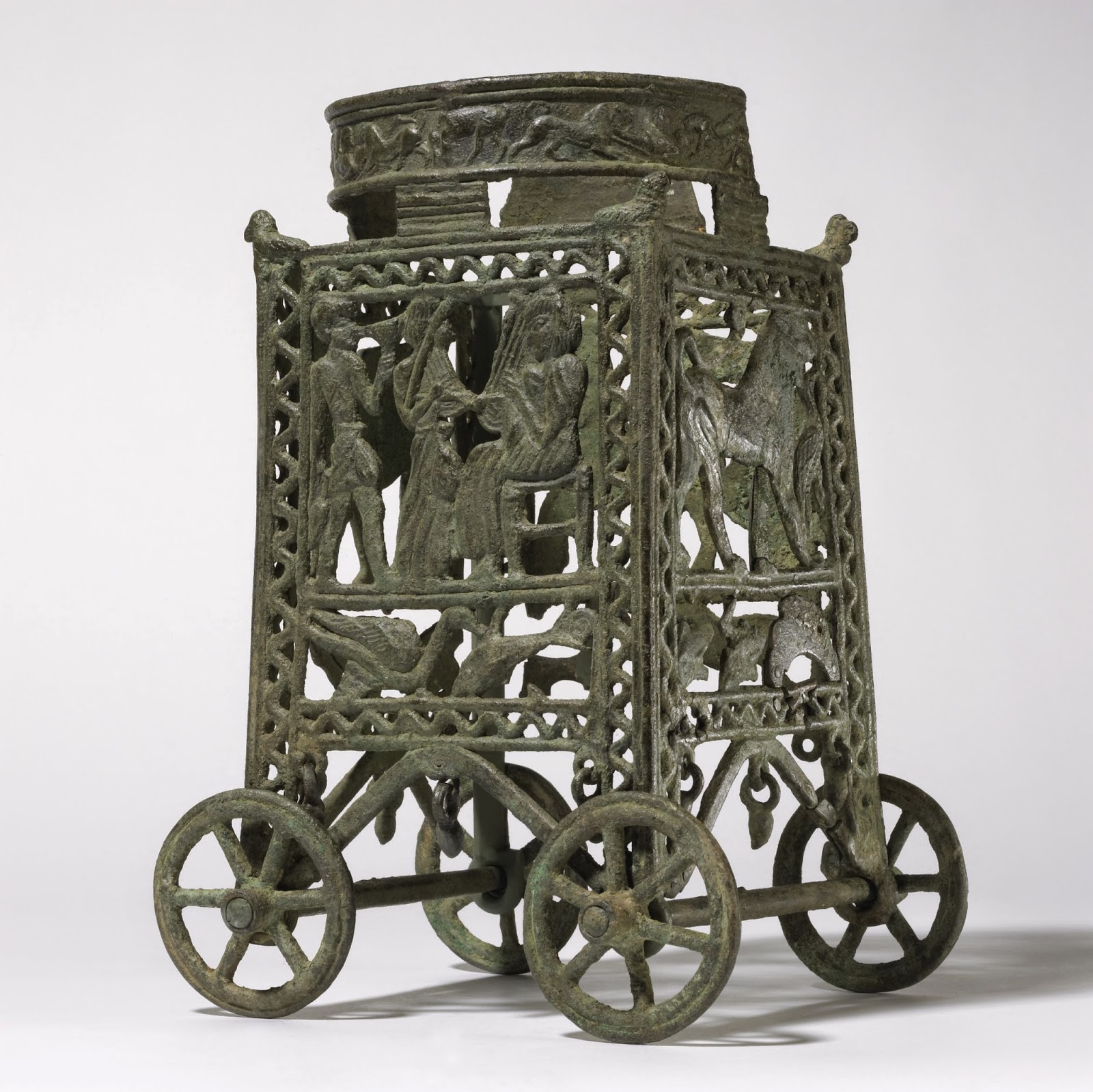
Bronze wheeled stand with sphinx from Cyprus, British Museum

A helpful source to consult as to what kinds of things are to be found in the British Museum that might have relevance for Bible teaching is:

Fant, Clyde E., and Mitchell G. Reddish.
2008  Lost Treasures of the Bible: Understanding the Bible through Archaeological Artifacts in World Museums. Grand Rapids: William B. Eerdmans.

HT: Jack Sasson

Share:

Oxford University Press: “To celebrate National Library Week (April 13th – 19th 2014) and all the hard work librarians do to support their patrons, OUP is freeing up our entire list of online products for one week only!”

UPDATE (4/16): OUP is *not* making available most of the titles listed here. Therefore we have deleted the previous contents of this post. We’re sorry. (See comments below for a reply from OUP.)

Share:

Now online: the video of Eugene Merrill’s recent lecture on “Ai and Old Testament Chronology: Who Cares?

Places of the Passion Week in 360-Degrees – Wayne Stiles shares some new photos.

The ASOR Blog has a series of posts about Passover and Jesus:

Also on the ASOR Blog: 10 Tips for Packing for a Dig

The sale of a Nebuchadnezzar II cylinder set a world auction record.

Now available for Kindle: Hebrew Bible and Greek New Testament with English translation ($6.99)

iPad users can purchase the HebrewBible app here ($9.99).

Happy 6th Blogiversary to BibleX!

HT: Ted Weis

Share:

Leo Depuydt still believes that the “Gospel of Jesus’ Wife” is “hilarious” and “patently fake.” His article in the Harvard Theological Review is online as is Karen King’s response. Some excerpts are given in The Washington Post. Christianity Today runs an interview with Nicholas Perrin of Wheaton College about what it all means.

A fascinating new exhibition will be opening next month at the British Museum on mummies and what we know about them from the latest technology. The changing graphic on the museum website provides a preview. This AP article has more details.

Luxor Times has photos of antiquities recently stolen from the Luxor Temple.

Barry Kemp has posted a report from the latest season of excavations of the Great Aten Temple in
Amarna.

King Tut began his US tour in Kansas City this week. He will be in San Diego in time for the annual meetings.

Some excellent Zondervan e-resources on sale until tomorrow:

The full list is here. The first two are particular favorites of mine. All 5 volumes of ZEB for only $34 is very good, though this resource may be more difficult to use in electronic format than in print form ($121).

HT: G. M. Grena, Jack Sasson

Tell el-Amarna Small Temple of Aten from west, tb010905318
Small Temple of Aten, Tell el-Amarna
Photo from Pictorial Library of Bible Lands
Share:

From the New York Times:

A faded fragment of papyrus known as the “Gospel of Jesus’s Wife,” which caused an uproar when unveiled by a Harvard Divinity School historian in 2012, has been tested by scientists who conclude in a journal published on Thursday that the ink and papyrus are very likely ancient, and not a modern forgery.
Skepticism about the tiny scrap of papyrus has been fierce because it contained a phrase never before seen in any piece of Scripture: “Jesus said to them, ‘My wife…’ ” Too convenient for some, it also contained the words “she will be able to be my disciple,” a clause that inflamed the debate in some churches over whether women should be allowed to be priests.
The papyrus fragment has now been analyzed by professors of electrical engineering, chemistry and biology at Columbia University, Harvard University and the Massachusetts Institute of Technology, who reported that it resembles other ancient papyri from the fourth to the eighth centuries. (Scientists at the University of Arizona, who dated the fragment to centuries before the birth of Jesus, concluded that their results were unreliable.)
The test results do not prove that Jesus had a wife or disciples who were women, only that the fragment is more likely a snippet from an ancient manuscript than a fake, the scholars agree. Karen L. King, the historian at Harvard Divinity School who gave the papyrus its name and fame, has said all along that it should not be regarded as evidence that Jesus married, only that early Christians were actively discussing celibacy, sex, marriage and discipleship.

The full NYT article is here. The Harvard Theological Review article is available for free download here.

An initial radiocarbon analysis dated the fragment to 404–209 BC; a second analysis gave a mean date of AD 741. King concludes with a date in the 7th or 8th centuries AD. As far as being a reliable witness to 1st century events, it is not. The author notes that the fragment should be studied in light of the Muslim view that prophets were usually married.

In King’s reading, “The main point of the GJW fragment is simply to affirm that women who are wives and mothers can be Jesus’s disciples.”

Previous posts about this subject:

Somebody Once Believed Jesus Had a Wife

Articles on Jesus’ Wife

Share: