(Post by Seth M. Rodriquez)

In 1 Corinthians 11:17-34, Paul describes an extremely dysfunctional church event.  When the church gathered to observe the Lord’s Supper, there were divisions and factions (v. 18-19) due to the fact that people were not sharing food with those who were hungry and were eating before the others arrived (vv. 21, 33-34).  What could have possessed them to act in such an unloving way during one of the holiest events in the life of their church?

In his book St. Paul’s Corinth: Texts and Archaeology, Jerome Murphy-O’Connor suggests a historical context which could help explain this passage.  His suggestion centers around the fact that wealthy homes in that culture typically had two public areas: a room just inside the entrance called an atrium and a dining room called a triclinium.

Our picture of the week is an example of an atrium found in one of the houses at Pompeii.  This photo comes from Volume 14 of the revised and expanded version of the Pictorial Library of Bible Lands, which focuses on Italy and Malta. The photo is entitled, “Pompeii House of Sallust Atrium.”  An atrium typically had a a rectangular pool in the center of the room called an impluvium.
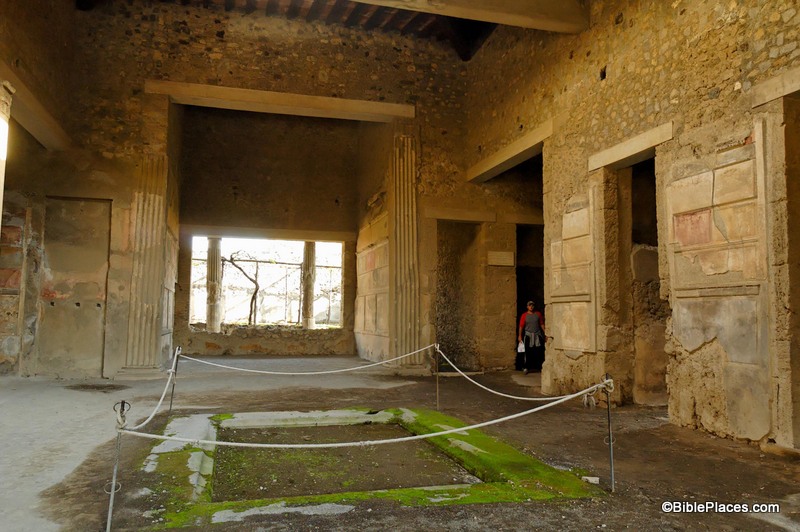
Murphy-O’Connor suggests that part of the problem in the Corinthian church was due to the fact that a small group of the wealthiest church members were invited to dine in the triclinium while the rest of the members had to sit in the atrium.  He explains a hypothetical historical background in the following way:

Private houses were the first centers of church life.  Christianity in the 1st cent. A.D., and for long afterwards, did not have the status of a recognized religion, so there was no question of a public meeting-place, such as the Jewish synagogue. Hence, use had to be made of the only facilities available, namely, the dwellings of families that had become Christian. …

Given the social conditions of the time, it can be assumed that any gathering which involved more than very intimate friends of the family would be limited to the public part of the house …

… [T]he average size of the atrium is 55 sq. meters and that of the triclinium 36 sq. meters.  Not all this area, however, was usable. The effective space in the triclinium was limited by the couches around the walls; the rooms surveyed would not have accommodated more than nine, and this is the usual number …. The impluvium in the center of the atrium would not only have diminished the space by one-ninth, but would also have restricted movement; circulation was possible only around the outside of the square. Thus, the maximum number that the atrium could hold was 50, but this assumes that there were no decorative urns, etc. to take up space, and that everyone stayed in the one place; the true figure would probably be between 30 and 40. …

The mere fact that all could not be accommodated in the triclinium meant that there had to be an overflow into the atrium.  It became imperative for the host to divide his guests into two categories; the first-class believers were invited into the triclinium while the rest stayed outside.  Even a slight knowledge of human nature indicates the criterion used.  The host must have been a wealthy member of the community and so he invited into the triclinium his closest friends among the believers, who would have been of the same social class.  The rest could take their places in the atrium, where conditions were greatly inferior. Those in the triclinium would have reclined, as with the custom … where as those in the atrium were forced to sit ….

The space available made such discrimination unavoidable, but this would not diminish the resentment of those provided with second-class facilities.  Here we see one possible source of the tensions that appear in Paul’s account of the eucharistic liturgy at Corinth (1 Cor 11:17-34).  However, his statement that “one is hungry while another is drunk” (v. 21) suggests that such tensions were probably exacerbated by another factor, namely, the type of food offered. …

The reconstruction is hypothetical, but no scenario has been suggested which so well explains the details of 1 Cor. 11:17-34.  The admonition “wait for one another” (v. 34) means that prolambano in v. 21 necessarily has a temporal connotation; some began to eat before others.  Since these possessed houses with plenty to eat and drink (vv. 22, 34), they came from the wealthy section of the community and might have made a contribution in kind to the community meal. This, they felt, gave them the right to think of it as ‘theirs’ (to idion deiphon).  Reinforced by the Roman custom they would then have considered it their due to appropriate the best portions for themselves. Such selfishness would necessarily include a tendency to take just a little more, so that it might happen that nothing was left for the ‘have-nots’ (v. 22), who in their hunger had to content themselves with the bread and wine provided for the Eucharist.  However, as Paul is at pains to point out, under such conditions no Eucharist is possible (v. 20). 

Excerpt is taken from Jerome Murphy-O’Connor, St. Paul’s Corinth: Texts and Archaeology, Good News Studies, vol. 6 (Wilmington, DE: Michael Glazier, Inc, 1983), 153-161, and can be purchased here. This and other photos of Pompeii are included in Volume 14 of the Pictorial Library of Bible Lands and can be purchased here.  More information on Pompeii and additional photos (including another atrium) can be found on the BiblePlaces website here.

Share:

Streams in the Desert: A 20-second clip from SourceFlix.com

New exhibit at the Oriental Institute Museum: Between Heaven and Earth: Birds in Ancient Egypt,

October 16, 2012-July 28, 2013

The Sea of Galilee is entering fall at a higher level than in six years.

Wayne Stiles: Connecting Cisterns, Rain, and Reading the Bible

Haaretz: Samson follows the sun to Galilee

The date palm growing from a 2,000-year-old seed is shown and discussed on video.

The Mazotos shipwreck is the oldest shipwreck found off Cyprus to date. The vessel sank in 350 BC
with a load of 1,000 amphorae of wine.

Elizabeth Payne, conservator of the Yale Babylonian Collection, is interviewed in the school paper.

HT: Joseph Lauer, Jack Sasson

Share:

From the Jerusalem Post:

On October 9, 1968 a thirteen-year-old girl made history, as she squeezed through a narrow hole into the underground chambers of the Cave of the Patriarchs in Hebron, which the Jews had been forbidden to enter for 700 years under Mamluk, Ottoman, British and Jordanian rule. Jews were only allowed access to the staircase at the southeast of the site, initially only up to the fifth step and later increased to the seventh.
[…]
“On October 9, 1968, my mother asked me if I would agree to climb into a narrow hole that would lead me to a cave,” Arbel wrote in her personal account of the event published on the Hebron website. “After I agreed, my mother told me that it was the Cave of the Patriarchs.”
Arbel recalls how her father later woke her and bundled her into the car “wrapped like a parcel with a blanket over her head” and they made their way to Hebron from their Jerusalem home. When they arrived they stopped at the police for a while and then continued to the cave. “I got out of the car, wrapped in the blanket, and entered the Muslim mosque. I saw the opening that I would need to fit into.” The hole measured 28 centimeters in diameter. Arbel was harnessed with ropes and equipped with a flashlight and matches in order to check the air inside the cave. “They lowered me down onto a pile of paper and money. I found myself in a square room.” She describes seeing three tombstones opposite her, “the middle one adorned and taller than the other two.” Abraham, Isaac, Jacob, Sarah, Rebecca, and Leah are all believed to be buried in the Cave of the Patriarchs.

The story continues here. For more photos and information about Hebron and the Machpelah constructed by King Herod, see here.

HT: Joseph Lauer

Hebron Machpelah, shaft to caves below, tb092204022
Hebron Machpelah. The shaft to the subterranean cave is protected by the green railings. (photo source)
Share:

The Jerusalem Post suggests six tourist attractions you might have missed:

1. Camel Riders—Mamshit

2. Alpaca Farm—Negev Highlands

3. Deer Farm—Gush Etzion

4. Robotic Cowshed—Kfar Yehezkel

5. Hai Park—Kiryat Motzkin

6. Ma’ayan Zvi Fishing Park—Sharon Plain

The full article is here.

Gazelle in Nahal Paran, tb042107595
Gazelle in Nahal Paran.
Photo from
Cultural Images of the Holy Land.
Share:

One of my book sets that was acquired through some measure of trial and tribulation is William Thomson’s The Land and the Book. If you’ve done much reading of ancient customs and how they may illuminate the Bible, then you’ve certainly heard of this three-volume work if you haven’t read it yourself. You also may have enjoyed selections from it if you have The American Colony and Eric Matson Collection that was produced by us and published for Accordance.

Logos Bible Software has put the set in its Community Pricing which gives you the opportunity to get the full text for a low price. (The way that C.P. works is that a single bid of $20 is equal to two bids of $10, so feel free to bid low if you get a friend to join you.)

To give you a sense for some of Thomson’s writings, I opened up a few of the American Colony presentations and started reading. I very quickly found a number of quotes that relate very well to my recent study and teaching in Genesis.

For instance, when I was reading Genesis 18, I was struggling with the timeline. The three men show up “in the heat of the day,” eat a prepared calf, and then walk down to Sodom by evening. Apart from the fact that this makes it very difficult (i.e., impossible) to locate Sodom on the northern side of the Dead Sea, I was wondering how the calf could have been cooked so quickly. Thomson’s experience was helpful.

With the Bedâwin it is nearly universal to cook the meat immediately after it is butchered, and to bake fresh bread for every meal. Visit any Arab sheikh, for example, whose tent is now in the valley below us, and you will witness the entire process. A sheep or calf will be brought and killed before you, thrust instanter into the great caldron which stands ready on the fire to receive it, and, ere you are aware, it will reappear on a large copper tray, with a heap of bûrgûl, cracked wheat, or of boiled rice and leben, sour milk. In Cincinnati, a hog walks into a narrow passage on his own feet, and comes out at the other end bacon, ham, and half a dozen other commodities; at the sheikh’s camp, it is a calf or sheep that walks past you into the caldron, and comes forth a smoking stew for dinner. (2: 205)

Of course, we cannot assume that the way things were in the late 1800s are the way things were more than three thousand years ago. But it is possible that traditional ways were maintained for a long time.

Certainly the practice of killing a choice animal for visitors was similar in Abraham’s day as it was among Arabs in 19th century Palestine.

Not only is this true, but amongst the Bedâwin Arabs the killing of a sheep, calf, or kid in honor of a visitor is required by their laws of hospitality, and the neglect of it is keenly resented. They have a dozen caustic terms of contempt for the sheikh who neglected to honor his guest with the usual dabbîhah, sacrifice, as it is universally called—a name suggestive of the religious rite of hospitality as practiced in ancient times by the patriarchs, and frequently confirmed by a solemn oath and covenant” (2: 205).

I’ll close with one more, this one related to the story of Esau.

In my rambles about the outskirts of the town last evening I lit upon a company of Ishmaelites sitting round a large saucepan, regaling themselves with their dinner. As they said “Tŭfŭddâl”—oblige us—very earnestly, I sat down amongst them, and, doubling some of their bread spoon-fashion, plunged into the saucepan as they did, and found their food very savory indeed. The composition was made of the red kind of lentiles which we examined in the market at Jaffa; and I can readily believe, from the little experience I had of its appetizing fragrance and substantial taste, that to a hungry man it must have been very tempting” (2: 252).

I wouldn’t let that Thomson’s experience take anything away from your disdain for a son who despised the glorious promises of God, but it is certainly valuable to be able to “see” things more clearly.

You can bid on the Logos set here. There’s a free Google version here. There are many used copies available, but they come in abridged and 2-volume formats that can make purchasing confusing. You might also consider one of the volumes in The American Colony Collection, such as the fascinating Traditional Life and Customs. For $20, you get 600 photographs and hundreds of interesting quotations from Thomson and many other early explorers.

Bedouin hospitality, having coffee in sheikh's tent, mat05980

Bedouin hospitality (photo source)
Share:

(Post by Seth M. Rodriquez)

In modern America, olive oil is something that is not given much thought or attention. It is occasionally used while cooking, but many people only encounter it while dining at an Italian restaurant when the waiter makes some available for dipping bread. All in all, it is not important in day-to-day life and we could readily do without it.

However, in biblical times, this was not the case. In fact, the opposite was true. Olive oil was something that was used everyday in every house for a variety of imporant purposes. It was used for cooking as it is today, but also much more. Olive oil was used as a base for purfume (Esth. 2:12) or used to anoint someone’s head to show them honor (1 Sam. 16:13, Luke 7:46). It was used as fuel in clay lamps to provide light (Matt. 25:3-4) even in a holy place such as the Tabernacle (Exod. 27:20). It was used in sacrifices (Exod. 29:40) and for medicinal purposes (Luke 10:34). The reason it became so important was not only because it was so versatile, but also because it was readily abundant in the Mediterranean basin where olive trees flourish. But the question arises, how was this vital product produced? One common process used in antiquity is described below.

For our “picture of the week” we will actually be focusing our attention on three photographs because they complement each other so well. They all come from Volume 13 of the revised and expanded version of the Pictorial Library of Bible Lands, which focuses on Cyprus and Crete. This volume is an entirely new addition to the collection. The previous version of the PLBL had no pictures of either island.

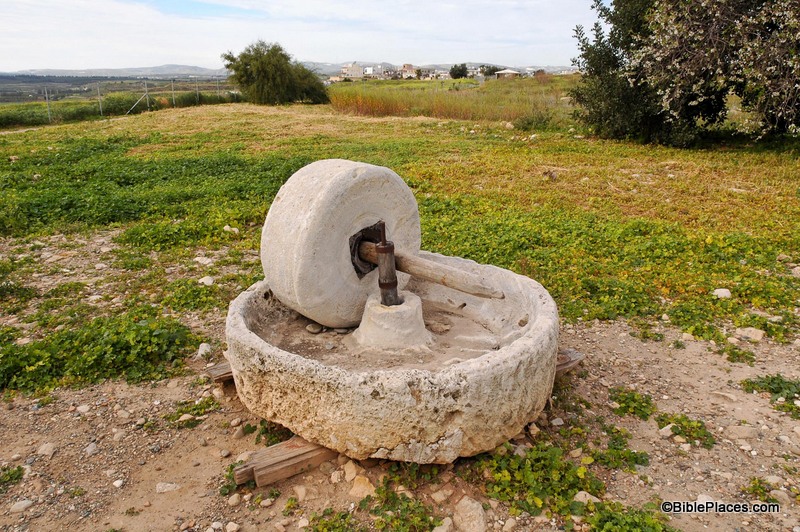
The first photo is entitled “Olive Press at Palaipaphos.” (Click on the photo for a higher resolution.) After the olives had been harvested, this type of press was used to break the olives up and prepare them to be squeezed by a second type of press. The olives would be placed in the bottom of the basin and the round stone would be rolled over them.

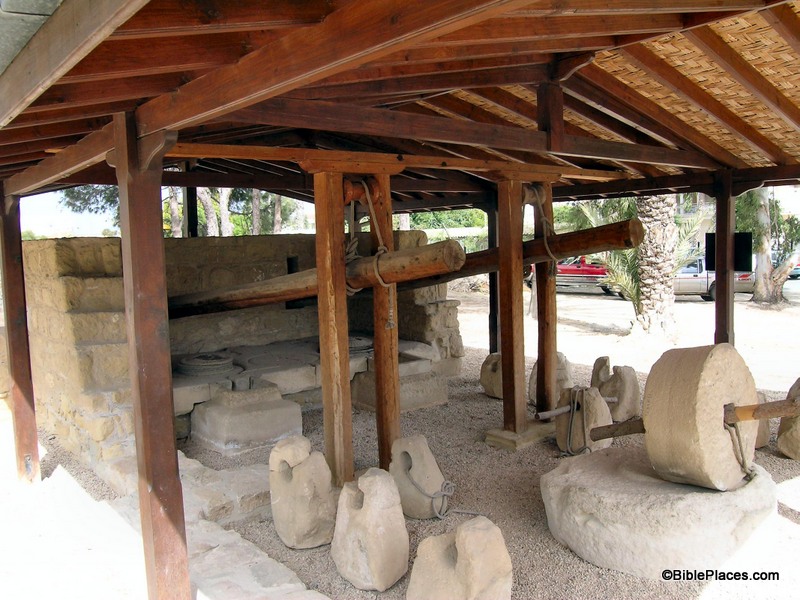
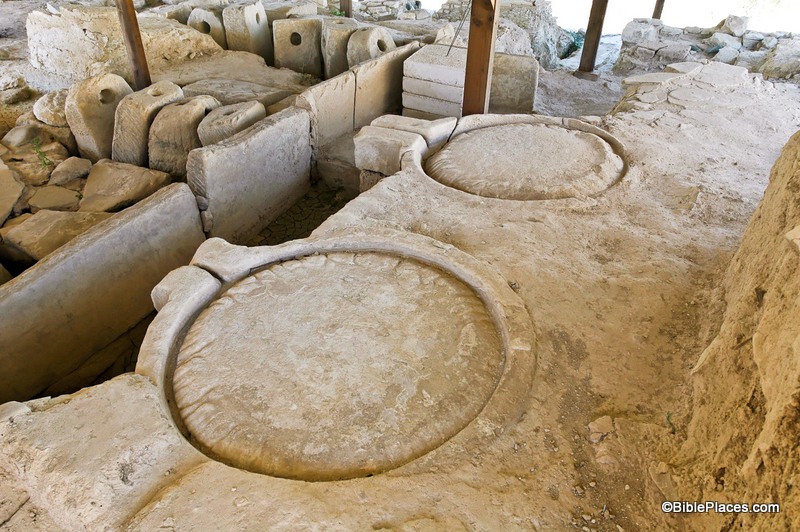
The second and third photos show the type of press used in the second stage of the process. The second photo is entitled “Olive Press at Larnaca Museum,” and the third, “Idalion Olive Press Factory.”

The top picture is a reconstruction of an olive press at a museum in Cyprus and the bottom shows the archaeological remains of the same type of press at the site of Idalion. They both are of the same type of press but are photographed from opposite angles: the round circles in the foreground of the bottom picture are barely visible in the background of the top picture. Placing the pictures side by side, you can get a good idea of how this type of press worked.

After the olives had been broken up, they were placed in flat, circular baskets and laid on top of the stone circles.  Several baskets would be stacked together. The stack would then be pressed using the large wooden beams shown in the top picture. The pressure on the beams would come from the stone weights which can been seen in both of these pictures: the standing stones with holes drilled through their top section. These stones would be tied onto the beam pulling it down and placing pressure on the baskets and the olives, forcing the oil to ooze out. The oil would then drip down onto the stone bench and would be caught by the circular channel which had been cut into the bench. Within the channel, the oil would be funneled into a spout where it would pour into a basin or vessel. From there the oil would be taken and used for a variety of purposes.

These and other photos of Cyprus are included in Volume 13 of the Pictorial Library of Bible Lands and can be purchased here. More information on olives and olive trees can be found on the BiblePlaces website here and at the Life in the Holy Land website here.

Share: