The Fall 2012 Lecture Series of the California Museum of Ancient Art (Beverly Hills) is entitled

“The ‘Exodus’ and Settlement of the Land of Israel: Examining the Literary and Archaeological Evidence.” Four Monday evening lectures are scheduled:

Oct 15, 2012: “The Exodus from Egypt in Biblical Literature and Tradition” by Dr. P. Kyle
McCarter, Jr., Johns Hopkins University

Oct 22, 2012: “The Exodus Narrative — Did it Really Happen? An Egyptologist’s Perspective” by Dr. Donald Redford, Pennsylvania State University

Oct 29, 2012: “The Israel Stela of Pharaoh Merenptah: Earliest Extra-Biblical Reference to Israel” by Dr. Peter Brand, University of Memphis

Nov 5, 2012: “The Settlement of the Hill Country of Canaan around 1200 BCE” by Dr. Robert Mullins, Azusa Pacific University

I do wish they had asked someone to present the biblical view. Whether or not it’s “extremist,” it is at least as defensible as any other view. (If you attend, I’d appreciate knowing if anyone acknowledges the problem of Merneptah Stela.)

Lectures are $22, or $76 for the whole series, payable with a mail-in form and a check. More details about each lecture is available at the website. The recordings will be available on CD and DVD.

HT: G. M. Grena

Wadi Shagg and Jebel Catherine from northwest, tb062005823
The mountains of Sinai (photo source)
Share:

From UrCrowdsource:

Ever wonder if old archaeological excavations were really like they are in the movies?
Find out.
Help us document a 1922-1934 excavation by reading and transcribing letters, field notes, and reports from the dig in southern Iraq.
The site of Ur, one of the earliest cities in the world, was jointly excavated by the British Museum and the University of Pennsylvania Museum for 12 years in the early 20th century. Despite many publications on the site, there is still much to learn. And new digital techniques mean we can get data to researchers more completely and efficiently.
We have a plethora of 90-year-old information to make digitally searchable. And we need help. With thousands of pages of typed letters and reports from the field and thousands more handwritten field notes in need of transcription, one or two research assistants just can’t do the job.

You can sign up and get started here. Ur is mentioned in the Bible four times in connection with Abraham: Genesis 11:28, 31; 15:7; Nehemiah 9:7.

HT: Charles Jones

Ur, Ziggurat from east, mat13196

Ziggurat of Ur from the east
Photo: Library of Congress, Prints & Photographs Division, LC-DIG-matpc-13196
Share:

Three excavation reports were published yesterday by the Israel Antiquities Authority.

In Palmahim, on the coast south of Tel Aviv, archaeologists uncovered a large and unique Chalcolithic cemetery with fourteen circular tombs and six ossuaries.

In Nahariyya, excavations revealed a portion of the Roman road running from Acco to Tyre.

On the west side of Jerusalem, an agricultural farmstead from the Iron, Roman, and Byzantine periods was excavated. The discoveries include three winepresses, a watchman’s hut, three quarries, a couple of caves, and farming terrace walls.

All of the reports include maps, plans, and photographs.

“Chain-type burials” from the Chalcolithic period near Palmahim.
Photo by IAA.
Share:

Acts 14 records an awkward situation that the Apostle Paul found himself in during his first missionary journey:

Now at Lystra there was a man sitting who could not use his feet. He was crippled from birth and had never walked. He listened to Paul speaking. And Paul, looking intently at him and seeing that he had faith to be made well, said in a loud voice, “Stand upright on your feet.” And he sprang up and began walking. And when the crowds saw what Paul had done, they lifted up their voices, saying in Lycaonian, “The gods have come down to us in the likeness of men!” Barnabas they called Zeus, and Paul, Hermes, because he was the chief speaker. And the priest of Zeus, whose temple was at the entrance to the city, brought oxen and garlands to the gates and wanted to offer sacrifice with the crowds. But when the apostles Barnabas and Paul heard of it, they tore their garments and rushed out into the crowd, crying out, “Men, why are you doing these things? We also are men, of like nature with you, and we bring you good news, that you should turn from these vain things to a living God, who made the heaven and the earth and the sea and all that is in them. In past generations he allowed all the nations to walk in their own ways. Yet he did not leave himself without witness, for he did good by giving you rains from heaven and fruitful seasons, satisfying your hearts with food and gladness.” Even with these words they scarcely restrained the people from offering sacrifice to them. (Acts 14:8-18, ESV)

The ancient city of Lystra is located in central Turkey today.  A few pictures of the site can be found in Volume 9 of the Pictorial Library of Bible Lands.  It was a mainly market town and, as can be surmised from this passage, it contained a temple to Zeus.

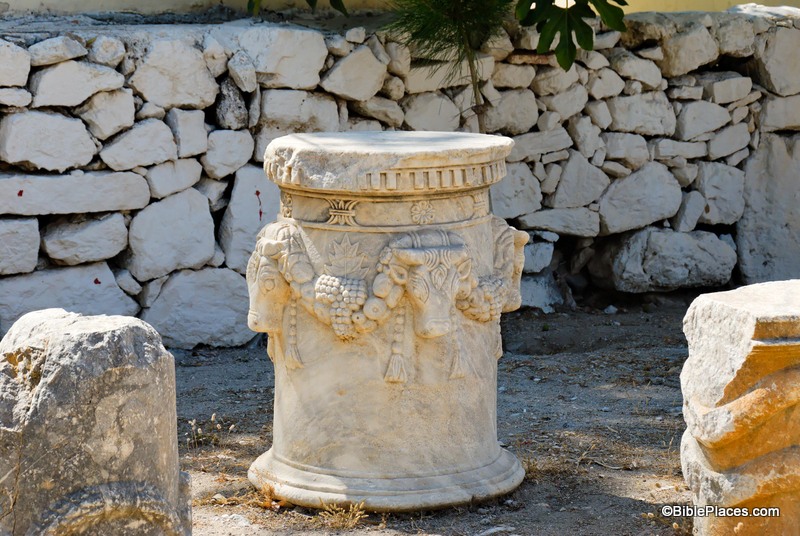
However, our picture of the day comes from Volume 10 of the revised and expanded edition of the PLBL, which focuses on Western Turkey.  The photo is entitled “Cnidus Architectural Fragments, Bull with Garlands” (photo ID #: tb062206733).  This picture illustrates verse 13 (in bold above) which mentions the priest of Zeus bringing “oxen and garlands” so that he could offer sacrifice.  This seems to have been a common practice, not only in Lystra but in several other places as well.  Several carvings of bulls with garlands have been found in this region of the world. 

The picture above is one example of this common architectural motif.  (Click on the picture for a higher resolution.)  This object was found at Cnidus, a city on the western edge of modern Turkey.  It is a fragment of a decorative pillar depicting a bull’s head on each side.  The heads are connected by a garland, and tassels can be seen hanging down on either side of each bull’s head.  Within the garland are clusters of grapes and possibly some other fruit.

At least four examples of this motif can be seen in the PLBL collection:

Volume 9
“Pisidian Antioch stone with bull and garlands, tb010201834”
 
Volume 10
“Cnidus architectural fragments, bull with garlands, tb062206733”
“Ephesus fragment with bull and garlands, tb041405323”
 
Volume 12
“Samos Pythagorio Roman baths fragment with bull and garlands, tb061606256”

Little insights from archaeology such as this can add interest to the retelling of a familiar story and grab the listener’s attention.  Over the last few generations, many societies in the world (including the U.S.) have become extremely visually oriented.  Whether it watching television, going to the movies, or surfing the Internet, much of what people do today is visual.  Pastors and teachers should seek to meet people where they are and use multimedia resources to their advantage to communicate their message.  And similar to Paul and Barnabas, we need to make every effort that our message is not misunderstood.

This and other photos of the Cnidus are included in Volume 10 of the Pictorial Library of Bible Lands and can be purchased here. More information and a photo of Lystra can be found on the BiblePlaces website here.

Share:

Eilat Mazar has resumed excavations in the (so-called) Ophel, and her partners at Armstrong College plan to provide regular updates. They begin with an on-location interview of Mazar.

Excavations continue to reveal Egyptian presence in Joppa from the New Kingdom period.

Mark Fairchild’s search for ancient synagogues in Turkey is profiled in the local press. The article includes an interesting video by Fairchild of his discoveries.

In light of an article in the Wall Street Journal, Charles Savelle reflects on the value of knowing biblical geography.

Ferrell Jenkins is back in Israel and he shares a rare photo of Jacob’s well.

King Tut and his predecessors may have been afflicted with temporal lobe epilepsy.

Did you forget to celebrate the 2000th anniversary of Caligula’s birthday?

Clean-up of the polluted Kishon River is finally scheduled to begin, 12 years after divers were found
to have contracted cancer.

The cedars of Lebanon are threatened by climate change.

As Rosh HaShanah (the New Year) begins in Jewish homes around the world at sundown on Sunday,

Wayne Stiles reflects on the Gezer Calendar and other ways we keep time.

The 50th anniversary of Lawrence of Arabia inspires Anthony Horowitz to travel to Jordan.

HT: Explorator, Jack Sasson
Wadi Rum Jebel el Qattar, df070307712
Wadi Rum. Photo from the Pictorial Library of Bible Lands.
Share:

Southwestern News has a full issue devoted to the Dead Sea Scrolls and the Bible. Published by Southwestern Baptist Theological Seminary, currently hosting an exhibition on the Dead Sea Scrolls, the magazine has some valuable content, including:

  • Historic photographs from the Ecole Biblique collection
  • A description of the current exhibition and how to prepare for a visitswbts-dss
  • A feature of the iScroll kiosks
  • The story of the initial Scrolls discovery (that buys into the lie of the innocent shepherd)
  • “Why the Dead Sea Scrolls Matter”
  • Suggestions for further reading
  • Information on the school’s M.A. and Ph.D. programs in Archaeology and Biblical Studies, including a list of offered classes
  • And more

The issue is available via issuu and may be printed or saved as a pdf file.

HT: Alexander Schick

Share: