En Gedi, the oasis on the western shore of the Dead Sea, may be a more enjoyable place to visit in the future.  From the JPost:

The Ein Gedi stream started flowing on Monday for the first time in 50 years, following an agreement signed in May 2007 between Kibbutz Ein Gedi and the Israel Nature and Parks Authority. The agreement stipulates that the kibbutz must let water flow from the Ein Gedi spring into the stream before drawing it for kibbutz use. The agreement also limits the amount of water that the kibbutz may use, thereby increasing the flow from the spring to the stream. The stream dried up in the 1950s because those developing the kibbutz needed its water for agriculture. After that, until the signing of the agreement, the kibbutz drew water directly from the spring, which was the stream’s source. The Ein Gedi water company also drew from the spring prior to the deal. “We didn’t deal with the principal question of whether the kibbutz needed to get this water,” said Omri Gal, an assistant spokesperson for INPA. “We took as a given that the kibbutz needed that water. Our goal was to lessen the damage to the water. The previous situation was unacceptable, and the stream was a tragedy.” Several months later, after the kibbutz dismantled its water-drawing facilities, water has begun to flow down the stream at a rate of 10 meters per second, a number that should rise to 25 by the time the process is completed. Though the Ein Gedi water, if not drawn, would flow to the Dead Sea, Gal said that its reaching the stream brought tremendous benefit to the surrounding area, as well as to the government agency that protects it. “This is an amazing thing for the environment,” he said. “Ein Gedi is an important natural area. There have been guards working there for 30 years, and for them this is a holiday.”

The story continues here and ends with this line:

“Ein Gedi used to be unique,” said Gal. “We want to revive the flora and bring back the water. It will look like it did in days of old.”

You can read (and see) more about En Gedi at this BiblePlaces page.

Share:

From the JPost:

“This is the worst crisis since records started being kept 80 years ago,” Water Authority head Uri Shani declared Tuesday morning at a special press conference in Tel Aviv. “Like most countries, Israel is dependent on rainfall and the amount of rainfall is decreasing. There is a drop of 100 million cubic meters per year.”
Shani described a situation of increasing damage to Israel’s main natural water sources. The Coastal Aquifer “has dropped below its black line,” which means that it will suffer rapid damage, possibly irreversible damage, Shani said.
The water level in the Mountain Aquifer was currently a meter above its Lower Red Line, but was also expected to reach its bottom limit – the Black Line – by this year. He added that water levels in the aquifers had never been this low.
Shani predicted that Lake Kinneret [Sea of Galilee] would reach its Black Line by December 2008. The Kinneret dropped below its bottom limit on Monday, 213 meters below sea level. The lake’s Black Line is 214.87 meters below sea level.

The story continues here.

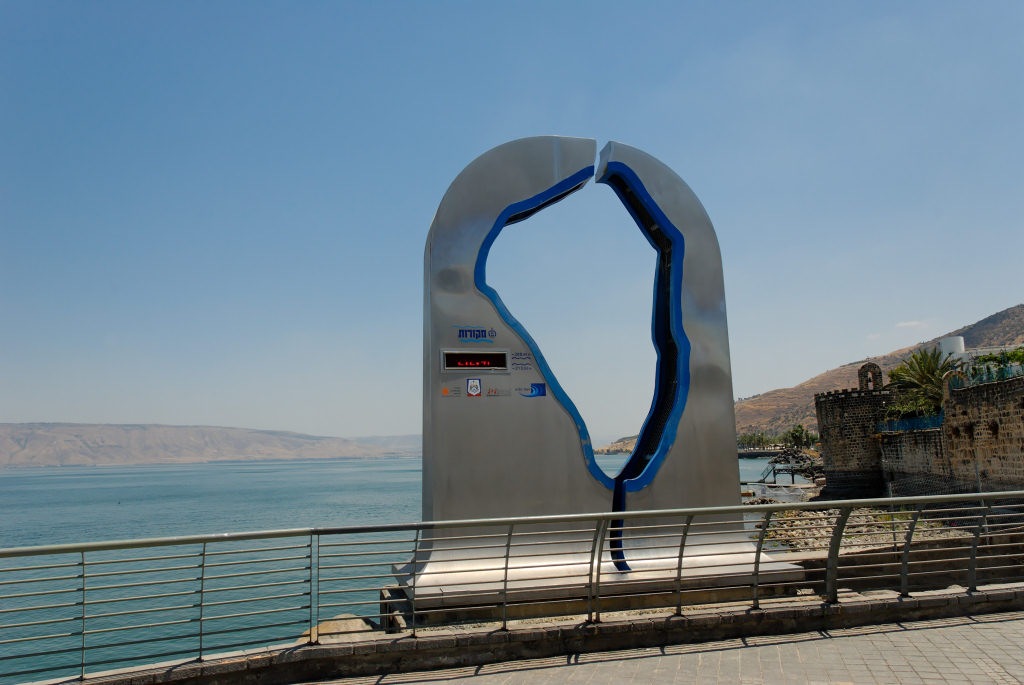
Sea of Galilee water level sign, tb052808512
New sign in Tiberias displays the present water level in the Sea of Galilee, a main source of fresh water for Israel today
Share:

The New York Times publishes an article on old news, Drudge links to it, and suddenly we have a sensational story that will “shake our basic view of Christianity.”  Hold on a minute.

You can read the story in the NY Times, a copy at the International Herald Tribune, Haaretz, World Net Daily, and elsewhere.  You could also have read about it a year ago in Haaretz, or read the article in Biblical Archaeology Review Jan/Feb 2008 issue.  Why is it suddenly “news” now?

You can see photos of it at Haaretz, a large photo here, line drawing and transcription here (pdf), and an English translation here.  You can also read the original journal article published in Cathedra here (in Hebrew; pdf).

Here’s a brief summary:


What: Three-foot tall stone inscribed in ink with 87 lines of Hebrew text describing a vision given by the angel Gabriel


When: The stone was written in the 1st century B.C. and it was discovered 8-10 years ago and sold by a Jordanian antiquities dealer to an Israeli-Swiss antiquities collector.


Where: It was found in the vicinity of the Dead Sea, possibly on the Jordanian side.  Ada Yardeni: “You have got a Dead Sea Scroll on stone.”


Forgery?: Even though this was not uncovered in a legal excavation, scholars believe the inscription to be authentic.


The Sensational Claim: The end of the inscription mentions a messiah who would rise in 3 days.  Since the text was written before Jesus’ resurrection, it explains how the story of Jesus’ resurrection came to be.


The Sensational Quotation: “Resurrection after three days becomes a motif developed before Jesus, which runs contrary to nearly all scholarship. What happens in the New Testament was adopted by Jesus and his followers based on an earlier messiah story” (Israel Knohl, professor of biblical studies at Hebrew University and proponent of this theory). 


The Disputed Reading: “In three days you shall live, I, Gabriel, command you.”


Why Disputed: “There is one problem.  In crucial places of the text there is lack of text. I understand Knohl’s tendency to find there keys to the pre-Christian period, but in two to three crucial lines of text there are a lot of missing words” (Moshe Bar-Asher, president of the Israeli Academy of Hebrew Language and emeritus professor of Hebrew and Aramaic at the Hebrew University).


Why This Matters:

Knohl said that it was less important whether Simon was the messiah of the stone than the fact that it strongly suggested that a savior who died and rose after three days was an established concept at the time of Jesus. He notes that in the Gospels, Jesus makes numerous predictions of his suffering and New Testament scholars say such predictions must have been written in by later followers because there was no such idea present in his day.

In other words, if the disputed reading is correct, this reveals that Jesus and/or his disciples did not create the story of his resurrection after three days, but rather they borrowed it from existing ideas. 

Of course, it is either one or the other: they invented it or stole it.  Here’s a radical idea: Jesus was raised by God from the dead after he had been in the tomb three days.  Jesus expected this, which is why he predicted it.  His disciples remembered it, which is why they recorded it.

The author of this theory, Israel Knohl, says that this stone “should shake our basic view of Christianity.”  Several assumptions are required for this stone to be so significant:

1) Knohl’s disputed reading must be correct;

2) Knohl’s interpretation of the text overall must be correct;

3) Jesus and/or his disciples must have known about this text (or a similar one not yet attested to);

4) Jesus did not rise from the dead;

5) Jesus’ disciples were dishonest in claiming that he did rise from the dead and in attributing this idea to him from another source;

6) Jesus’ disciples were stupid in dying for a lie that they invented.  Altogether, I think that these assumptions are shaky enough to suggest that Knohl is a little too optimistic about the impact of his theory.

UPDATE (7/8): I found the BAR article mentioned above online and added a link.  For today’s articles and analysis on the story, see this post at Paleojudaica.

UPDATE (7/9): I can hardly do better than Paleojudaica with the latest stories, so I will not even try. 

Note his choice for “inflated headline of the week.”
Share:

Ferrell Jenkins has posted about the 4th of July in Israel while excavating at Lachish in 1980.  He also has some interesting photos of the excavators, showing some of today’s leading archaeologists at a younger age.  I remember Gabriel Barkay talking about the visit of the Arab workers that Ferrell witnessed.  He recalled how one day the old workmen and women showed up at the dig site.  They had formerly lived in Qubeibe, a village just north of the tell, but were now living in a refugee camp in Jordan.  Barkay had photos from Starkey’s excavation in the 1930s and the workmen identified themselves.  The town of Qubeibe was leveled by the Israeli military in the 1960s and the stones of the village, probably many taken from the ruins of Lachish, were sold to building contractors.  Who knows but some ancient inscription was unknowing transferred from Lachish to Qubeibe and is now part of a wall in the area?

Share:

Some years ago Zondervan released a educational game on CD called “Get Lost in Jerusalem.”  The goal of the game was to navigate through the Old City of Jerusalem with the help of clues.  shabanMany American students were particularly delighted to find that “home base” in the game is the shop of the famous Shaban (photo at right).  The copyright on the game has now reverted to its creator, Ted Hildebrandt, and he is making it available for free download.  So if you’re hankering for a stroll down the historic narrow alleyways of Christian Quarter, minus the odors, you’re in luck.  You can check out Hildebrandt’s page with the download (and lots more), get more information at Amazon, or take a look at Biblical Studies and Technological Tools to get some helpful instructions before downloading and installing the 550 MB file.

lost
Share:

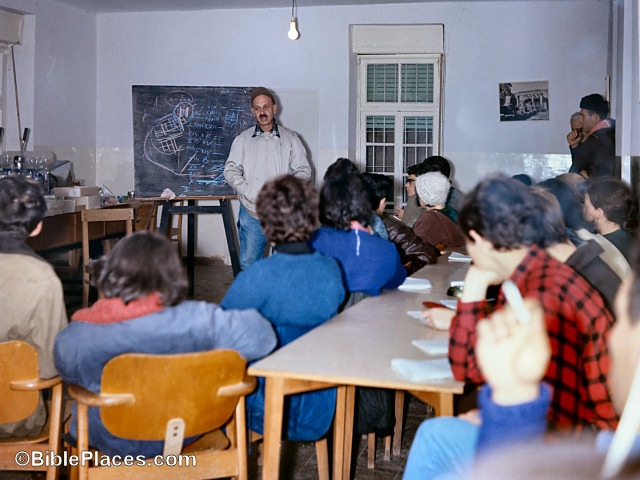
One thing (an important thing) to consider when choosing an excavation to join is the extra-curricular activities. By that I mean the evening lectures and the afternoon or weekend tours. Digging in the dirt is nice, but your experience will be greatly enhanced if you can learn about your site and travel around the area. Having said that, and having looked at the schedule at Gath this season, I would certainly recommend choosing Gath for your excavation next year. Check the schedule out at the Gath blog. A tip to other excavations interested in boosting their number of volunteers for future seasons: put your extra-curricular schedule online. And start a dig blog.

Yigael Yadin lecturing at Megiddo, db6703260103
Yigael Yadin lecturing at Megiddo excavation, 1967from forthcoming photo collection of David Bivin
Share: