Archaeologists working in the City of David have found a necklace pendant depicting the menorah that dates to the Late Byzantine period when Jews were not allowed to enter Jerusalem.

“A rare clay oil lamp from the Hasmonean era was uncovered at the Nebi Samwil archaeological site northwest of Jerusalem on Sunday evening, the first night of Hanukkah.”

The Times of Israel runs a story about the previously reported Assyrian-era tombs in the Jezreel Valley.

David Ramati writes about some of the more recent studies related to Masada.

The Times of Israel explains the importance of the Mount of Olives, including important people buried there and controversy over the building of a visitor center.

“A new computational tool developed at the University of Haifa is changing how archaeologists document and analyze ancient ruins, using drone imagery and machine learning to reveal architectural patterns that cannot be identified from ground level.”

“In an apostolic letter dated December 11, 2025, Pope Leo XIV has placed Christian archaeology at the core of the Church’s intellectual and pastoral mission.”

On The Book and the Spade, Joan Taylor makes a case against Bethlehem being a little town when Jesus was born.

Leon Mauldin shares a panoramic photo of the Sorek Valley and Zorah, taken from Beth Shemesh.

New release: Tel Miqne-Ekron 14/1: Objects and Material Culture Studies: Middle Bronze Age II Through Iron Age II, edited by Seymour (Sy) Gitin (Eisenbrauns, $98 with code NR26)

New release: Tel Nagila: The Amiran/Eitan Excavations, edited by Joe Uziel, David Ilan, Matthew Susnow, and Aren M. Maeir (De Gruyter, $220)

The Hasmonean palaces at Jericho (Tulul Abu el-Alayiq) will be open to visitors tomorrow and Monday, and funds have been allocated to develop the site as a heritage destination in the coming year.

After the IAA moved its headquarters to the new Jay and Jeanie Schottenstein National Campus for the Archaeology of Israel, discussions about the future of the Rockefeller Museum are taking place, including the possibility of turning it into a hotel.

HT: Agade, Alexander Schick, Andy Cook, Ted Weis, Explorator
Italian scientists have confirmed a large underground complex beneath the Giza Plateau using satellite data.

Turkish Archaeological News rounds up the top stories for the month of November.

Reporters were invited to view renovation work in the Pergamon Museum in Berlin. Some areas will reopen in 2027.

The Times of Israel interviewed Thomas Levy in connection with the release of his graphic autobiography.

Ben and Ann Witherington are hosting a tour of Egypt in early 2027.

Appian Way has produced a 7-minute video explaining why the Madaba Map is so important for biblical studies.

New release: Jehu’s Tribute: What Can Biblical Studies Offer Assyriology?, edited by Jeffrey L. Cooley and Rannfrid I. Lasine Thelle (Eisenbrauns, $100, or cheaper at Amazon)

New release: Narrating Archaeological Sites and Places: Fifty Years of the Madaba Plains Project at Tall Hisban, Tall al-‘Umayri, and Tall Jalul, edited by Douglas R. Clark, Øystein S. LaBianca and Randall W. Younker (Equinox, $120; Amazon)

New release: Past Perfect? The Archaeologies of Mandate Palestine 1917-1948, by Raz Kletter (90 euros)

The Biblical Archaeology Society is offering several classes in 2026:

A seminar of Ancient and Medieval Middle East (AMME) at the University of Helsinki will feature two talks on ancient waste:

  • “Trash and Treasure: Con-textualizing Trash at Oxyrhynchus,” by AnneMarie Luijendijk (Zoom)
  • “Down the Drain: What Trash Reveals about Bathing Culture in Late Antique Jerash,” by Louise Blanke (Zoom)

The Ancient Near East Today lists the top archaeological discoveries of the year.

Archaeology Magazine identifies the top 10 discoveries of 2025.

The AP posts drone footage of the Colosseum of Rome.

HT: Agade, Ted Weis, Alexander Schick, Explorator

“An impressive section of Jerusalem’s fortification wall from the second century BCE has been uncovered on the grounds of the Tower of David complex in the Old City.” About 130 feet of the “First Wall” has been uncovered in the Kishle.

Archaeologists have found evidence for the famous battle at Bet Zecharia described in 1 Maccabees. “It is the first time we have possible archaeological evidence from one of Judah Maccabee’s battlefields.”

A scholar believes that he has cracked Cryptic B, a rare alphabet known only from two uses in the Dead Sea Scrolls.

Coins previously believed to sloppy versions of coins minted by Alexander Jannaeus should instead be understood as coming from the economically weak era of the Hasmonean civil war between 60 and 40 BC.

Hartebeests went extinct in Israel not in the Iron Age but in the Byzantine period.

Doron Spielman spoke about some of his experiences in the City of David at a recent event in Jerusalem.

On Digging for Truth, Scott Stripling explains the archaeology that is related to Hanukkah.

On the Biblical World podcast, Kyle Keimer talks with David deSilva about his two new archaeology books.

Dig has released a 27-minute video about Labayu of Shechem.

The foundation stone of the Pontifical Biblical Institute in Jerusalem was laid 100 years ago.

A powerful winter storm caused death and destruction all over Israel this week.

New release: The Archaeology of the Kingdom of Judah, by Yosef Garfinkel (SBL Press, $75)

You can now purchase soil from the Temple Mount.

Jerusalem University College will be presenting its 6th annual online seminar on January 10. The “Geography and the Bible” seminar is free and will include four sessions:

  • “Road Systems from Egypt through Sinai,” by James Hoffmeier
  • “Trekking from the Desert to the Land of Milk and Honey,” by Hélène Dallaire
  • “What Does it Mean that Jerusalem was ‘Built as a City which is Compact Together?’ A Geographical and Archaeological Reading of Psalm 122:3,” by Chandler Collins
  • “The Early Church’s Encounter with the Roman Imperial Cult,” by Carl Rasmussen

There is no hat tip (HT) below to Gordon Franz, because Gordon died on November 22. I met Gordon when studying at IHLS in the early 90s, and we stayed in touch over the years, including a tour he gave my family of NYC. Gordon taught for various schools over the years, including the Israel and Turkey/Greece/Rome programs for the Talbot School of Theology.  Most recently Gordon sent me stories for these roundups, and in the last email he wrote me, he said he was on his way to buy Rabbi Landy’s latest book. He was quite the book connoisseur. And he had much yet he planned to accomplish. Some of Gordon’s writings are still available on his website. A recording of his celebration of life service is online. He will be missed.

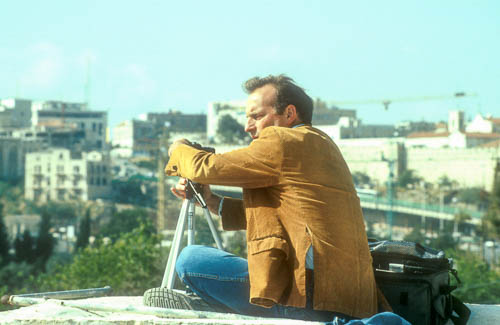
Gordon Franz taking photos from the rooftop of the Institute of Holy Land Studies in Jerusalem, 1993

HT: Agade, Ted Weis, Keith Keyser, Arne Halbakken, Alexander Schick, Explorator

A new study using two radiocarbon dates puts Ahmose’s reign later than previously believed and places the Thera eruption 60-90 years earlier.

New excavations in Pompeii reveal that some slaves ate better than ordinary people.

A cuneiform tablet dating to the end of the 4th millennium BC was discovered at the Sumerian city of Niĝin (Tell Zurghul).

Archaeologists working at Blaundus in western Turkey have discovered a Roman stadium, temple, and more.

The Luwian Studies Foundation has published an up-to-date map of Luwian sites from the Middle and Late Bronze Ages.

“A pioneering robotic system is set to revolutionise the painstaking task of reassembling Pompeii’s ancient Roman frescoes.”

Iraq is planning a $14 million renovation of the ancient city of Ur.

New release in open-access: The Social Context of Writing Practices in Late Bronze Age Ugarit, by Philip J. Boyes (Oxbow, £50; open-access)

A one-minute BBC video explains that the reason why Roman buildings last for millennia is the type of concrete they used.

Tickets to the Louvre are increasing sharply for non-Europeans.

HT: Agade, Joseph Lauer, Explorator, Baruch Kvasnica, Paleojudaica, Wayne Stiles

Archaeologists have found remains of a royal palace on the northwestern slope of Alexandrium (Sartaba).

“Israel’s Civil Administration says it seized dozens of archaeological artifacts from a site north of Ramallah in Area B today and transferred them to the Museum of the Good Samaritan archaeological site in Area C.”

The top three reports in biblical archaeology last month were “about an Early Bronze Age winepress, a Late Bronze Age site, and Iron Age trade.”

Bryan Windle is on Digging for Truth to discuss the identity of the Magi.

Josephus Christianus is a new research project devoted “to studying the reception of Flavius Josephus’ works within the Greek Christian tradition from the second to fifteenth centuries CE.”

Online course from the Biblical Archaeology Society: “The Arameans and the Bible,” taught by K. Lawson Younger Jr., Feb 3 to March 12 ($319)

Westminster Books is the first I’ve seen to have available the Lexham Geographic Commentary on the Historical Books, Volume 1: Joshua-Ruth, edited by Barry J. Beitzel ($34). They also have the set of the four available volumes on sale ($130). Amazon will have the book next week ($38).

HT: Agade, Alexander Schick, Ted Weis

A discovery at Tanis indicates that Shoshenq III was buried not in his own tomb but in an unmarked sarcophagus in Osorkon II’s tomb.

“Researchers in Istanbul have confirmed the existence of an underwater copper mine near Heybeliada (Greek: Χάλκη, Latinized: Halki) island, providing rare archaeological evidence for a description recorded by Aristotle more than 2,300 years ago.”

Excavations in Tunisia have uncovered the second largest Roman olive oil mill in the Roman empire.

A monumental staircase leading to nowhere may give evidence that a large villa in Pompeii had a viewing tower.

Alex Joffe writes about the use of animal dung as fuel in ancient Mesopotamia.

Zoom lecture on Dec 9: “From Pasargadae to Neyrīz, ca. 500 BCE: The View from the Persepolis Fortification Archive,” by Rhyne King

Students who climbed onto the roof of a temple of Apollo in Cyprus have been criticized.

Mick Boersma, a longtime professor at Talbot School of Theology and faithful friend to me and this ministry, is with the Savior he loved so much and served so well.

HT: Agade, Explorator, Paleojudaica