My observation in the past couple of weeks of travels around Israel is that there has not been this many tourists since 2000.  An Arutz-7 story suggests that this is more than a feeling.

The Ministry of Tourism reports that 290,000 tourists visited Israel in April 2008, an amount similar to that recorded in Israel’s record-breaking tourism year, 2000.  The totals for this past April were 26% over April 2006, as well as 41% more than April 2007, when tourism was still negatively affected by the Second Lebanon War eight months earlier.  During the first four months of 2008, 936,000 tourists arrived in Israel – an increase of 43% from the same period in 2007, and 34% more than the same period in 2006.  The current pace of growth is consistent with Tourism Ministry goals to attract 2.8 million tourists to Israel this year.  However, Tourism Ministry Director General Sha’ul Tzemach says that this blessing places in bold relief the increasing shortage of available guest rooms in Israel.

The story continues here.  If you’re planning to bring a group, you would do best to get hotel reservations more than a year in advance.

Share:

If you’re in Israel this summer, you may be disappointed that the Archaeology wing of the Israel Museum is closed for renovation (until 2010 or so).  But some students of mine yesterday were going through other sections of the museum and found the Tel Dan Inscription displayed in the Youth wing.  The anthropoid sarcophagi are also on display.

The Isaiah Scroll is on display now until the end of August.  While two shorter sections of the scroll have been rotated on the permanent display over the years, the two longest sections have not been displayed since 1967.  Visitors can now see Isaiah 1-28 and 44-66.

Update (5/21): The above has been corrected to reflect that the inscription is in the Youth wing.

Share:

Like the quarry found last year, this one is north of the Old City.  From the Jerusalem Post:

For the second time in the past year, archeologists have uncovered a Second Temple Period quarry whose stones were used to build the Western Wall, the Israel Antiquities Authority announced Monday. The latest archeological discovery was made in the city’s Sanhedria neighborhood, located about two kilometers from the Old City of Jerusalem. The quarry was uncovered during a routine "salvage excavation" carried out by the state-run archeological body over the last several months ahead of the construction of a private house in the religious neighborhood. The quarry is believed to be one of those used to build the Jerusalem holy site because the size of the stones match those at the Western Wall. "Most of the stones that were found at the site are similar in size to the smallest stones that are currently visible in the Western Wall, and therefore we assume that the stones from this quarry were used to build these structures," said Dr. Gerald Finkielsztejn, director of the excavation. The stones were dated by pottery found at the site, he added. "This is a rather regular quarry except that there are really big stones," Finkielsztejn said. The largest of the stones found at the quarry measures 0.69 x 0.94 x 1.65 m, while some of the stones were apparently ready for extraction but were left in place. The quarry was probably abandoned at the time of the Great Revolt against the Romans in 66-70 CE, he said.

Share:

I’ll be traveling aggressively throughout Israel the next four weeks.  Time and internet access will be limited, so posting will be less frequent.  If you’re interested in following a (different) group along on their Holy Land tour, Insight for Living has started a video blog for their trip.  From their first post, it looks they will update it daily and do it with plenty of whiz-bang. 

Share:

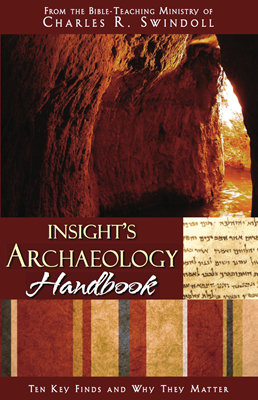
Insight for Living, the ministry of Chuck Swindoll, has just released Archaeology Handbook: The Key Finds and Why They Matter.  This is a 120-page introduction to the top ten archaeological discoveries related to the Bible.  I think it’s an excellent overview of artifacts like the Merneptah Stele, the Tel Dan Inscription, and the Sea of Galilee boat.  There are also chapters on the Temple Mount, Hezekiah’s Tunnel, and the Dead Sea Scrolls.  The writing is clear and engaging, the photographs are beautiful, and the layout is attractive.  If you’re one of the archaeologists who reads this blog, you probably won’t learn anything from this IFL Archaeology Handbook cover book, but if you’re someone who hasn’t had much exposure to biblical archaeology, this is a great starting point. 

I served as a consultant for the book, supplied many of the photographs, and was interviewed in one of the chapters.  That’ll make some of you happy, while others will run the other way.

Here’s one of the questions I was asked: What role does faith play within the scientific discipline of archaeology? 

My answer: Archaeology should not be carried out in order to prove some pre-conceived idea, whether pro- or anti-Bible.  Archaeology is best when it is carried out with the best of scientific methods and interpreted by a range of scholars.  Archaeology is ill-served when the interpretation of sites and artifacts is divorced from our knowledge of ancient texts, including the Bible.

Here’s another: Has archaeology revealed anything that contradicts the Bible?  If so, what?  And how should Christians respond to such discoveries?

My answer: Archaeology has revealed many things that can be interpreted in a fashion that is not compatible with the biblical record.  But those same things can also be interpreted in a way that is consistent with Scripture.  This ambiguity is not intrinsic to issues related to faith, but is the nature of the discipline.  But those matters related to the Bible are naturally more popular and receive more attention in the press.  I do not know of any major issues that conflict with the accuracy of the Bible. 

There are some issues of a lesser nature that are not yet resolved, but I recognize that that is due to the limited nature of the evidence.

Most of the book is more interesting than these questions reflect, as it’s not dealing with theory, but with actual discoveries and what they mean.

Through May, the book is available for a donation.  Beginning next month, the book will be sold in their online store.  There is also a video that gives more details about the book.
Share: