From Arutz-7:

The Common Swift, a unique bird that spends most of its life on the wing, returns to Western Wall for a short vacation from Africa. Nature-lovers are planning a welcoming ceremony Monday.
The Friends of the Swifts Association, the Society for the Protection of Nature in Israel, and Tel Aviv University are working together to save existing nesting sites of the special bird. Its arrival at the Western Wall also symbolizes the approaching spring, said the sponsors of the welcoming ceremony.
[…]
They said that a special study to map the nests was conducted in 2002 by researcher Ulrich Tigges and by the late Prof. Mendelssohn, during which 88 nests were noted. This study map served as a guideline during the work of strengthening the Western Wall, keeping the nests unblocked.

The full story is here.

Birds have been making their nests near the temple ever since the psalmist wrote, “Even the sparrow has found a home, and the swallow a nest for herself, where she may have her young, a place near your altar….Blessed are those who dwell in your house” (Psalm 84:3-4).

Bird perched on stone of Western Wall, tb090705995

Pigeon perched in hollow of the Western Wall
Share:

Bryant Wood has written a short summary of the 2009 and 2010 excavation seasons at Khirbet el-Maqatir, a site he believes may be biblical Ai.

Of the Talpiot Tomb, Richard Bauckham has a detailed examination of the four-line inscription, concluding that it does not have anything to do with Jesus or early Christianity but is nonetheless a very interesting ossuary inscription. Paleobabble observes that there is nothing in the “Jesus Discovery” related to Jesus or early Christianity. Those interested in reading about the first “Jesus tomb” in Talpiot can access a 2006 issue of Near Eastern Archaeology on the subject for free.

The Maps of the Zucker Holy Land Travel Manuscript have been digitized and put online by the University of Pennsylvania. The map was made in the late 1600s.

John Monson’s lecture on “Physical Theology: The Bible in its Land, Time, and Culture” at the Lanier Theological Library last month is now online.

Wayne Stiles visits the Mount of Beatitudes, Tel Dan, and Beth Shean. He provides an interesting quotation from George Adam Smith about Beth Shean, written in 1896: “There are few sites which promise richer spoil beneath their rubbish to the first happy explorer with permission to excavate.”

How right he was!

Joe Yudin describes a favorite hike in lower Galilee.

Turkey claims that Roman mosaics at a university in Kentucky were stolen in the 1960s and should be returned.

The Roman ruins in Palmyra are apparently being threatened by the Syrian army.

Greece is re-burying ruins because of a lack of funds.

HT: Jack Sasson, Joseph Lauer

Palmyra, triumphal arch, central portion, mat01428

Triumphal arch of Palmyra
(
source, with 30 free photos of the site)
Share:

Christianbook.com is running a Fabulous Friday sale on The New Interpreter’s Dictionary of the Bible for only $130.
33468: The New Interpreter"s Dictionary of the Bible: Five Volume Set
This five-volume work includes 7,100 articles and many illustrations. NIDB is not quite as comprehensive or detailed as Anchor Bible Dictionary but it is more up-to-date. Amazon sells it for $316.

Carl Rasmussen’s excellent Zondervan Atlas of the Bible is also marked down to $18 for the sale (which lasts through Monday).

Share:

One does not often read reports in the media of archaeological surveys, and this review of the Jarash Hinterland Survey is an interesting account of the final season in October 2010. The article notes that the population of Jerash (biblical Gerasa) has doubled in the last 15 years, making the survey of field and farm, tomb and quarry, an important project. They estimate that about “10% of the archaeological sites around the city are being lost to development year upon year.”

The team faced dangers such as scorpions, shabab-ed, and nappies. But they had great success as well, identifying 203 tombs, along with numerous other ancient features.

It is all too easy to get distracted from the survey by kind offers of tea, but as always local knowledge is gained as a result. For instance, to be informed that a tomb containing about twenty sarcophagi on Abu Suwan had been used as a bomb shelter in 1973 and had subsequently been filled in leaving no visible trace represented a great result. The route of a Classical water course in the Wadi Deir – now scattered and bulldozed – was shown to us by a man who played in it as a child. An intense artefact scatter also got us excited, only to be told to our disappointment that it had been deposited by trucks moving earth from elsewhere in the preceding few months.

The article includes a video and some great photos (click one to begin a slideshow).

HT: Jack Sasson

Share:

I am going to forego a roundup of the Talpiot tomb(s) at this point, instead pointing you to Paleobabble’s “State of the Question,” Jack Poirier’s rebuttal of the name statistics, James Tabor’s colored drawing of the “fish,” and Robert Cargill’s case that the image was photoshopped. I’m not aware of any scholar who didn’t publish a book on the subject within the last week that subscribes to the fish/Jonah interpretation.

The first three chapters of Lois Tverberg’s Walking in the Dust of Rabbi Jesus are available to read online.

While the snow in Jerusalem was pretty, and the Sea of Galilee rose more than a foot, the weekend storms caused about $8 million in damage to agriculture in Israel.

The “All Out Adventure” column this week describes hikes in the lower and upper sections of Nahal David.

Finding a place to volunteer to excavate in the spring is next to impossible, but Tel Burna is accepting volunteers the week of March 18-22.

Ferrell Jenkins has the latest on discoveries at the Colossi of Memnon. For additional photos, see the Luxor Times.

Luxor Times also reports on the discovery of the name of a king from the 17th Dynasty. While it is the first artifact related to the king, it is not the first time we’ve known of him.

Wayne Stiles has a post for the first day of the Insights for Living tour. (Unfortunately, they seem to have rejected my proposal that Herod Agrippa was struck down not in the theater of Caesarea, but in the amphitheater.)

More than 2,400 years ago, the Lord delivered the Jewish people from evil men in Persia. The remembrance of that deliverance begins tonight. Current threats from modern Persia (Iran) should
keep the celebration sober. Happy Purim!

Share:

Some books are a pleasure to recommend and Walking in the Dust of Rabbi Jesus is the first that I would suggest to those interested in understanding Jesus’ teaching better with the help of the historical background. I’ve enjoyed several works of Lois Tverberg in the last few years, but this one is hands-down my favorite. Here’s why:tverberg-dust-rabbi-jesus
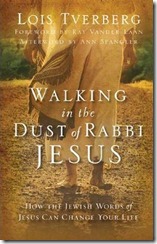
This book brims with insights. I love to learn new things about familiar and dear subjects, and again and again I found myself writing in the margin an exclamation mark or a reminder to return to that page. For example, concerning the command to love God:

You see this in ancient treaties, when an enemy king who signed a covenant would pledge to ‘love’ the king with whom he was making peace. This meant that the enemy king would act loyally, not that he would have warm thoughts about what a great guy the other king was every time he came to mind (44-45).

This book is biblically solid. Some subjects lend themselves to subbiblical treatments of Scripture, and Jewish backgrounds of Jesus is one of them. Tverberg never compromises what the Bible teaches in favor of the latest fad or scholarly theory. I appreciated her statement about a regular abuse in studies about the Jewish background of Jesus:

Part of the reason is from what I’ve experienced as I’ve seen people get interested in their Jewish roots. Sometimes in their enthusiasm, they take on a whole new [Hebrew] vocabulary that creates barriers between themselves and others. My thinking is that if you’ve discovered insights that bring you closer to God, you’re obligated to share them. To do so you need to be a bridge, not an island. So I deliberately use a more widely known vocabulary (83).

This book is entertaining. I carried this with me on an overseas flight, expecting to read a few chapters and then pick up my “fun” book. I never put this one down. The stories are fascinating and the quotes are going into my teaching notes. For example:

Just as rain water comes down in drops and forms river, so with the Scriptures: one studies a bit today and some more tomorrow, until in time the understanding becomes like a flowing stream. –Song of Songs Midrash Rabbah 2:8 (15).

This book is well-researched. The genre of this book with its devotional emphasis and its writing style geared towards any literate Christian is not normally associated with careful scholarship. Each chapter, however, has 10-25 endnotes.

This book echoes my thinking in some of my favorite subjects. To give but one example:

Often Jesus’ words in the Gospels presuppose an intimate familiarity with the biblical text. Sometimes Jesus made bold claims about his mission as Messiah through the Scriptures he quoted. If you don’t have the text in the back of your mind, some of his powerful statements can sail right past you (146). [Yes, and this is true for all of New Testament! I re-issue my call for a law banning the reading of the NT until one masters the OT. :-)]

This book challenges my thinking in a number of areas. For example:

One sage commented: ‘It’s better to give one shekel a thousand different times than a thousand shekels all at once, because each time you give, you become a kinder person’ (76).

I agree with my friend David Bivin who writes on the dust jacket: “It is filled with great practical wisdom that you can put to work in your life immediately.” The questions at the end of the chapter make this 14-chapter book easy to use in a group study.

There are many pitfalls in studying the background of Jesus’ time, but with only a few quibbles, Tverberg has avoided them by careful research and wise analysis. If you’re like me, after you read it, you’ll think of people who would enjoy the book as a gift. I’m a better person because of this book, and, I hope, a better blogger as well.

Share: