(Post by A.D. Riddle)

Available beginning today is an impressive-looking title published by Baker Academic, Behind the Scenes of the Old Testament: Cultural, Social, and Historical Contexts, edited by Jonathan S. Greer, John W. Hilber, and John H. Walton.
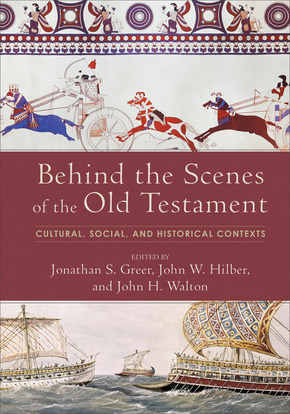
The book contains 65 essays (in 640 pages) by many well-known scholars in archaeology, and biblical and Ancient Near East studies, but it also includes several younger scholars who are just beginning their careers in these various disciplines. Perusing the range of topics, it seems that little has been overlooked—iconography, geography, literature, archaeology. The opening chapters addressing historical geography and physical geography will have special appeal to readers of this blog. Essays even extend beyond the title’s “Old Testament” to include Alexander the Great, the Hellenistic period, and the Hasmonean kingdom.

This authoritative volume brings together a team of world-class scholars to cover the full range of Old Testament backgrounds studies in a concise, up-to-date, and comprehensive manner. With expertise in various subdisciplines of Old Testament backgrounds, the authors illuminate the cultural, social, and historical contexts of the world behind the Old Testament. They introduce readers to a wide range of background materials, covering history, geography, archaeology, and ancient Near Eastern textual and iconographic studies.

Meant to be used alongside traditional literature-based canonical surveys, this one-stop introduction to Old Testament backgrounds fills a gap in typical introduction to the Bible courses. It contains over 100 illustrations, including photographs, line drawings, maps, charts, and tables, which will facilitate its use in the classroom.

Here is the full table of contents:

Introduction (Jonathan S. Greer, John W. Hilber, and John H. Walton)
Part One: Elements of the Drama
I. The Stage: Historical Geography
1. Introduction to Historical Geography (Paul H. Wright)
2. Regions and Routes in the Levant (Carl G. Rasmussen)
3. Climate and Environment of the Levant (Elizabeth Arnold)
4. Plants and Animals of the Land of Israel (Daniel Fuks and Nimrod Marom)
II. The Sets and Props: Archaeology
5. Introduction to Biblical Archaeology (Seymour Gitin)
6. Archaeology of the Late Bronze Age (Joe Uziel)
7. Archaeology of the Iron Age I (Aren M. Maeir)
8. Archaeology of the Iron Age II (Amihai Mazar)
9. Archaeology of the Neo-Babylonian and Persian Periods (Constance E. C. Gane)
10. Archaeology of the Hellenistic Period (Jordan Ryan)
III. The Scripts: Ancient Near Eastern Literature
11. Introduction to Ancient Near Eastern Literature (Adam E. Miglio)
12. Hebrew Inscriptions (Judith M. Hadley)
13. Mesopotamian Literature (Dave C. Deuel)
14. Egyptian Literature (Nili Shupak)
15. Hittite Literature (Alice Mouton)
16. Northwest Semitic Inscriptions (Margaret E. Cohen)
17. Ugaritic Literature (William D. Barker)
18. Early Jewish Literature (Ryan Stokes)
IV. The Frames: Ancient Near Eastern Iconography
19. Introduction to Ancient Near Eastern Iconography (Izak Cornelius)
20. Egyptian Iconography (Laura Wright)
21. Mesopotamian and Anatolian Iconography (Daniel Bodi)
22. Canaanite/Israelite Iconography (Brent A. Strawn)

Part Two: Acts and Scenes of the Drama
V. Acts: Integrated Approaches to Broad Historical Contexts
23. The Ancestral Period (Richard S. Hess)
24. The Egyptian Sojourn and the Exodus (David A. Falk)
25. The Settlement Period (Pekka Pitkänen)
26. The United Monarchy (Steven M. Ortiz)
27. The Divided Monarchy: Israel (Jens Bruun Kofoed)
28. The Divided Monarchy: Judah (Eric L. Welch)
29. The Exile and the Exilic Communities (Deirdre N. Fulton)
30. Persian Period Yehud (Kenneth A. Ristau)
31. The Maccabean Revolt and the Hasmonean Kingdom (Joel Willitts)
VI. Scenes: Integrated Approaches to Event-Based Historical Contexts
32. Akhenaten and the Amarna Period (Mark D. Janzen)
33. The Late Bronze Age Collapse and the Sea Peoples’ Migrations (Gregory D. Mumford)
34. Sheshonq’s Levantine Conquest and Biblical History (Yigal Levin)
35. The Battle of Qarqar and Assyrian Aspirations (Mark W. Chavalas)
36. The Mesha Inscription and Relations with Moab and Edom (Juan Manuel Tebes)
37. The Tell Dan Inscription, Jehu’s Revolt, and Aramaean Campaigns in Israel and Judah (K. Lawson Younger Jr.)
38. Sennacherib’s Invasion of Judah and Neo-Assyrian Expansion (Kyle H. Keimer)
39. Eighth-Century Levantine Earthquakes and Natural Disasters (Ryan N. Roberts)
40. The Battle of Carchemish and Seventh-Century Regional Politics (Sara L. Hoffman)
41. Alexander the Great and Levantine Hellenism (D. Brent Sandy)

Part Three: Themes of the Drama
VII. God: Integrated Approaches to Themes in Israelite Religion 
42. Monotheism in Ancient Israel (Matthew J. Lynch)
43. Biblical Texts Studied in Comparison with Other Ancient Near Eastern Documents (John H. Walton)
44. The Temple in Context (John H. Walton)
45. Priests in the Ancient Near East (Gerald Klingbeil)
46. Worship, Sacrifice, and Festivals in the Ancient Near East (Roy E. Gane)
47. Family Religion in Ancient Israel (Andrew R. Davis)
48. Prophecy, Divination, and Magic in the Ancient Near East (John W. Hilber)
49. Death and Burial in the Iron Age Levant (Christopher B. Hays)
VIII. Family: Integrated Approaches to Themes in Family Networks
50. Tribes and Nomads in the Iron Age Levant (Thomas D. Petter)
51. Women in Ancient Israel (Carol Meyers)
52. Family, Children, and Inheritance in the Biblical World (Victor H. Matthews)
IX. Sustenance: Integrated Approaches to Themes in Economic Contexts
53. Seasons, Crops, and Water in the Land of the Bible (Oded Borowski)
54. Trade in the Late Bronze and Iron Age Levant (Joshua T. Walton)
55. Slavery in the World of the Bible (Richard E. Averbeck)
56. The Local Economies of Ancient Israel (Peter Altmann)
57. Metallurgy in the World of the Bible (Brady Liss and Thomas E. Levy)
58. Ancient Technologies of Everyday Life (Gloria London)
59. Food Preparation in the Iron Age Levant (Cynthia Shafer-Elliott)
60. Feasting in the Biblical World (Janling Fu)
61. Music and Dance in the World of the Bible (Annie F. Caubet)
X. Governance: Integrated Approaches to Themes in Social Organization
62. Kingship and the State in Ancient Israel (Nili S. Fox)
63. Social Stratification in the Iron Age Levant (Avraham Faust)
64. Law and Legal Systems in Ancient Israel (David W. Baker)
65. Wisdom Traditions in Ancient Israel (Paul Overland)
66. Warfare in the World of the Bible (Mark Schwartz)
Share:

An archaeological team working at Hatnub in Egypt has discovered the ancient system used to transfer stone blocks from the quarry.

Egyptian archaeologists have discovered parts of a booth with a seat from the time of Ramses II.

“Archeologists at the University of Toronto are in advanced negotiations with Turkey’s Ministry of Culture and Tourism to establish an archeological park at Tell Tayinat.”

Over 2 million tourists visit Pamukkale in Turkey annually, but many of them never see the impressive remains of Hierapolis next door. Ferrell Jenkins shares a beautiful photo of the Pamukkale springs.

“Lawrence of Oxford” is a new exhibition at the Magdalene Libraries and Archives that focuses on the early life of the man later known as Lawrence of Arabia.

The Harvard Semitic Museum Youtube channel offers various short videos as well as lectures.

A relief from Persepolis valued at $1.2 million was stolen a couple of times before researches at the

Oriental Institute helped provide evidence that led to its seizure and repatriation.

A rare, 3,000-year-old Assyrian relief sold for $31 million, tripling the pre-sale estimate of $10 million.

New book: A. Lichtenberger & R. Raja, eds., The Archaeology and History of Jerash. 110 Years of Excavations.

HT: Ted Weis, Charles Savelle, Agade, A.D. Riddle

Share:

After being closed for six years to protect artifacts during the civil war, Syria’s National Museum of Damascus has reopened.

A Haaretz premium article suggests that the Israelites at Dan worshiped the Lord. “Suggestive finds include seal impressions with Yahwistic names, temple architecture, and artifacts typical of Yahwistic temple rituals.”

The latest in Brad Gray’s Psalm 23 series looks at the rod and staff (and sling) of the shepherd.

Israel’s Good Name has written a couple of posts about the Autumn Raptor Migration.

Biblical Israel Ministries and Tours has begun a new series of short devotional videos: “It Happened Here—Life Lessons from Israel.”

A snake crawled out of the stones of the Western Wall above the women’s prayer area, creating a bit of a scare.

Glenn Corbett and Jack Green explain the tremendous value of the ACOR Photo Archive.

A new 17-minute film entitled “Paul in Athens” reconstructs the famous events of Acts 17. This documentary was created by Yaron Eliav and the University of Michigan TLTC Team.

John McRay, longtime professor of New Testament and Archaeology died in August. The Book and the Spade shares an archived interview with him about Athens in the Time of Paul.

HT: Ted Weis, Charles Savelle, Agade

Share:
(Post by A.D. Riddle)

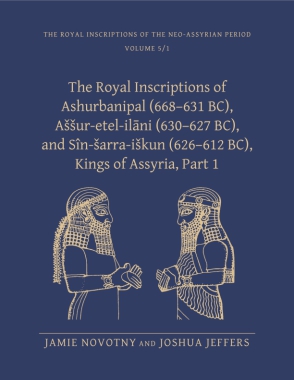
I had noticed earlier this year that inscriptions of Ashurbanipal had started appearing in the online corpus of the “Royal Inscriptions of the Neo-Assyria Period,” and sure enough, yesterday, Eisenbrauns released the latest volume of the series, The Royal Inscriptions of Ashurbanipal (668-631 BC), Aššur-etal-ilāni (630-627 BC), and Sîn-šarra-iškun (626-612 BC), Kings of Assyria, Part I, by Jamie Novotny and Joshua Jeffers (2018).

From the publisher:

In this book, Jamie Novotny and Joshua Jeffers provide updated, reliable editions of seventy-one historical inscriptions of Ashurbanipal, including all historical inscriptions on clay prisms, clay cylinders, wall slabs, and other stone objects from Nineveh, Assur, and Kalhu. Each text edition is accompanied by an English translation, a catalog of all exemplars, a comprehensive bibliography, and commentary containing notes and technical information. This volume also contains a general introduction to the reign of Ashurbanipal, his military campaigns, the corpus of inscriptions, previous studies, and chronology; translations of the relevant passages of several Mesopotamian chronicles and king lists; photographs of objects inscribed with texts of Ashurbanipal; indexes of museum and excavation numbers, selected publications, and proper names.

Ashurbanipal is mentioned once in the Bible (Ezra 4:10). The other two kings listed in the title are some of the last kings of Assyria, up to the time Nineveh was conquered in 609 BC by Medes and Chaldeans. Note that this is part 1, and that part 2 is still being prepared for publication. The publisher’s description of the book mentions only Ashurbanipal, so I do not know if Aššur-etel-ilāni or Sîn-šarra-iškun make into this part, or if they are in the next one. The online version of this volume, however, is already up and running, and there you can view (some of?) the inscriptions of these last two kings. The online material appears to contain most, if not all, of the information in the printed book, but I must say it is more enjoyable for me to use and read the printed volume, while using the online version for research. If you are interested in ordering a copy, visit the Eisenbrauns page. The announcement sent out yesterday included the code NR18 which you can use to receive a 30% discount.

This book is the first part of volume 5 in the series entitled the Royal Inscriptions of the Neo-Assyrian Period, or RINAP. Now, all we need is RINAP volume 2, the inscriptions of Sargon II (the publication of which I was told four years ago was imminent). RINAP is the successor to an earlier publication series named RIMA. You can explore both of these, and more, at the Royal Inscriptions of Assyria Online Project. These online resources are already very good, but they keep getting better and better. Big thank you to Eisenbrauns and all the other individuals, organizations, and acronyms (Oracc, RIAo, OIMEA, etc.) who make this available.

Related posts on this blog:
Neo-Assyrian Royal Inscriptions
Neo-Assyrian Kings and Biblical History
More on Neo-Assyrian Inscriptions

Share:

An intact 2,400-year-old ancient Greek shipwreck, believed to be the world’s oldest, has been found at the bottom of the Black Sea.

The Museum of the Bible in Washington D.C. announced that independent testing revealed that five of its Dead Sea Scroll fragments “show characteristics inconsistent with ancient origin and therefore will no longer be displayed at the museum.” Kipp Davis, who initially questioned their authenticity, thinks that more fragments held by American institutions will be proven to be forgeries.


Haaretz (premium) has an article on the new excavations at Tel Shimron, a biblical site that is three times larger than Megiddo.

At least 19 people were killed when a flash flood swept away a group of students touring on the Jordanian side of the Dead Sea.

The Smithsonian magazine looks at the work of Virtual Wonders in using drone and other advanced technology to create extremely detailed 3D models of Petra. The article includes a video preview of their work.

“For a video game that includes bloody mercenaries, extraterrestrial beings, and time travel, Assassin’s Creed: Odyssey is shockingly faithful to our contemporary historical understanding of what Ancient Greece looked like during its golden age.”

Leon Mauldin shares photos and descriptions of Troas and Gamla.

Two new books on ancient Israel:

HT: Ted Weis, Keith Keyser, Charles Savelle, Agade

Share:
(Post by A.D. Riddle)

The Jordan Valley Excavation Project will be starting a new excavation at Khirbet ‘Auja el-Foqa, a fortified city on a hilltop overlooking the Jordan Valley, just north of Jericho. Registration is now open for the inaugural 2019 season which will run from May 26 to June 23. The project is co-directed by David Ben-Shlomo and Ralph K. Hawkins. For information, visit the project’s website at www.jvep.org.

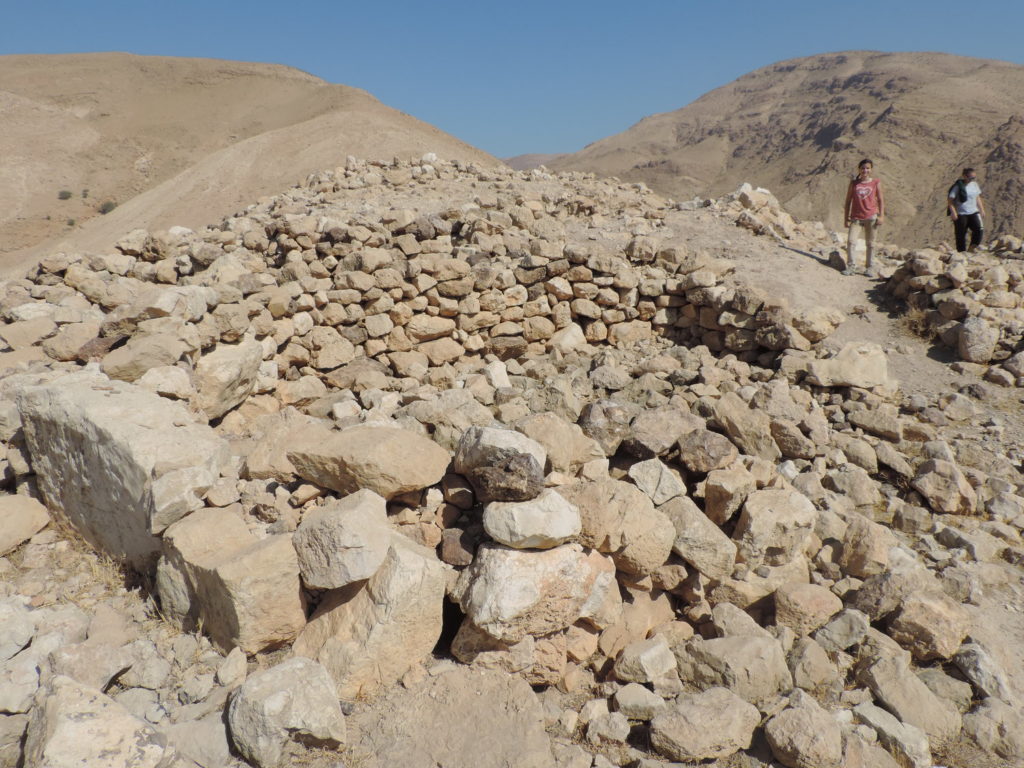
Khirbet ‘Auja el-Foqa was surveyed by Adam Zertal, who identified a casemate wall and towers (see photo blow). Zertal concluded, “The main settlement in the site was founded at the beginning of the Iron Age IIB and it was possibly abandoned during Sennacherib’s campaign to Judah in 701 BCE.” But until now the site has not been excavated. The Jordan Valley Excavation Project is interested in determining if there are earlier settlements beneath the Iron IIB remains. One reason for thinking there might is the Jordan Valley Excavation Project discovered Late Bronze II/Iron I at the site of Khirbet el-Mastarah, right next door to Khirbet ‘Auja el-Foqa. Zertal identified ‘Auja el-Foqa as Ataroth in Joshua 16:5, and Shmuel Ahituv suggested it is the town of Na’arta mentioned in an inscription from Jerusalem. The project’s website provides more details.

Tower at Khirbet ‘Auja el-Foqa (www.jvep.com). 

This map shows both Khirbet ‘Auja el-Foqa and Khirbet el-Mastarah, and their relation to the Jordan Valley and Jericho.

Share: