It’s not easy picking just one. The happy reality is that, except for little surveys like this one, we don’t have to. Beautiful vistas abound in the biblical lands, if only we can climb to the summit.

When forced to choose just one, the most common answer among our readers was Mount Arbel overlooking the Sea of Galilee. Here are a few of the reasons given:

I loved the view overlooking Sea of Galilee towards Capernaum. In addition to the view, what made this tops for me was the climb down using the chains.

So many places connected to historical events are visible from this one vantage point. The last time I was there Mt Hermon was visible. Seeing the geography, the topography, how the locations are in relation to one another is just amazing. I love the bird’s eye view but admit my stomach does flip flops looking straight down!

A favorite faculty member from my Bible Institute days preached a message regarding “The people who walked in darkness have seen a great Light” from Isaiah 9.  Nice climb, good heights, potential danger, lots of periods of history (OT, NT, Zealots, Crusaders) visible. 
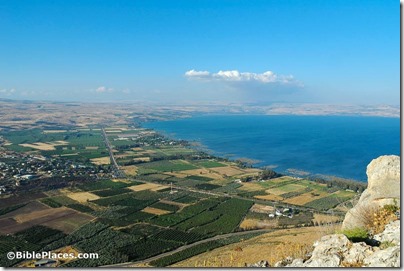
Plain of Gennesaret from southwest, tb053005508
View of the Sea of Galilee from Mount Arbel

In second place was the Mount of Olives. Given all that happened throughout history, it’s easy to spend a lot of time here re-living biblical events. Here’s what a couple of you wrote:

I can think of no other place where a person can see where so much biblical history took place.

It is a view that Yeshua knew well.
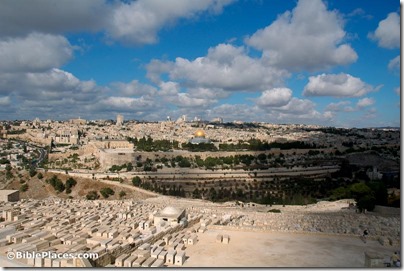
Jerusalem from Mount of Olives, tb092405392
Jerusalem from the Mount of Olives

A close third was Muhraqa on Mount Carmel, the traditional place where Elijah battled the prophets of Baal. One person chose this vista because they “have been there.” That’s a reminder that many tour groups, most of which are designed for the elderly, do not go to many of the choice vistas. Here’s why another reader chose Muhraqa as their favorite:

Because you can see Asher, Zebulun, Naphtali, Issachar, Manasseh, Phoenicia, and Transjordan + the landscape of about a dozen biblical events
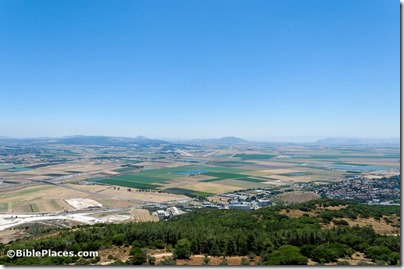
Jezreel Valley from Muhraqa, tb061216339
The Jezreel Valley from Muhraqa on Mount Carmel

Honorable mention goes to the view from Azekah:

It is really difficult to pick only one! While there may be more beautiful vistas, like Arbel, I love being on top of Azekah and reading I Samuel 17. It was one of the first locations for me where the Bible came to life and a treasured story became more real. It is a joy to bring others there and see them experience some of that. It is a moving experience to visualize such a familiar story unfolding in the Elah Valley below. It’s something that just can’t happen unless you visit Israel and set foot in a place like Azekah.

Perhaps the most interesting response (in my estimation) was the reader who chose the “sunrise over moab” for the reason that they can see it “from my bed.” I wonder how places there are where that’s possible!

Another respondent chose Mount Meron, because:

I figured I’d choose something different. Mt Meron is great because you can see from Mt Hermon and Mt Bental in the north all the way to Mount Carmel in the south. This provides a great view of practically the entire Galilee region (on a clear day).

A variety of other sites were selected, including Belvoir (“beautiful view”), Hippos, Masada, Mount Gilboa, Nazareth, Nimrod’s Castle, Qumran, and Tel Jezreel.

A few people chose locations outside of Israel, including Macherus:

I have been several times and have never seen more than one or two people there. I like the loneliness of the site, especially at sunset. A good place to reflect on the last days of John the Baptist. Great views of the Dead Sea and the hills of ancient Perea.

And one reader prefers the view from the Amman citadel at sunset:

Gradually the city’s lights come on.  I noticed the green lights all around in the city.  Then the Muslim hour of evening prayer began and the muzzains calls blend and compete. A delight for eyes and ears.

If you haven’t yet “panned the panorama” from all of these vistas, you can add them to your list for the next time you’re traveling through the biblical world.

Share:

Many of my favorite stops in touring around Israel are viewpoints. Whether it’s on top of a mountain or a mosque, a cliff or a convent, an overlook of the biblical landscape captures so much from one vantage point.

I thought that this week we would solicit your perspective on the best vista on your itinerary. The site can be in Israel or any other biblical land. If you would like, you can explain why the overlook is your favorite. We’ll share some of the results later this week.

To prime your thinking, here are some vistas I have enjoyed.

  • Arbel cliffs
  • Nazareth overlook (aka Mount of Precipitation)
  • Muhraqa on Mount Carmel
  • Mount Gerizim
  • Nebi Samwil rooftop
  • Nimrod’s Castle
  • Mount of Olives tower
  • Masada
  • Wadi Qilt near St. George’s
  • Beit Jalla field school
  • Cliffs above En Gedi
  • Machtesh Ramon Visitor’s Center
  • Mount Zephahot near Eilat
  • Jebel Musa
  • Amman Citadel
  • Macherus
  • Petra High Place
  • Philippi acropolis
  • Acrocorinth

Email readers may need to click through.

Share:

A large 4th-century AD winepress has been discovered and excavated in the Ramat Negev region.

The IAA has posted a 1-minute video in Hebrew.

A new study argues that everything we knew about the origin of the Philistines is wrong.


The Times of Israel reviews discoveries made in excavations at Magdala, with an eye on priestly inhabitants.

A new DNA study indicates that the modern-day Lebanese people are descended from people who
lived in the area 4,000 years ago.

Wayne Stiles reflects on a lesson Jesus taught when he walked on the Sea of Galilee.

The Tempe Mount Sifting Project has begun a video series that tours the Temple Mount, beginning with Solomon’s Stables, including footage of the destruction in 1999.

Steven Ortiz is on The Book and the Spade discussing the 10th season of excavations at Gezer.

On the 75th anniversary of his death, Sir Flinders Petrie is profiled in The National, with the focus on his support of eugenics.

The inaugural issue of Archaeology and Text is now online.

The Tell es-Safi (Gath) team got real creative for their season-end group photo.

HT: Joseph Lauer, Agade, Charles Savelle

Share:

For the last four months, the Israel Antiquities Authority has been excavating on the east side of the City of David, and today as the traditional anniversary of the temple’s destruction approaches they announced the discovery of evidence of the city’s fall in 586 BC.

The press release includes a 2-minute video of Joe Uzziel explaining what they found and questions that have been raised.

In the excavations – concentrated on the eastern slope of the City of David, dwelling places 2,500 years old, once covered by a rockslide, have been revealed. Nestled within the rockslide many findings have surfaced: charred wood, grape seeds, pottery, fish scales and bones, and unique, rare artifacts. These findings depict the affluence and character of Jerusalem, capital of the Judean Kingdom, and are mesmerizing proof of the city’s demise at the hands of the Babylonians.
Among the excavation’s salient findings were dozens of jugs which served to store both grain and liquids, a stamp seal appearing on some of them. Furthermore, one of the seals discovered was that of a rosette, a six-petal rose. According to Ortal Chalaf and Dr. Joe Uziel, Israel Antiquities Authority excavation directors: “These seals are characteristic of the end of the First Temple Period and were used for the administrative system that developed towards the end of the Judean dynasty. Classifying objects facilitated controlling, overseeing, collecting, marketing and storing crop yields. The rosette, in essence, replaced the ‘For the King’ seal used by the previous administrative system.”
The wealth of the Judean kingdom’s capital is also manifest in the ornamental artifacts surfacing in situ. One distinct and rare finding is a small ivory statue of a woman. The figure is naked, and her haircut or wig is Egyptian in style. The quality of its carving is high, and it attests to the high caliber of the artifacts’ artistic level and the skill par excellence of the artists during this era.
According to Ortal Chalaf and Dr. Joe Uziel, Israel Antiquities Authority excavation managers, “The excavation’s findings unequivocally show that Jerusalem had spread outside of the city walls before its destruction. A row of structures currently under excavation appears beyond the city wall that constituted the eastern border of the city during this period. Throughout the Iron Age, Jerusalem underwent constant growth, expressed both in the construction of the city wall and the fact that the city later spread beyond it. Excavations carried out in the past in the area of the Jewish Quarter have shown how the growth of the community at the end of the 8th Century BCE caused the annexation of the western area of Jerusalem. In the current excavation, we may suggest that following the westward expansion of the city, structures were built outside of the wall’s border on the east as well.”

The story is reported by the Jerusalem Post, Arutz-7, and other outlets.

Shattered jugs attesting to the destruction (COURTESY OF ELIYAHU YANAI / CITY OF DAVID ARCHIVE)
Shattered jugs destroyed in Babylonian conquest
Photo courtesy of Eliyahu Yanai, City of David Archive
Share:

Archaeologists working near biblical Aphek have discovered a large water reservoir dating to about the time of King Hezekiah. The press release includes a one-minute video.

They found Roman remains at el-Araj, a candidate for New Testament Bethsaida. Here’s a photo of some of the Roman mosaic floor.

The third week of the excavations of Gath has ended, and they found an inscription.

Chris McKinny summarizes the results of the third week at Tel Burna. And if you missed the second week review, you can find it here.

The Temple Mount Sifting Project has discovered a Doric capital dating to the 2nd century BC.


The Times of Israel profiles ABR’s new excavation project at Shiloh.

The Greek Orthodox Church has sold the amphitheater and hippodrome of Caesarea in a secretive manner that raises lots of questions.

Archaeologists have found 8 more ancient shipwrecks off the coast of Greece, bringing the total number now discovered there to 53.

“Egyptologists have discovered what they believe is the burial chamber of Ankhesenamun, Tutankhamun’s wife.”

Here are five surprising inventions of ancient Rome, including luxury cruise ships.

Ferrell Jenkins shares his experience and photos with camel caravans in the Sinai.

John MacDermot will lecture on “Olga Tufnell – The Life of a Petrie Pup” at the British Academy in
London on September 20.

Recent Shroud of Turin Research is the top of this week’s edition of The Book and the Spade.

I thought the Kindle sale for Eric Cline’s Three Stones Make a Wall: The Story of Archaeology was for one day only, but the $1.99 deal was still good the last time I checked.

HT: Carl Rasmussen, Charles Savelle, Joseph Lauer, Agade, Mike Harney

Share:

Jerusalem is a place deeply meaningful to so many people. It is not only full of history, but it is also full of the future. I really enjoyed reading through your responses on this survey, for we all feel passionately about this city!

The site chosen by more than any other was Hezekiah’s Tunnel. When you add the second most common response, the City of David, it’s obvious that the most ancient part of Jerusalem is a clear favorite. It wasn’t that many years ago that few people visited the City of David or walked through Hezekiah’s Tunnel. That has changed with recent development, and now you need to get reservations weeks or months in advance and pay more than 5 shekels for entrance!

Here’s why a few of you chose Hezekiah’s Tunnel as your favorite:

Fascinating history, quiet, away from crowds”
I love the feeling of re-living biblical history. I love teaching on the water systems of Jerusalem and seeing the joy of discovery on friends’ and study tour participants’ faces!”
(1) It’s just as it was (not just ruins). (2) It’s mentioned very specifically in the Bible, and was important. (3) Its discovery bolstered confidence in the Biblical record. (4) It’s good fun walking through it. (5) Not many people do walk it, so you feel you’re getting a special treat!”

The City of David provoked several interesting responses, including these:

In spite its small size (10 acres), the City of David contains an incredible amount of tangible evidence demonstrating the historical reliability of the Bible.
It is so important, so controversial, and still so difficult to figure out. I keep going back only to be more confused and intrigued. Who can help me?

Another favorite is just up the hill: the excavations on the south side of the Temple Mount.

Story of Mary, Joseph, Jesus and Simeon in Luke 2
Robinson’s arch, Herodian street and sewer tunnel, old shops, Roman destruction, mikvahs, are ancient history.  But you can also see the new Jewish quarter with its synagogues and Torah schools and the Muslim minarets on the Haram that remind you of the mix of societies living here today. . . . So much history meeting today all in one spot.

The Garden Tomb and the Church of the Holy Sepulcher received an equal number of votes. I’m not sure if I know those who voted for the Garden Tomb, but all (three) who chose the Holy Sepulcher are biblical scholars. Why the Holy Sepulcher?

My fascination with the burial of Jesus, among other things!
As close as it is possible to get to the place where Jesus died and rose.

One person who chose the Garden Tomb wrote:

That’s where I realized that He is not there but He has risen!

The Western Wall received three votes. Why?

It’s close to the Holy of Holies, had great prayerful experiences there with friends, and loved watching the feast of tabernacles and witnessing Jewish culture.  It’s beautiful at night! 

Bringing in the Shabbat with singing and dancing.

Several people chose locations for their views of the city, but they didn’t choose the same location:

Mount of Olives: From the Mount of Olives you can look down at the Temple Mount and so much biblical history took place right there from the Old Testament to the New Testament and to think of what will happen in the future there at that site!

Ramparts Walk: It affords the best views of the city, a good overview of the surrounding topography and you can see the dovetailing of Jordanian defense walls with those from 1492. You also have a good view of the recent excavations on Mt. Zion as well as interesting portions of the Arab quarter.

Herod’s Tower: The timeless, expansive view of most of the Old City, Temple Mount, Mount of Olive’s, Holy Sepulchre, St. John of Hospitallers.  Perhaps the best view of the City.

A number of you picked the Pools of Bethesda/St. Anne’s Church, the Mount of Olives (including Gethsemane), the Israel Museum (including the model of Jerusalem and the Shrine of the Book), and Yad VaShem.

Let me wrap it up with a couple of the more unusual choices.

Church of the Sepulchre of Saint Mary: Awesome stairs going DOWN inside the entrance with a mixed ecclesiological history. Great architecture!

Atop the Russian Ascension Bell Tower, Mount of Olives: Of course, this is a place I have yet to get to, but based on images I have seen taken from this vantage point, the view of the Old (and New) City westward, and the views eastward across the wilderness, with a excellent camera to capture the view, would be my FAVORITE site in Jerusalem. Perhaps one day!

Interestingly enough, no one picked my favorite place in Jerusalem: the Temple Mount. It can be difficult to get up there, but I make every effort with every group I lead because:

  • There are so many awesome Bible stories to talk about here, including God’s choice of the spot, Solomon’s dedication of the temple, Jesus’s visits, the apostles in Solomon’s colonnade, and Paul’s arrest.
  • It’s a good place to talk about Islam, including its (occasional) interest in Jerusalem.
  • You just cannot grasp how large the Temple Mount is until you’re there.
  • God is not done here. There is no place on the planet more central to the fulfillment of God’s purposes.

Thank you for participating! We’ll do another survey in a week or two.

Share: