Word is out about a ancient papyrus to be presented next week by Shmuel Ahituv. The Hebrew papyrus includes the word “to Jerusalem,” and dates to about the time of King Hezekiah. It was discovered recently in the Judean wilderness and purchased from an antiquities dealer. For information about the conference, see Aren Maeir’s post and his mention of this “VERY
INTERESTING” papyrus.

HT: Joseph Lauer

UPDATE (10/22): The now-deleted reference to the number of lines on the papyrus was based on the mistaken assumption that the article’s photo showed the newly discovered papyrus.

Share:
(Post by A.D. Riddle)

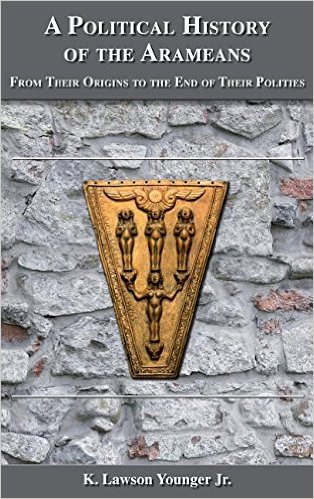
At the end of last week, after a lengthy delay, we were happy finally to get our grubby mitts on Lawson Younger’s newest book, A Political History of the Arameans: From Their Origins to the End of Their Polities (Atlanta: SBL, 2016).

Lawson Younger is a professor at Trinity Evangelical Divinity School, and I have had the pleasure of taking several of his classes during my sojourn in Illinois. I am not sure when he began work on this volume. I do recall attending a seminar that he first offered in the fall of 2006 entitled “Arameans and the Bible.” Since then, Younger has published a handful of book chapters and articles dealing with the Arameans and he has given several lectures on the subject. Now, 10 years later, that initial course has morphed into a two-inch-thick book.

This is a technical work packed with data and analysis—it is not fluff reading. Bible students will find much of interest in its pages, for Younger treats all biblical references to Aram/Arameans, beginning with the Patriarchs through the divided monarchy. But he does much more than that, covering Aramean kingdoms and entities that receive no biblical mention but that are attested in the textual and/or archaeological record of the Near East. It is quite an impressive accomplishment. Due to the nature of the sources, a good portion of the book is told from the perspective of the Assyrians as they campaigned to the West. There are over 100 maps, illustrations, and tables sprinkled throughout the chapters (we are quite fond of the maps). You should find that this volume will satisfy all of your Aramean-history needs, and at 857 pages, it should satisfy them for some time.

From the back cover:

This volume presents a political history of the Arameans from their earliest origins at the end of the Bronze Age to the demise of their independent polities. Employing the most recent understanding of tribal political structures, aspects of mobile pastoralism, and models of migration, K. Lawson Younger Jr. takes a regional approach to explain the rise of the Aramean political institutions. He thoroughly explores the complex relationships and interactions of the Arameans with the Luwians, the Assyrians, and the Israelites. By drawing on all available sources—sociological, textual, and archaeological—Younger is able to develop a comprehensive picture of this complex and important people whose influence and presence spanned the Fertile Crescent during the Iron Age.

A Political History of the Arameans can be purchased in hardback ($118) or in paperback ($98). (Apparently, SBL has chosen to opt for European publishers’ pricing on this title which is too bad.) Below is the table of contents.

1.      Preliminary Issues
     a.     Geographic Issues
     b.     Chronological Issues
     c.     Linguistic Issues: Luwian, Phoenician, Akkadian, Aramaic
2.      The Origins of the Arameans
     a.     The Word “Aram” in the Earliest Sources
     b.     The Question of Qir/Kir
     c.     Socially Constructed Groups
     d.     Nomadism
     e.     Links with the Aḫlamû and Sutû
     f.     Aram in the Biblical Texts
3.      The Rise of the Aramean Polities in Iron I
     a.     The Hittite Sphere
     b.     The Assyrian Sphere
     c.     The Levantine Sphere
4.      The Aramean Polities of the Jezirah
     a.     The Early Renewal of Conflict between Arameans and Assyrians (934-884 BC)
     b.     Temanites
     c.     Gōzān/Bīt-Baḫiāni
     d.     Azallu, Bīt-Yaḫiri
     e.     The Laqē Confederation
     f.     Bīt-Zamāni
     g.     Aramean Tribal Entities of the Jezirah
5.      Bīt-Adīni
     a.     Territory
     b.     History
     c.     Šamšī-ilu
6.      Samʾal/Yādiya/Bīt-Gabbāri
     a.     Introduction
     b.     Territory
     c.     History
7.      Hamath and Luǵath
     a.     Territory
     b.     History
8.      Bēt-Gūš/Arpad
     a.     Territory
     b.     History
9.      Aram-Damascus
     a.     Introduction
     b.     Territory
     c.     History
10. Arameans in Southern Mesopotamia
     a.     Aramean Tribal Entities of the Jezirah
     b.     Aramean Tribes of Southern Mesopotamia
11.      Conclusion

Side note: For a treatment of the Aramean oppression of Israel from the Israelite perspective, I recommend this work.
Share:

An ancient Christian “crossword puzzle” has been discovered in the agora of Smyrna.

A sewage system in the Urartian city of Van that dates to 800 BC has been fully excavated.

You missed the first-ever “Swim the Corinth Canal” event, but perhaps you can join next year.

Greece’s National Archaeological Museum is celebrating its 150th anniversary.

At the ASOR Blog, the executive producer of a new documentary about Gertrude Bell provides some background. You can also watch the trailer.

New paper at Academia: “Computer Experiments on the Khirbet Qeiyafa Ostracon,” by Eythan Levy and Frédéric Pluquet.

Nigel Fletcher-Jones considers the ethical problem of the public display of mummies and alternative approaches.

A French-Egyptian citizen turned over a golden mummy mask to the Egyptian government.

The November/December issue of Biblical Archaeology Review is now online.

If you’re a subscriber to the Wall Street Journal, you can read Roger Toll’s “The Real Adventurer’s Guide to the Ancient City of Petra.”

I made it into Wayne Stiles’s post this week about the Dead Sea Scrolls. Check out the great quote by Frederic G. Kenyon.

Shmuel Browns shares a couple of photos he took at Machtesh Qatan.

The extraordinary Bible collection of the late Charles Ryrie is being auctioned off by Sotheby’s.

HT: Charles Savelle, Agade, Joseph Lauer, Ted Weis, Paleojudaica

UPDATE: Next weekend’s roundup will be delayed by several days.

Share:

A couple of Israeli scholars are suggesting that the Hasmonean Hall (aka “Hall of the Freemasons”) in the Western Wall Tunnels may have served as a triclinium for Jerusalem’s city council.

Scientists working in Galilee have discovered caves used by rebels in the Jewish Revolt. For a more academic study, see this journal article.

The eastern temple of Ramses II at Karnak has been opened after restoration.

Excavations at Petra have revealed new information about the water systems that kept the city alive 2,000 years ago.

Municipal workers in Turkey’s Çanakkale province discovered gold jewelry in an 8th century BC sarcophagus.

Russia is sending a team of scientists to investigate World Heritage sites in Syria allegedly destroyed in the civil war.

The Basrah Museum is opening soon in a former palace of Saddam Hussein.

The Archaeological Museum of Kos re-opened up last month after renovation.

A competition is being held for the architectural design of the new Cyprus Museum in Nicosia.

The International Criminal Court in The Hague has ruled that destroying cultural antiquities is a war crime.

Wayne Stiles’s new post on the history and significance of Eilat is filled with lots of photos I really like.

Ferrell Jenkins shares a photo of a beautiful sunrise over the Sea of Galilee.


Haaretz reviews the best of archaeology in Israel this past (Jewish) year.

John S. (Jack) Holladay died last week. He was a long-time professor at the University of Toronto and he was involved in excavations at Gezer and in the Wadi Tumilat Project.

HT: Agade, Charles Savelle, Joseph Lauer

Share:

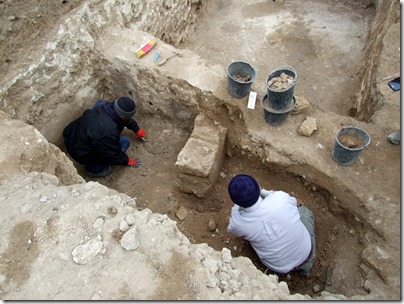
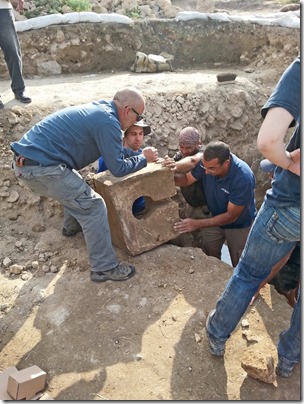
Archaeologists working at Tel Lachish have excavated the second half of a six-chamber gate and claim to have discovered two horned altars suggested that this was a “shrine in the gate” that was desecrated in the reforms of Hezekiah (2 Kgs 18:4). The evidence of the desecration is a stone toilet that was never used but that recalls Jehu’s conversion of the Baal temple in Samaria into a latrine (2 Kgs 10:27). The horns of one(?) of the altars were removed in the reform as well. The gate was destroyed in the invasion of Sennacherib in 701 BC.

For more information, take a look at the IAA press release or read the reports in the Jerusalem Post and The Times of Israel. The first four photos are courtesy of the Israel Antiquities Authority. More photos and videos are available here. I’m curious to see Aren Maeir’s take, but he has not yet posted on it.

HT: Joseph Lauer, Chris McKinny

1
Aerial view of the excavated gatehouse at Tel Lachish.
Photo by Guy Fitoussi.
4
Excavation of the gate shrine with the “altar” visible in the center. Photo by Saʽar Ganor.
7
Evidence of “altar’s destruction.” Photo by Yoli Shwartz.
14
Removal of the stone toilet. Photo by Igor Kramerman.
Lachish inner gate reconstruction, tb060816602
Reconstruction of gatehouse, taken in June, following the January–March excavations.
Share:

Digital imaging technology has virtually opened an ancient scroll from En Gedi to reveal the first two chapters of Leviticus. The publication in Science Advances includes a number of photos. Another article published in Textus is also online. The portions deciphered so far exactly match the Masoretic Text, but the radiocarbon date of 3rd-4th centuries AD differs from the paleographer’s date to the 1st or 2nd centuries.

The discovery of a menorah at Abila provides the first evidence of Jewish presence at this city of the Decapolis.

2,000-year-old human skeleton remains have been found buried at sea near a shipwreck at Antikythera, Greece.

A fisherman’s house from the Ottoman period was discovered along the beach in Ashkelon.

Bedouin youths have helped to excavate Byzantine-era farm buildings in the Negev.

A new virtual reality tour in Jerusalem takes “visitors” inside the Temple. There’s a short video clip here.

Archaeologists plan to finish reconstruction work on Laodicea’s Hellenistic theater within three years.

The Malawi Archaeological Museum in Minya was reopened this week after three years of renovation.

Omar Ghul, an epigrapher at Yarmouk University, discusses important inscriptions discovered in Jordan.

Laïla Nehmé is interviewed by Ancient History Etc. about the history of the Nabateans.

Ferrell Jenkins concludes his series on Iznik (Nicea) with a post on the modern city and its vicinity.

Wayne Stiles considers the history and the lessons from Hezekiah’s Tunnel.

Chris McKinny will be lecturing at Texas A&M Corpus Christi on October 3 on the Late Bronze finds from Tel Burna.

On sale for Kindle for $2.99: Do Historical Matters Matter to Faith?, edited by James K. Hoffmeier and Dennis R. Magary. I require several of the chapters for at least one course I teach.

Mordechai Gichon died this week.

Ferrell Jenkins remembers Erle Verdun Leichty on the announcement of his passing.

HT: Joseph Lauer, Agade, Ted Weis, Charles Savelle

Share: