(Post by A.D. Riddle)

Yesterday we mentioned the Royal Inscriptions of the Neo-Assyrian Period publication project. The Neo-Assyrian kingdom (sometimes empire) began with the reign of Tiglath-pileser II ca. 966 B.C. and continued for 3-1/2 centuries until 609 B.C. when the Assyrians were definitively defeated by the Babylonians.

The first Neo-Assyrian king to have direct contact with Israel was Shalmaneser III, who ruled 858-824 B.C. Shalmaneser III is not mentioned in the Bible, but he mentions two kings of Israel in his inscriptions. A version of Shalmaneser III’s royal annals was inscribed on the Kurkh Monolith, a stele found at the base of the tell at Kurkh (now modern Üçtepe), near the Tigris River in Turkey. The annals recount (among other things) Shalamaneser III’s campaign in 853 B.C. to Qarqar where he fought a coalition of kings including Irhuleni of Hamath, Hadad-ezer of Damascus (possibly Ben-Hadad II), and Ahab of Israel. See Michael Caba’s post about the Kurkh Monolith here.


This same Neo-Assyrian king about 12 years later, in 841 B.C., campaigned against Damascus and in the process received tribute from Jehu of Israel. The event is recorded in several of Shalmaneser III’s inscriptions and is pictorially represented on the Black Obelisk. Again, see Michael Caba’s post about this monument here.
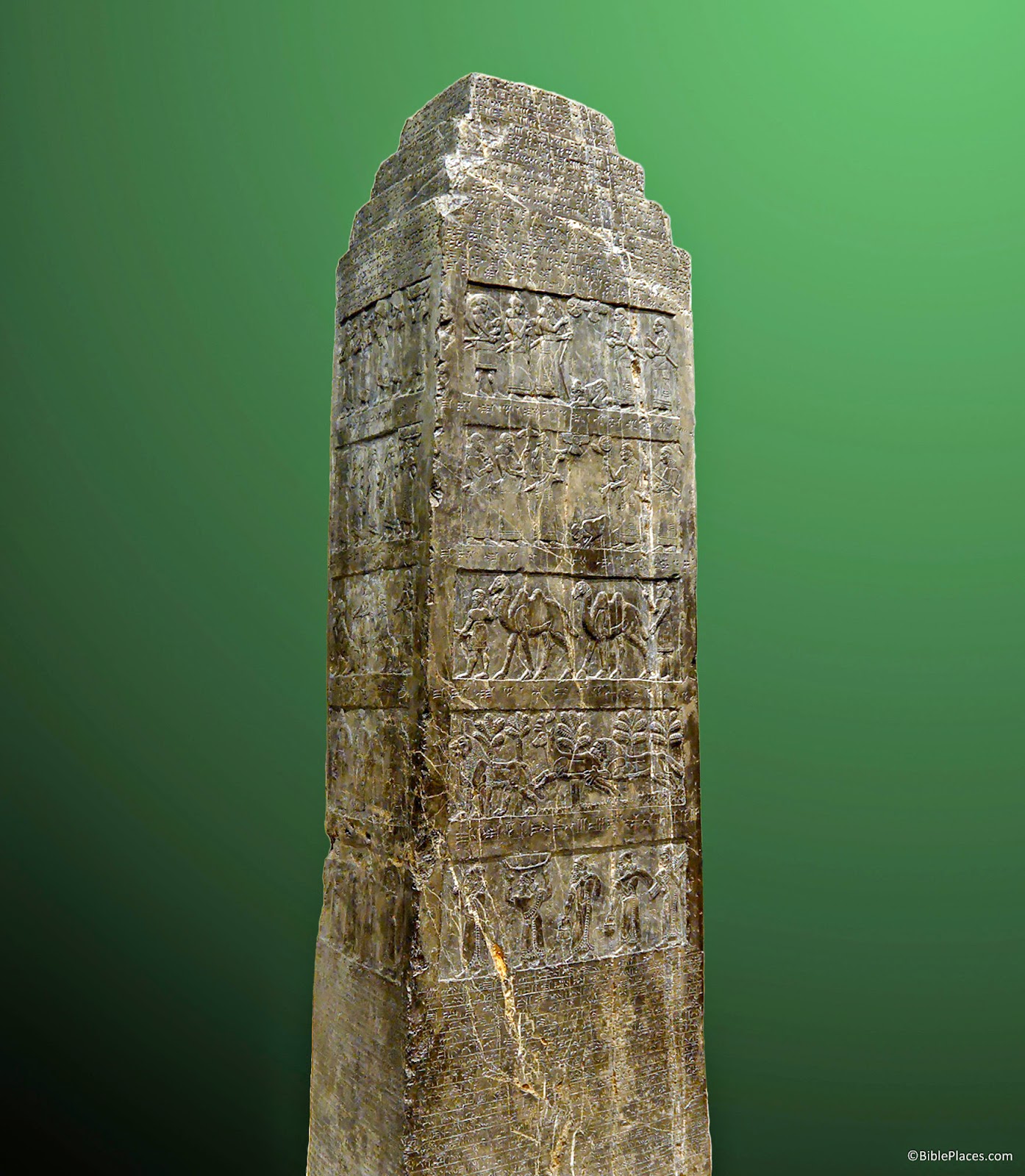
Black Obelisk (British Museum).

Following were a series of five kings who oversaw a period of relative weakness in the Neo-Assyrian monarchy: Shamshi-Adad V, Adad-nerari III, Shalmaneser IV, Ashur-dan III, and Ashur-nerari V. Although military campaigns were still conducted, this period saw rebellions in the heartland of Assyria, increase in the number of years the Assyrian king did not go on campaign, the rise in power of Assyrian governors who in some ways behaved as kings in their own right, and the massive expansion of Urartu to the north which posed a threat to Assyria.

None of these five kings are mentioned in the Bible, and only Adad-nerari III mentions a biblical king. During a campaign against Damascus in 796 B.C., Adad-nerari III received tribute from Jehoash of Israel.

The next king of Assyria, Tiglath-pileser III, paved the way for the Assyrian empire’s greatest expansion and he initiated the demise and eventual fall of the northern kingdom of Israel. Tiglath-pileser III and the next five kings are all mentioned by name in the Bible. Furthermore, these kings mention several kings of Israel and Judah in their inscriptions.

  • Tiglath-pileser III
    • 2 Kings 15:29; 2 Kings 16; 1 Chronicles 5:26; 2 Chronicles 28:20
    • Mentions Menahem of Israel, Pekah of Israel, Hoshea of Israel, Uzziah/Azariah of Judah, and Ahaz of Judah
  • Shalmaneser V
    • 2 Kings 17:3; 2 Kings 18:9
    • Conquers the northern kingdom of Israel in 722/721 B.C.
  • Sargon II
    • Isaiah 20:1 = campaign to Ashdod in 712 B.C.
  • Sennacherib
    • 2 Kings 18–19; 2 Chronicles 32; Isaiah 36–17
    • Mentions Hezekiah of Judah (see Michael Caba’s post here)
  • Esarhaddon
    • 2 Kings 19:37; Ezra 4:2; Isaiah 37:38
    • Mentions Manasseh of Judah
  • Ashurbanipal
    • Ezra 4:10
    • Mentions Manasseh of Judah
Stele of Tiglath-pileser III from Iran in which he mentions Menahem (Israel Musum).

There were at least four more kings after Ashurbanipal, but none of these are mentioned in the Bible, nor do any of them mention kings of Judah, for the Neo-Assyrian kingdom collapsed and ceased to exist within 18 years. The Medes captured the city of Ashur in 614 B.C., and the city of Nineveh in 612 B.C. The Babylonians pursued the Assyrians westward, defeating them at Harran in 610 B.C. and finally at Carchemish in 609 B.C.

Share:
(Post by A.D. Riddle)

The Royal Inscriptions of Mesopotamia (RIM) volumes are an excellent resource for reading and studying inscriptions by the kings of Babylonia, Assyria, Ur, and other Mesopotamian kingdoms. The texts are presented in transliteration and English translation, with brief introductions, catalogues of text exemplars, and bibliography. The RIM project was directed by A. Kirk Grayson at the University of Toronto.

RIM is divided up into RIME, RIMB, and RIMA. RIME = The Royal Inscriptions of Mesopotamia Early Periods, and includes volumes 1, 2, 3/1, 3/2, and 4.

  • Frayne, Douglas R. 2008. Presargonic Period (2700–2350 BC). The Royal Inscriptions of Mesopotamia Early Periods 1. Toronto: University of Toronto Press.
  • Frayne, Douglas R. 1993. Sargonic and Gutian Periods (2334–2113 BC). The Royal Inscriptions of Mesopotamia Early Periods Volume 2. Toronto: University of Toronto Press.
  • Edzard, Dietz Otto. 1997. Gudea and His Dynasty. The Royal Inscriptions of Mesopotamia Early Periods 3/1. Toronto: University of Toronto Press.
  • Frayne, Douglas R. 1997. Ur III Period (2112–2004 BC). The Royal Inscriptions of Mesopotamia Early Periods 3/2. Toronto: University of Toronto Press.
  • Frayne, Douglas R. 1990. Old Babylonian Period (2003–1595 BC). The Royal Inscriptions of Mesopotamia Early Periods 4. Toronto: University of Toronto Press.

RIMB = The Royal Inscriptions of Mesopotamia Babylonian Periods, of which only volume 2 was published. It would seem that RIMB volume 1 was supposed to have covered the Kassite Babylonian period, but I have seen nothing about the fate of this volume.

  • Frame, Grant. 1995. Rulers of Babylonia: From the Second Dynasty of Isin to the End of Assyrian Domination (1157–612 BC). The Royal Inscriptions of Mesopotamia Babylonian Periods 2. Toronto: University of Toronto Press.
RIMA = The Royal Inscriptions of Mesopotamia Assyrian Periods and includes volumes 1, 2, and 3.

RIMA 2 and RIMA 3 in particular get a lot of use in my own studies.

  • Grayson, A. Kirk. 1987. Assyrian Rulers of the Third and Second Millennia BC (to 1115 BC). The Royal Inscriptions of Mesopotamia Assyrian Periods Volume 1. Toronto: University of Toronto Press.
  • Grayson, A. Kirk. 1991 Assyrian Rulers of the Early First Millennium BC I (1114-859 BC). The Royal Inscriptions of Mesopotamia Assyrian Periods Volume 2. Toronto: University of Toronto Press.
  • Grayson, A. Kirk. 1996 Assyrian Rulers of the Early First Millennium BC II (858-745 BC). The Royal Inscriptions of Mesopotamia Assyrian Periods Volume 3. Toronto: University of Toronto Press.
The RIM volumes are not cheap, and many of them are now out of print. Several can be ordered from the University of Toronto Press’s website.

The RIM project was launched in 1978, and sometime around 2006 or 2007 (I am not sure of the exact chronology), it was discontinued. The last volume was published in 2008. I think the main cause was lack of continued funding. Unfortunately, the Assyrian royal inscriptions stopped at Ashur-nerari V, right before things get really interesting for the history of the southern Levant.

In 2006, Grant Frame, at the University of Pennsylvania, assumed direction of publication of the royal inscriptions, and thanks to Eisenbrauns, the Assyrian portion of the RIM project was revived under a new name, the Royal Inscriptions of the Neo-Assyrian Period, or RINAP. First, the RINAP project improved on the earlier RIM volumes by creating online indexes of personal names, deity names, place names, temple names, astronomical names, and so forth. Second, RINAP has already produced four volumes in print covering the reigns of Tiglath-pileser III, Shalmaneser V, Sennacherib, and Esarhaddon. In addition to the print volumes, RINAP has made the texts available online, in transliteration and English translation. You miss out on the introductions to the texts (important for making sense of them) and the bibliography that appear in the print versions, but you get the added feature of hyperlinked text which connects to a glossary and list of attested forms.

There are some other resources as well. The RINAP website is worth taking a little time to explore.

  • Tadmor, Hayim, and Shigeo Yamada. 2011. The Royal Inscriptions of Tiglath-Pileser III (744–727 BC) and Shalmaneser V (726–722 BC), Kings of Assyria. Royal Inscriptions of the Neo-Assyrian Period 1. Winona Lake: Eisenbrauns.
  • Grayson, A. Kirk, and Jamie Novotny. 2012. The Royal Inscriptions of Sennacherib, King of Assyria (704–681 BC), Part 1. The Royal Inscriptions of the Neo-Assyrian Period 3/1. Winona Lake: Eisenbrauns.
  • Grayson, A. Kirk, and Jamie Novotny. 2014. The Royal Inscriptions of Sennacherib, King of Assyria (704–681 BC), Part 2. The Royal Inscriptions of the Neo-Assyrian Period 3/2. Winona Lake: Eisenbrauns.
  • Leichty, Erle. 2011. The Royal Inscriptions of Esarhaddon, King of Assyria (680–669 BC). Royal Inscriptions of the Neo-Assyrian Period 4. Winona Lake: Eisenbrauns.

We were happy to hear just last week that Grant Frame has been awarded another grant for the RINAP project (see here). Volume 2, the reign of Sargon II, is nearly complete, and the article states that the grant money will be used for volume 5, the reign of Ashurbanipal.

Grant Frame, an associate professor of Assyriology in the Department of Near Eastern Languages & Civilizations in the School of Arts & Sciences (SAS) has been awarded a two-year, $250,000 National Endowment for the Humanities (NEH) grant for his Royal Inscriptions of the Neo-Assyrian Period (RINAP) Project.
The grant brings the total NEH funding Frame has received for the RINAP Project to nearly $950,000 since 2008.

Four books have been published so far by the RINAP Project; Frame is working on a fifth. The latest grant is for a sixth book, which will include most of the official inscriptions of Ashurbanipal (668c.-631 B.C.E.). Frame hopes to complete the Project with a seventh volume containing the remainder of Ashurbanipal’s inscriptions and those of his successors, up until the fall of Assyria.


We are grateful to Eisenbrauns and Grant Frame for taking on the task of seeing through to completion the publication of these royal inscriptions. Jamie Novotny also appears heavily involved in several steps of the project as well, and there are surely many others. The RINAP volumes are available from Eisenbrauns here.

HT: Agade
Sources:

Royal Inscriptions of Mesopotamia Project

RIM volumes listed at Eisenbrauns—all out of stock.

RIM volumes available from University of Toronto Press

History of the RINAP Project, by Jamie Novotny

Share:

Archaeologists found Egyptian artifacts from the Late Kingdom period in a cave in southern Israel near Kibbutz Lahav.

Arad would like to become a tourist destination in southern Israel.

A researcher believes that the famous “Meidum Geese” painting from ancient Egypt is actually a modern fake.

Now is a good time to visit Egypt.

The 2,000-year-old date palm known as Methuselah has turned out to be male, but there is hope that another seed may produce a female plant. The scientist would like to produce an orchard of ancient date palm trees.

A large Iron Age fortification has been discovered at Ashdod-Yam, the port of the ancient Philistine city of Ashdod.

Eisenbrauns is having a big sale on excavation reports, including works on Ashkelon, Tel Malhata, Megiddo, Tell el-Borg, Timnah, and Dothan.

Tel Burna – The Late Bronze and Iron Age Remains after Five Seasons, by Chris McKinny, Deborah Cassuto, and Itzhaq Shai.

New from Zondervan: The Most Significant People, Places, and Events in the Bible: A Quickview Guide, by Christopher Hudson.

Larry G. Herr favorably reviews Biblical Lachish, by David Ussishkin.

A £2 million statue looted from Cyrenaica, Libya, was confiscated upon entry to the UK.

A new video shows ISIS destroying Iraq’s UNESCO World Heritage city of Hatra.

The British Museum has proposed lending the Elgin Marbles to Greece.

They’re using drones in Jordan to track the looting of ancient tombs.

Test your knowledge of Bible numbers with the BAR Anniversary Bible Quiz.

HT: Charles Savelle, Agade, Joseph Lauer, Ted Weis

Share:

The Passover sacrifice was reenacted recently by Jewish priests-in-training. The Times of Israel article includes a graphic 3-minute video.

Wayne Stiles explains how God connected Passover, redemption, and the Holy Land. He also shows how archaeology helps us to understand the Passion Week.

BibleX shares how one can illustrate the triumphal entry using photos from the Pictorial Library of Bible Lands.

The Temple Mount Sifting Project found a finger from an Egyptian statue last week.

Leen Ritmeyer was recently interviewed on “Cry for Zion.” His blog lists some of the questions he was asked.

The Gazelle Valley Urban Wildlife Park opened in Jerusalem last week.

A.D. The Bible Continues airs Sunday evening on NBC. A trailer is online.

David Laskin visits sites related to King Herod in a travel piece in the New York Times.

Archaeologists have discovered an ancient Egyptian brewery in Tel Aviv.

Passages opened yesterday in Santa Clarita, California.

The Egyptian Museum in Turin, Italy, has re-opened after a five-year restoration. This is the only museum entirely devoted to Egyptian culture outside of Egypt.

A new technology will reduce the length of time required for carbon-14 dating from six weeks to two days.

Accordance’s 20% off sale ends on Monday (with code Celeb2). That discount applies to our own photo collections, including The American Colony Collection ($30 off), Views That Have Vanished, and the new ones: Cultural Images of the Holy Land and Trees, Plants, and Flowers of the Holy Land.

HT: Agade, Ted Weis, Joseph Lauer

Share:

What does a field archaeologist carry in his dig bag? I like Eric Welch’s answer.

After a porcupine uncovered a Byzantine oil lamp in Emek Hefer, the Israel Antiquities Authority was up in arms. “The IAA calls on all porcupines to avoid digging burrows at archeological sites and warns that digging at an archeological site without a license is a criminal offense.”

Why did people stop eating pork in the ancient Near East around 1000 BC? A new study suggests one answer.

A new video from the Museum of the Bible reveals some of the work of the Green Scholars Initiative and the associated educational tools being developed for use in Israel and the U.S.

“Visual data about cultural heritage sites within conflict zones in near real-time has become possible with new technology, particularly satellite imagery.” This article considers the ethical questions.

BBC Magazine: The men who uncovered Assyria.

Three Jordanians who floated to the Israeli side of the Dead Sea were returned to Jordan.

The Oriental Institute of the University of Chicago has several courses and workshops scheduled for the coming months.

Now free at The Bible and Interpretation: the first two chapters of Ancient Israel’s History: An Introduction to Issues and Sources, edited by Bill T. Arnold and Richard S. Hess.

Sad news: William W. Hallo died on Friday. A funeral service is scheduled for 1:00 pm, Monday,
March 30, at Mishkan Israel, 785 Ridge Road, Hamden, Connecticut.

The Agade list is now being archived at the SBL website.

HT: Agade

Share:

Just before Palm Sunday, Jesus made the trek from Jericho to Jerusalem. What did he see?

A good book to read this week in the days leading up to Good Friday is The Final Days of Jesus, now $3.99 on Kindle.

The Temple Institute has built a sacrificial altar to be used in the Third Temple. Leen Ritmeyer comments.

Who is buried in the Prophetess Hulda’s tomb on the Mount of Olives? Miriam Feinberg Vamosh considers the question in a premium article at Haaretz.

The city of Afula plans to preserve its archaeological remains which span from the Chalcolithic to the Crusader periods.

Aren Maeir visited Hebron and took some photos of the ancient fortifications.

Leon Mauldin is in Athens now and shares some photos from the acropolis museum.

A large underground city has been discovered in Cappadocia.

You can vote for your favorite excavation photo in this year’s AIA Photo Contest. (No registration required.)

Now $0.99 on Kindle: The World and the Word: An Introduction to the Old Testament, by Eugene H.
Merrill, Mark Rooker, and Michael A. Grisanti. Also $0.99 on Vyrso.

HT: Agade

Share: