(Posted by Michael J. Caba)

 
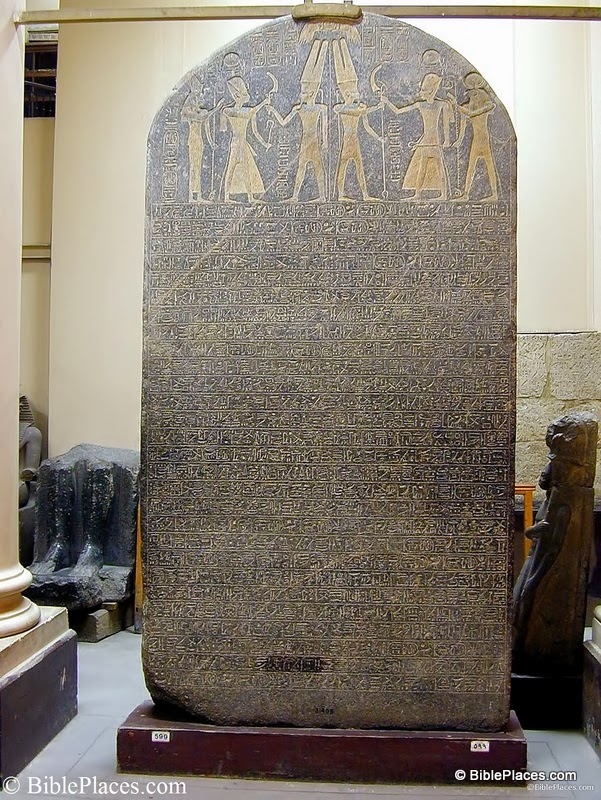
This month’s artifact is an engraved slab of granite that is more than ten feet tall. It was discovered in 1896 in Western Thebes, Egypt by Sir Flinders Petrie and it contains the oldest* certain reference to “Israel” outside of the Bible. It is commonly referred to as the Merneptah Stela and the text was carved c. 1210 BC in hieroglyphs under the auspices of Pharaoh Merneptah.  It is now located in the Egyptian Museum in Cairo, and the word “Israel” is in the darkened section in the second line from the bottom that can be seen more clearly by clicking on the photo to enlarge it.
 
The wording on the stela is hymnic in nature and recounts the military exploits of Pharaoh Merneptah, especially against the Libyans. Indeed, of the 28 lines of inscribed text, 23 deal with the Libyan conflict. It is only in the later part of the inscription that Israel is mentioned, and in this regard the Israelites are referred to with the language designating them as an ethnic group instead of a settled nation state. This description is fully in line with the Biblical portrayal of the Israelites during the era of the Judges, which represents them as a  people group lacking in central leadership and without a capital city.  
 
(Photo: BiblePlaces.com. Significant resource for further study: The Context of Scripture, Volume 2, page 40-41.)
 
*The Berlin Pedestal may contain a reference to Israel that is older than the Merneptah Stela. See:  Israel in Canaan (Long) Before Pharaoh Merenptah? A Fresh Look at Berlin Statue Pedestal Relief 21687. Journal of Ancient Egyptian Interconnections 2.4: 15–25.


Share:

The latest Caspari Center Media Review includes a brief summary from the Hebrew-language Yerushalayim Shelanu of tourism to Israel in 2012.

56% of the 2.88 million tourists who visited Israel were Christian. Of these, 90% visited Jerusalem, 68% visited the Dead Sea, 62% visited Tiberias and the Sea of Galilee, and 60% visited Bethlehem. Most Christian tourists come from Italy, Spain, Germany, Austria, Poland, Mexico, Russia, Romania, and Nigeria.

A photo of a flock of tourists all wearing floppy orange hats would fit right here.

Share:

In my estimation, perhaps the most interesting lecture series related to biblical archaeology is that held each year by the International Women’s Club at Tel Aviv University. They bring in outstanding lecturers who discuss topics of broad interest.

This year’s theme is “In the Eye of the Storm—‘Jerusalem in History and Archaeology Through the Ages.’” The schedule is as follows:

February 18: Dr. Gabriel Barkay, Jerusalem of Kings and Prophets

February 25: Prof. Avraham Faust, Jerusalem and Sennacherib: The City, before, during, and after the Assyrian Campaign of 701 BCE

March 4: Dr. Joe Uziel, Recent Excavations in Jerusalem and Their Importance for 
Understanding the First Temple City

March 11: Dr. Stephen Gabriel Rosenberg, “The Hezekiah Tunnel.” How Was It Built and Why Was It Built?

March 18: Dr. Stephen Gabriel Rosenberg, The History and Archaeology of the Book of Esther

March 25: Dr. Guy Shtibel, “By Far the Most Famous City of the East” – Herod and Jerusalem

April 1: Dr. Guy Shtibel, The Eagle and the Flies – The Roman Siege of Jerusalem

April 8: Dr. Guy Shtibel, “Between Two Cities” – From Jerusalem to Aelia Capitolina

April 29: Dr. Yonatan Adler, Mikva’ot (Ritual Baths) in Late Hellenistic and Early Roman Jerusalem

May 13: Dr. Shlomit Weksler-Bdolah, Jerusalem (Aelia Capitolina) in the Roman Period: The Foundation of the Roman Colony and the Bar-Kokhba Revolt

May 20: Dr. Oren Gutfeld, From Aelia Capitolina to Hagia Polis Hierosalima: Changes in the Urban Layout of Jerusalem

June 10: Mr. Perez Reuven, The Umayyad Building Project on the Temple Mount and Its Environs

Individual lectures cost 50 NIS; the entire series is 400 NIS. The lectures will be held 9-11:30 am in the Gilman Building, Room 282, Tel Aviv University. A flyer with contact details is available here.

Share:

Excavations in Hebron have already revealed an Iron Age house, artifacts from the 10th century, and Second Temple period items.

Nadav Shragai writes in Israel HaYom on recent Temple Mount discoveries that have not been publicized.

Plans are underway for a new museum at Petra.

The Rapid City Journal recounts how a collection of cuneiform tablets came to be in the collection of Black Hills State University in South Dakota.

National Geographic presents “Indiana Jones and the Adventure of Archaeology,” a new exhibition coming to the Fort Worth Museum of Science and History.

Ferrell Jenkins has posted several entries recently in his Visualizing Isaiah series: a skirt of sackcloth, trusting in horses and chariots, and a booth in a vineyard.

Jerusalem’s Biblical Zoo has welcomed a new male lion to replace the one who died last year.

ASOR has a roundup of stories from around the world.

HT: Joseph Lauer, Charles Savelle, Jack Sasson

Share:

The American Jewish University in Bel Air, California, is hosting the Simmons Family Charitable Foundation’s Twenty-Fifth Annual Program in Biblical Archaeology on Sunday, February 16, 9:00 a.m. – 4:30 p.m. The registration fee is $55. The schedule includes the following lectures:

Carol Bakhos, The Idea of Jerusalem in the Hearts of Those Who Call Out “Lord” or “Allah” or “Adonai”

Shimon Gibson, Christian Jerusalem: From Constantine the Great in the 4th Century to Emperor Heraclius in the 7th Century

Shimon Gibson, Jerusalem under the Moslems: from Caliph Omar to Saladin

Gabriel Barkay, When the Second Temple Stood

Gabriel Barkay, The Footprints of Kings in Jerusalem

The website includes more details about each lecture and provides a link for online registration. Gibson and Barkay are both excellent lecturers, and Jerusalem is a fascinating subject.

HT: G. M. Grena

Dome of the Rock, mat06204
The Dome of the Rock and Al Aqsa Mosque, early 1900s 
Photo from the American Colony Collection
Share:

(Post by Seth M. Rodriquez)

Our “obscure site” for the week was the location of a famous haircut.  Acts 18:18 tells us, “After this, Paul stayed many days longer [in Corinth] and then took leave of the brothers and set sail for Syria, and with him Priscilla and Aquila. At Cenchreae he had cut his hair, for he was under a vow.” (ESV)

The city of Cenchrea (or Cenchreae) was a port city near the Corinthian isthmus in Greece.  Paul was on his second missionary journey and had just completed his 18-month stay in the city of Corinth

When he passed through Cenchrea, he was reaching the end of his journey.  After this, he made a short stop at Ephesus, and then continued on to Caesarea, Jerusalem, and finally Antioch where he started his journey.  Cenchrea is also mentioned in Romans 16:1 where Paul mentions a lady named Phoebe who served the church in that city.

In the photograph below you can see the harbor of Cenchrea. This city served as the eastern port of Corinth, which explains why Paul passed through here on his way back to Jerusalem and Antioch.

John McRay, in his book Archaeology and the New Testament, provides the following information about Cenchrea:

Virtually nothing has been found of the main city of Cenchreae, which lay northwest of the harbor, because during five seasons of excavation from 1963 to 1968 the government restricted work to the harbor except in 1966. … The picturesque harbor thus far excavated, dates to the Roman period. … The Roman harbor originally contained about 1600 feet of shoreline and was 98,000 square feet. In comparison with other Greek and Roman harbors, this one was rather small …. Two large breakwaters, were constructed around a natural bay. The modern shore is about 7.5 feet lower than during New Testament times, due to seismic activity. The harbor’s breakwaters or moles are completely submerged. Pottery and coins give evidence to a city whose commercial life, prosperity, and general status was inextricably tied to Corinth’s. Almost all the coins uncovered have been of Greek mintage or from the eastern Mediterranean, confirming that Cenchrea’s commercial significance was the link it provided between Corinth and the east.

It is unfortunate that further excavations of the site have not been allowed, but that probably explains why we have not yet found the hair that was cut from Paul’s head. 😉

This map and photograph, along with over 800 other images, are available in Volume 11 of the Pictorial Library of Bible Lands, which can be purchased here for $34 (with free shipping).  Another photograph of the harbor at Cenchrea can be seen here on the BiblePlaces website. Ferrell Jenkins has a picture of the harbor available on his blog here. For other posts in our series on “obscure sites in the PLBL,” see here.

The excerpt is taken from John McRay, Archaeology and the New Testament (Grand Rapids: Baker Book House, 1991), pp. 336-337.

Share: