Though the lectures are in Hebrew and in Haifa, the subject matter merits re-posting this conference schedule from the Agade list.


THE KINGDOM OF DAVID AND SOLOMON IN LIGHT OF NEW EPIGRAPHIC AND ARCHAEOLOGICAL DATA
UNIVERSITY OF HAIFA / FACULTY OF HUMANITIES Department of Biblical Studies and 
Jewish History. Hecht Auditorium.
2013 Annual Meeting, Monday, December 2nd 2013
(All lectures will be presented in Hebrew)
08:30-09:00 OPENING SESSION

Greetings: Prof. Reuven Snir, Dean of the Faculty of Humanities, University of Haifa

Opening Remarks: Prof. Gershon Galil, Head of the MA Program “The Bible and its World”, University of Haifa

0900-1050 1st Session: THE ARABAH, THE NEGEV HIGHLAND AND THE NORTH. Presiding: Prof. Sariel Shalev, University of Haifa

09:00-09:20 Dr. Erez Ben-Yosef, Tel Aviv University, Transparent Archaeology and Biased Interpretations in the Study of the United Monarchy: Methodological Insights from the Ancient Copper Mines of the Arabah

09:20-09:40 Dr. Moti Heiman, Israel Antiquities Authority and Bar-Ilan University, The Iron Age II in the Negev Highland: Material Culture, Economy and Population in A Desert Environment

09:40-10:15 Prof. David Ussishkin, Tel Aviv University, “Solomon’s Gate” at Megiddo: A Debate of Fifty Years

10:15-10:35 Dr. Doron Ben-Ami, The Hebrew University of Jerusalem, Hazor in the Iron Age IIA: The Stratigraphical and Chronological setting of the First Fortified Town

10:35-10:50 DISCUSSION
10:50-11:00 BREAK

11:00-13:00 2ND SESSION: EPIGRAPHY, BIBLE AND ARCHAEOLOGY. Presiding: Prof. Shmuel Ahituv, Ben-Gurion University of the Negev

11:00-11:20 Dr. Haggai Misgav, The Hebrew University of Jerusalem, The 10th Century BCE Inscriptions Reconsidered

11:20-12:00 Prof. Amihai Mazar, The Hebrew University of Jerusalem, The Kingdom of David and Solomon and the Archaeological Research: An Ongoing Story

12:00-12:40 Prof. Gershon Galil, University of Haifa, Israel and Palistin in the 11th-9th Centuries BCE in Light of New Epigraphic and Archaeological Data

12:40-13:00 DISCUSSION
13:00-14:00 LUNCH

14:00-16:00 3RD SESSION: THE COAST, THE SHEPHELAH AND PHILISTIA. Presiding: Prof. David Ussishkin, Tel Aviv University

14:00-14:20 Dr. Ayelet Gilboa, University of Haifa and Prof. Ilan Sharon, The Hebrew University of Jerusalem, Capital of Solomon’s Fourth District? Israelite Dor

14:20-14:40 Mr. Saar Ganor, Israel Antiquities Authority, Seven Seasons of Excavation at Khirbet Qeiyafa

14:40-15:00 Dr. Madeleine Mumcuoglu and Prof. Yosef Garfinkel, The Hebrew University of Jerusalem, New Light on Solomon’s Palace and Temple and on the Second Temple in View of the Shrine Model from Khirbet Qeiyafa

15: 00-15:30 Prof. Avraham Faust, Bar-Ilan University, Between Judah and Philistia: Settlement Dynamics and Changes in Material Culture in the 10th Century BCE

15:30-16:00 DISCUSSION
Share:
post by Chris McKinny


This post is slightly different than previous “Secret Places” posts in that the secret to finding Qumran Cave 1 (and 2) has been out for a while due to Todd’s excellent post from back in 2010.

If you are interested in visiting Cave 1 (depsite Todd’s health warning) then you should definitely refer to the post linked above. If you don’t plan on making the dangerous trek up the cliffs of the Judean Wilderness or if you just want a slightly better idea of what Cave 1 looks like up close check out the model below. Click on the option “3D Model” to get an interactive view.


Share:

From the Jerusalem Post:

Antiquities Authority anti-theft officers and police from the Kiryat Gat station arrested a man on Sunday from Moshav Sde Moshe suspected of stealing antiquities from archeological sites in the Lachish region.
A few months earlier, Antiquities Authority enforcement officials caught him with a metal detector digging illegally in an archeological site, and they began to perform surveillance on him.
[…]
The arrest came two days after Antiquities Authority enforcement officials caught three men, two from Beit Lehem [Bethlehem] and one from Kfar Nahalin, illegally digging in an archeological site in Eila [Elah] Valley, near Beit Shemesh.
According to enforcement officials, the antiquities theft industry is a highly lucrative multi-million dollar illicit business involving illegal excavators, dealers and collectors working in Israel, the West Bank and abroad.
The most highly-skilled excavators come from villages in the South Hebron Hills, where generations have made a living illegally excavating antiquities from archeological sites within the Green Line. They search for all types of relics, but particularly coins from the Bar-Kochba era, which can fetch thousands of dollars from collectors abroad.

The full story is here. For every one they catch, there are probably 99 they miss.

UPDATE: A follow-up article is posted here.

Tekoa corner of large building, tb111706982
Illegal excavations at the biblical city of Tekoa
Photo from Judah and the Dead Sea
Share:

Mohamed Ibrahim, Egypt’s minister of state for antiquities, requests help in the Washington Post in fighting antiquities theft in his country.

Egypt’s future lies in its history, particularly its archaeological history. For hundreds of years the mystery and wonders of the pyramids, the sphinx and the Valley of the Kings have attracted visitors from around the world. Tourism is the lifeblood of Egypt’s economy and touches the lives of most Egyptians, whether they work as tour guides, restaurant owners, craftsmen or bus operators. Egypt’s history holds the prosperity of the country’s future generations, including that of youths — more than 40 million Egyptians are age 30 or younger — who are seeking opportunities.
But thieves are raiding our archaeological sites and selling their findings to the highest bidders. They are taking advantage of Egypt’s security situation to loot our nation’s economic future and steal from our children.
Egyptians need the people and the government of the United States to support our efforts to combat the systematic and organized looting of our museums and archaeological sites. Imagine a world in which the stories of King Tut, Cleopatra, Ramesses and others were absent from the collective consciousness. And with much of our history still waiting to be discovered under the sand, the potential losses are staggering. Antiquities theft is one of the world’s top crimes — after the trafficking of weapons, narcotics and people — but it is seldom addressed.
Egyptian antiquities are flooding international markets. Recent auctions at Christie’s in London and New York included several items from Egypt. Fortunately, when contacted, Christie’s in London withdrew a number of items that had been stolen from the tomb of King Amenhotep III, discovered in 2000 in Luxor. Among the items was a steatite bust of an official dating from 1793 to 1976 B.C.

The full op-ed is here.

HT: Jack Sasson

Three great pyramids with smaller pyramids of queens, tbs89289701
The Pyramids of Giza
(photo source)
Share:

(Post by Seth M. Rodriquez)

What is the most significant, ancient harbor city in Israel that hardly ever gets visited by tourists?

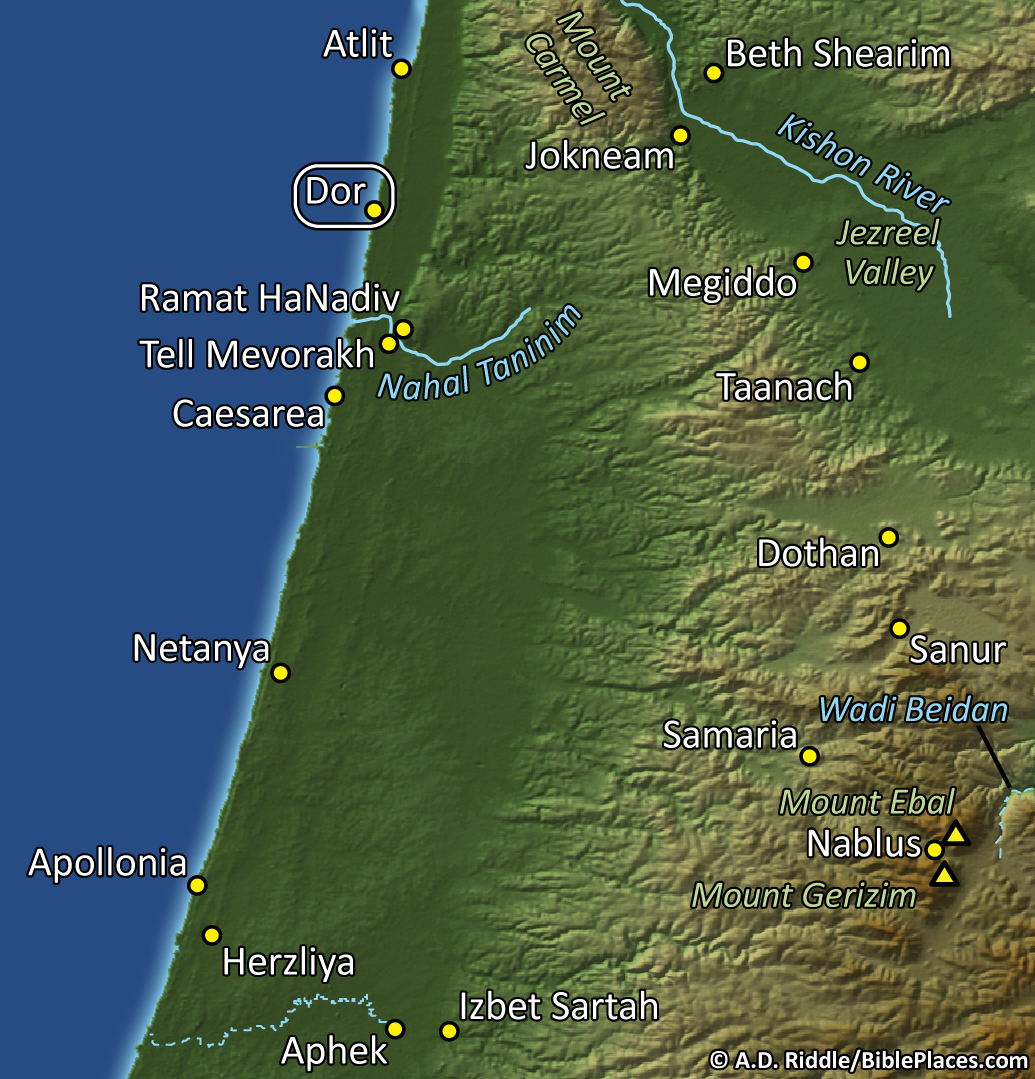
Everyone has heard of Caesarea, but that place is a young sprout compared to this site. Acco and Joppa are potential candidates, but even they get more publicity than this site. Continuing our series of “Obscure Sites in the PLBL” (or “What You Missed on Your Trip to the Holy Land”) we focus this week on the small but significant site of Dor.

The map below is from the PowerPoint files included in Volume 2 of the Pictorial Library of Bible Lands. Dor is circled in the top left section of the map.

Tel Dor is located on the small Plain of Dor, which is nestled between Mount Carmel and the Mediterranean Sea. For a description of this small region, you can read a post I wrote on the Wild Olive Shoot blog here. In that post you will learn that this small strip of land in Israel’s central region was more often controlled by foreigners than it was by Israelites. It served as a foothold into the region for Phoenicians and the Sea Peoples. In fact, in ancient times it was easier to get to this region by boat than it was by foot, due to the marshy terrain in the area.

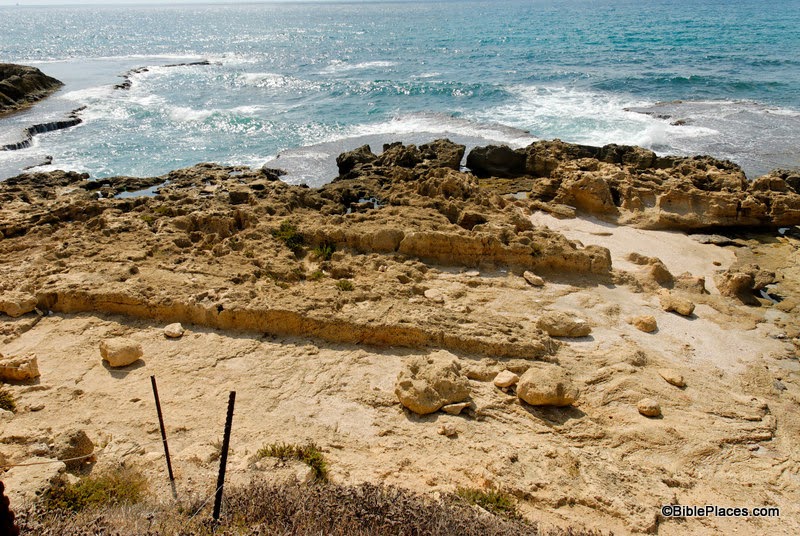
This brings us to the photo itself. Below you can see three boat slips used in ancient times by the inhabitants of Dor. The city was built right next to the sea which made it easy to haul boats in and out of the water. According to the excavators of Tel Dor, “The boat-slips are probably Hellenistic and/or Persian; they may have been dry-docks for fishing vessels, or berths for war-galleys.” (Reference: http://dor.huji.ac.il/areaE.html.) According to the photo annotations included in the PLBL, you won’t find boat slips like this at any other site on the eastern coast of the Mediterranean.

So the next time you’re in Israel, take a little time to explore this small (but significant) site. Archaeological remains from the time of Abraham to the period of the Crusaders have been found here. In addition to the boat slips, you will find the remains of a two-chambered gate from the Iron Age, two temples from the Roman Period, a purple dye factory used from the 1st to 6th centuries AD, a museum where you can see artifacts found in the area, and beautiful harbors where you can take a refreshing dip in the sea.

This photo and over 1,200 others are available in Volume 2 of the Pictorial Library of Bible Lands, which can be purchased here for $39 (with free shipping). Aerial shots of Tel Dor are available here and here on Ferrell Jenkins’s blog, and the Tel Dor excavation team has a very informative website at http://dor.huji.ac.il/. For more information on the region and additional photographs, see my post here.

Share:

The Caspari Center Media Review reports on a couple of items in the Israeli press of interest to this blog. The first is from an article in Haaretz on October 17.

The Catholic Church in Israel launched a petition demanding the removal of an electricity pole that was put up two years ago across from the Garden of Gethsemane, which is “one of the holiest [sites] to Christians – the place where tradition says Jesus and his disciples prayed together before Jesus was arrested by the Romans and crucified the next day.” The pole was put up at the request of Jewish settlers in East Jerusalem “who have asked to be disconnected from the Jerusalem District Electricity Corporation, which supplies electricity to Arab neighborhoods on the city’s east side.”
The Catholic custodian of the Garden of Gethsemane wrote in his petition that “the huge pylon obstructs the view of the Old City from the prayer garden of the church used by pilgrims. … One of the significant reasons for the popularity of the church is the unique view of the Temple Mount and the Old City, and the pylon utterly destroys this uniqueness.”
The judge presiding over this case criticized the placement of the pole, saying that “it was a beautiful corner of Jerusalem and in addition a holy place.” He later added, off the record, that the Israel Electric Corporation “would not have done it in the Kotel [Western Wall] plaza.” By the end of the hearing, “the two sides agreed to transfer the matter to the appeals committee of the Jerusalem Regional Planning and Building Committee.”

I do not have a photo of the pole, but if any of our readers do, you’re welcome to send it in and we’ll post it here.

UPDATE: See photo below.

The second is from HaModia and HaMevaser.

Prime Minister Binyamin Netanyahu will be traveling to Rome next week to meet with the pope; they will discuss, among other things, the transfer of certain holy sites to the custody of the Catholic Church. “It turns out,” says HaModia, “that the new pope has set a public declaration of the transfer as a condition for his promised visit to the land.” One of the sites in question is David’s Tomb, “which the Catholics have claimed as their own for hundreds of years.”
HaMevaser reports that Rabbi Haim Miller has appealed to Knesset Members in an effort to stop the deal from going through. Miller claims that it is better for the pope not to visit Israel than that the tomb be handed over to the Catholic Church, even if this causes a rift between the Vatican and Israel.

The full Caspari Center Media Review is here.

David's Tomb and Upper Room on Mount Zion, mat14676
David’s Tomb and the Upper Room on Mount Zion
Photo from Jerusalem

UPDATE: A.D. Riddle has sent along a photo that shows the electrical pole. On the right side of the photo, there’s a purple bush with the pole to the left.

Mount-of-Olives-and-Church-of-All-Nations-from-Old-City-wall,-adr1306224803
Church of All Nations and Garden of Gethsemane

UPDATE #2: Pat McCarthy notes that Haaretz has posted two photos of the pole.

UPDATE #3: Paul Mitchell points to Google Images which has a link to this image in an article dated to last year in the Jerusalem Post.

UPDATE #4: Shawn French has sent a photo of an old electric pole that tarnishes the view from Gethsemane.

clip_image002
View from Gethsemane towards Temple Mount, 2008
Photo by Shawn French
Share: