The Jerusalem Post reports on an excavation near the coast south of Haifa where thousands of teenagers are taught the value of archaeology each year.

The Tel Esur dig is the largest communal excavation in the country, [Dr. Shay] Bar said. “It’s a project of the community, for the community, for the education of the children of this community,” Bar said last week at the dig’s makeshift headquarters. He said that different skills involved in archaeology – from the meticulous digging required to unearth artifacts to careful record keeping – allow the teenagers to discover their talents. “Here they open like a flower,” he said. “They are flourishing.” On a typical day in Tel Esur, 150 children from four different schools work at different areas at the dig site, supervised by 20 staff members, volunteers and the students’ teachers. The teenagers don’t necessarily mix with students from other schools, in order to simplify the logistics, Bar said. Still, students from Arab and Jewish schools “can work five meters from each other” on a common project under the supervision of researchers from a variety of backgrounds, he said. At points throughout the day, students take a break from digging to hear short educational lessons about archaeology. Instead of discussions about who recently owned the land, the archaeologists attempt to instill an appreciation for the craft of the research. “They have to understand the value of history before they understand the relationship to different ethnicities that existed here,” said Netanel Petrushka, one of the archaeologists.

The full story is here.

Share:

Gordon Franz reports on his time at the “International Noah and Judi Mountain Symposium” in Sirnak, Turkey. He also provides a summary of a number of the presentations.

On The Book and the Spade this week: “Discovering Dalmanutha” with Ken Dark (direct link).

Norma Franklin believes the Megiddo water system was built during the Middle Bronze Age.

George Athas asks, “What’s New in Biblical Inscriptions?” and he suggests a cautious approach in announcing new discoveries.

An enormous Corinthian capital has been excavated at a temple of Hadrian in western Turkey.

A report in the Belfast Telegraph provides details about the ongoing excavations at Sidon.

Aviva and Shmuel Bar-Am provide a tour of Gezer.

Before there was writing, there were clay balls. Scholars are trying to decipher the code from objects found in Iran.

Dove Booksellers reports that the retail price is jumping up to $395 for The Oxford Encyclopedia of the Bible and Archaeology. It’s on sale for $257 until Tuesday (cheaper than Amazon).

HT: Jack Sasson, Joseph Lauer, Explorator

Mount Cudi from west, adr1005222380
Cudi (Judi) Dagh, possible location of Mount Ararat, from west
Photo from Eastern and Central Turkey
Share:

The world’s largest Ark of the Covenant has been donated to Israel.

Leen Ritmeyer discusses the little-known Jewish excavation underneath the Temple Mount.

As for the recent challenge to the identification of Herod’s tomb at the Herodium, Ritmeyer sides with Netzer.

Have you been to Joseph’s tomb at Shechem? Ferrell Jenkins gives the biblical significance and a recent photo.

The Ephraim of Jesus’ day is modern Taybeh. There are more reasons to visit than ever before.

The “most popular photo” at The Bible and Interpretation is one our sunset shots over the Sea of
Galilee.

Tomb of Joseph, Nablous, ef0131
Joseph’s Tomb in Shechem
Photo source
Share:

Two former students of Ehud Netzer are disputing their teacher’s claim that he discovered Herod’s tomb at the Herodium. Prof. Joseph Patrich and Benjamin Arubas, both of Hebrew University, presented a paper yesterday in which they argued that the hillside shrine may have served Herod’s family but not the king himself.

They argue that the newly discovered tomb could not have been built for King Herod:

  • The tomb is too modest for one who considered himself the greatest king.
  • The plaza next to the tomb was too small to accommodate the large crowd that Josephus describes.
  • The later construction of the monumental staircase does not reflect the careful planning characteristic of Herod.

Nir Hasson provides a detailed summary in Haaretz of the presentation given at the seventh annual “Innovations in Archaeology in Jerusalem and the Surrounding Area” conference. The article also includes some counter-arguments by Netzer’s successor Roi Porat. I find the latter more convincing.

HT: Joseph Lauer

Herodium model tomb of Herod, tb042512613
Replica of Herod’s mausoleum at Herodium
Share:

(Post by Seth M. Rodriquez)

In 1886, J. Leslie Porter finished a book called Jerusalem, Bethany, and Bethlehem which captured what life was like in Palestine in the mid- to late nineteenth century. It was in some sense a “snapshot” of the Holy Land at that time. In the book, he takes the reader on a journey from Joppa to Jerusalem and then to the surrounding regions. All along the way, he describes what you would have seen if you could have traveled there yourself and explains to you the historical significance of each place. In his own words, he says:

I have not attempted to write a learned treatise on the topography or history of Jerusalem. My task has been far simpler—to produce a book whose pictures, by pen and pencil, may perchance direct the attention of readers of all classes to scenes of absorbing sacred interest.

Things were beginning to change in Palestine during the mid-1800s, but at that point the Holy Land still looked more like the primitive culture it was in biblical times than like the modern country it became in the 1900s. You almost see the transformation taking place in the following excerpt from Porter’s work …

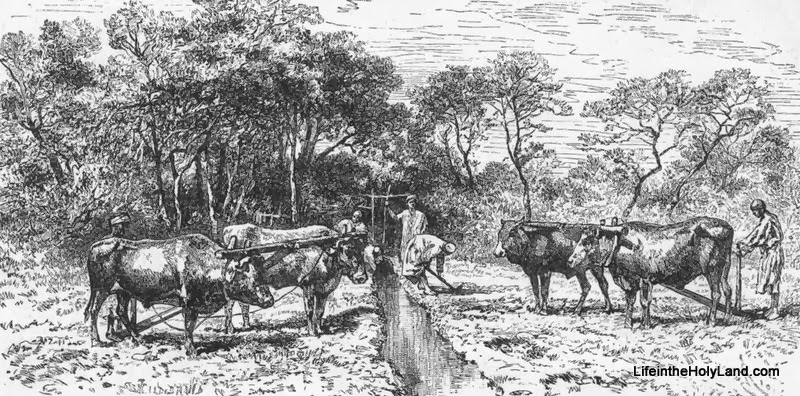
EGYPTIAN COLONISTS, JOPPA.

The road from Joppa to Jerusalem is the best in Palestine; in fact it may be said to be the only road in the country, for all others are merely bridle-paths, sometimes more like goat-tracks. The present road, thanks to French influence and money, is fit for wheeled conveyances, though the drive will call forth many a groan from those of delicate frames or weak nerves. But the scenery is fine; and the villages, people, ruins, and historic associations are sufficient to draw away the attention from physical discomfort. At first we wind through gardens of vegetables and groves of fruit-trees. Many imposing houses have recently been built; and we have all around us evidences of active life and reviving prosperity. Colonists from America, Germany, and even from Egypt, have settled here, attracted by a soil of unsurpassed fertility and a grand climate. Nowhere in the world are the orange-groves more luxuriant or the fruit of finer flavour. As we pass along we may notice the Egyptians at work in the fields, with their yokes of oxen and their ploughs so rude and primitive in design that it might be supposed they had come down unchanged from the days of Abraham. The ploughman, too, carries his goad—a weapon apparently better fitted for a lancer than a peaceful husbandman. After examining the size and make of one of those goads, I did not think the story of the sacred historian so very wonderful, that Shamgar, the Israelitish judge of old, should have slain six hundred men with an ox-goad.

To read more of the work, you can see an excerpt on LifeintheHolyLand.com by going here (for a high-resolution image) or here (for a low-resolution image). This image, about 90 other images, and the entire 170 pages of text from Jerusalem, Bethany, and Bethlehem are available here for only $15 (with free shipping). Additional images from the book can be seen here, here, and here (note that images from other historical works are shown on those pages as well).

Share:
(Post by A.D. Riddle)

About four years ago, we were happy to see the arrival of Barry Beitzel’s revised atlas, The New Moody Atlas of the Bible.

And now, this year, the atlas has been translated into Dutch, Italian, and German—for those who know a missionary, a mother-in-law who does not speak English, an overseas pen-pal, or a graduate student who has to learn foreign languages. (This list is not exhaustive. Some humor is intended.)

The newest translation which just appeared is the German Großer Atlas zur Bibel for €49,95. (Note that the link is to Amazon Germany, not Amazon USA.)

For the Dutch speaker/reader in your life, there is De grote Bijbelatlas for €35,28. (Note that the link is to Amazon Germany, not Amazon USA.)

For those seeking Italian, there is Nuovo atlante biblico (we could not find a link for ordering).

In the coming months, we have heard that the atlas will also be translated into Spanish, Portuguese, Korean, and Chinese.

Share: