(Post by Michael J. Caba)

image

The Grotto of Saint Paul, located in the foothills on the southern side of ancient Ephesus, has recently yielded intriguing finds related to early church history. The cave has been used from the early Christian era until the late 19th century for worship purposes, but was only “rediscovered” by modern researchers in 1995.

image

The grotto is adorned with numerous inscriptions and illustrations with the visual portrayals covering the gamut from Old Testament saints to soldiers from the Byzantine Middle Ages. The artwork itself ranges in age from the 4th century to the 12th/13th century, and the theme is consistently Christian.

The actual grotto enclosure is in the form of an elongated cavern measuring approximately 15 meters long, 2 meters wide and 2.3 meters high. The main passage leads back to a slightly expanded rectangular area measuring about 2.7 meters wide.

image

In the late 1990s Dr. Renate Pillinger from the University of Vienna discovered an early fresco on the western wall of the grotto’s passageway that includes a clear picture of the cave’s namesake, the Apostle Paul. The painting, which had been plastered over by subsequent occupants, is dated by Pillinger to the late 5th to early 6th century AD. The illustration also includes two women: Thecla to the left and her mother Theocleia to the right.

image

In the center of the image, Paul is shown seated with a book on his lap and his right hand raised with two extended fingers in a manner depicting a preaching gesture.

image

His discourse is the object of interest to the young woman Thecla, who is depicted on the left side of the fresco peering out a window.

image

The mural is actually a portrayal of an episode found in the apocryphal book, Acts of Paul and Thecla. Dated to the mid-2nd century AD, this text relates a story in which the betrothed Thecla listens from a window to Paul preach on “virginity and prayer.” Upon hearing Paul preach, Thecla reportedly decides to forgo her marriage and remain a lifelong God-fearing virgin, a decision for which she victoriously endures the heated opposition of friend and foe alike. Indeed, the hostility is so fierce that even her own mother (Theocleia) cries out, “Burn the wicked wretch.”

Not dissuaded from either her religion or chastity, Thecla is miraculously delivered from assorted ordeals and is reportedly even commissioned by Paul to “teach the word of God.” In this regard, Tertullian responded in De Baptismo:

But if the writings which wrongly go under Paul’s name, claim Thecla’s example as a license for women’s teaching and baptizing, let them know that, in Asia, the presbyter who composed that writing, as if he were augmenting Paul’s fame from his own store, after being convicted, and confessing that he had done it from love of Paul, was removed from his office.

The fact that Tertullian (c. 200 AD) was aware of the Acts of Paul and Thecla, and felt it necessary to comment on it, indicates both the text’s widespread circulation and its antiquity.

However, it appears that Tertullian’s denouncement of the book had little effect on the artist in Ephesus who portrayed one of its central scenes in a prominent manner in the cave.

Unfortunately, in order to protect its delicate contents, the grotto is not typically open to the public at large.

(Quotations from Acts of Paul and Thecla taken from Ante-Nicene Fathers, Vol. 8, pages 487-492. Tertullian quote taken from Ante-Nicene Fathers, Vol. 3, page 677.)
Share:

Plans to reconstruct Herod’s tomb at the Herodium have been scrapped.

The same article reports that the Herod exhibition at the Israel Museum has been extended to January 2014.

Tuesday’s Samaritan Passover ceremony is described in a Haaretz article. (I believe the first photo caption is wrong, for the animal is not slain until sunset.)

105 million euros is not enough to save Pompeii from deterioration, according to a New York Times video.

Ferrell Jenkins is back in Israel and he recently spent a morning with Shmuel Browns.

The Spring 2013 season at Tel Burna is over and they have found evidence of a destruction in the 9th century. There are still a few days left to sign up for the summer season.


Haaretz’s “Tourist Tip #218” describes the significance of the Broad Wall of Jerusalem.

The temporary bridge to the Mughrabi Gate next to the Western Wall still stands, but next month a committee is going to meet in Paris to discuss its replacement.

FoxNews reports on apps for archaeology.

Berlin’s Pergamon Museum has a new exhibition on the Mesopotamian city of Uruk. Better photos are available here.

Christianbook.com is now selling The New Interpreter’s Dictionary of the Bible (5 vols.) for only $99.99. (That’s 75% the $400 list.)

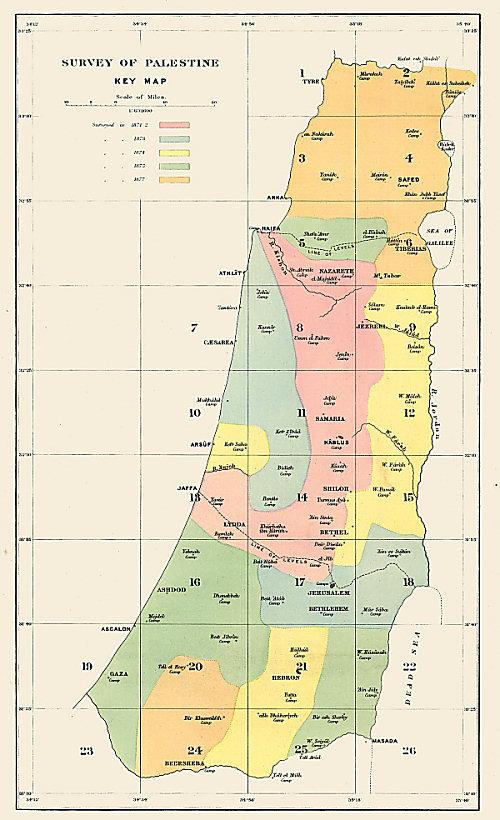
A rare, original set of the 13 volumes of the Survey of Western Palestine has just been listed by a UK bookseller for $6,400. For $35 more, you can pick up a digital copy of the oversized maps.

HT: Jack Sasson

Key Map for the Survey of Western Palestine. All 26 maps (plus one from Transjordan) are for sale here.
Share:
(Post by Chris McKinny) 

For an introduction to this series see here.

Studium Biblicum Franciscanum Museum at the Church of the Flagellation – Old City Jerusalem, Muslim Quarter 

Directions


View Secret Places: BiblePlaces in a larger map

Use the above map to find the Church of the Flagellation (it is near Hadrian’s Arch on the Via Dolorosa). Some nearby sites are Lion’s Gate (Rampart’s walk), the Western Wall Tunnels and the Pools of Bethesda. If you would like to visit the museum in conjunction with a tour of the Old City you might consider stopping at the museum after visiting the Temple Mount (use the northeastern exit near Lion’s Gate) or the Western Wall Tunnels (after exiting the tunnels walk directly across the street to the Church of Flagellation). The SBF museum is just inside the courtyard near the walkway to the bathrooms.

Operating Hours and Admission
The official website for the museum is here.
Open Tuesday-Saturday 9:00-1:00; 2:00-4:00
Entrance Fee – 5 NIS

Museum Information and Touring Suggestions
Biblewalks has a nice overview of the Church of the Condemnation/Monastery of the Flagellation’s history. Since our goal is to discuss the museum only we will leave the Church and its (historically problematic) tradition to others.

The SBF museum is by no means a “new” museum as it was originally founded in 1931 (it seems no coincidence that this followed the laying of the foundation of the Rockefeller Museum in 1930). Since then the museum has added to its collection through excavations sponsored by the Studium Biblicum Franciscanum. Some of these excavations include: Bab edh-Drah, Mt. of Olives (including Dominus Flevit), Nazareth, Bethlehem, Herodium, Machaerus, and Capernaum. Recently, the SBF museum has undergone a facelift and its exhibits are a bit more accessible. Their website describes the layout of the museum as follows:

Three rooms were dedicated to the excavations at Nazareth, Capharnaum and Dominus Flevit, respectively. This prominence was due in view of the importance these sites had in commencing a new era of Christian archaeology in the Holy Land, in unraveling the problem of Christian origins, especially the history of the Judaeo-Christian communities of Palestine.

In order of importance the other rooms are subdivided among other excavations made on the Mount of Olives, in the sanctuaries of Jerusalem and its vicinity, in the desert of Judea, in Transjordan, and in two Herodian fortresses Machaerus and Herodion. The purpose is to characterize the SBF collection in such a way as to be correctly perceived as Jerusalem’s archaeological Museum of Christian origins, at the service of scholars and pilgrims who, in ever greater numbers, visit the Holy Land.

In addition to these important collections, the SBF museum has a great collection/display of pottery from the Chalcolithic to Byzantine periods showing the different forms of vessels (e.g. jug) and their development through time. Of special note is their collection of lamps from the Early Bronze Age-Byzantine period—I know of no better location to witness the major shifts in the development of the lamp form. This is a great location to point out the difference between an Iron Age II “lamp unto my feet” (Psalm 119:105) and the kind of Roman lamp that the “ten virgins took…to meet the bridegroom” (Matt. 25:1).

Reconstruction of 1st cent. CE/AD house from Capernaum (i.e. Peter’s house)

As you might expect from a Catholic School/Monastery in Jerusalem the main thrust of the museum is directed towards Christian Archaeology (first century CE–Byzantine era), but that does not mean that there is not important material from earlier periods. There are some fantastic local Canaanite and imported Cypriot vessels from the Early Bronze-Late Bronze Age that come from the excavations in and around the ancient city of Jebus (cf. 2 Sam. 5). There are also some very nice Egyptian and Hyksos seals in the scriptorium room. For those interested in the early Canaanite period, do check out the back room where there is an exhibit on Bab edh-Dhra (Early Bronze–Intermediate Bronze, ca. 3300–2000 BCE).

For all of its strong points, the SBF museum’s artifacts do lack sufficient labeling for most of its materials. However, this seems to also be changing as they continue their facelift with plans of even adding a multimedia room in the near future.

Conclusion
In conclusion, the SBF museum should not be on your “must see” list whenever you visit Israel, however, if you have an extra half-hour to spend in the Old City it is well worth a visit even for first-time visitors. It is a decent stand-in for the Israel Museum if you don’t have enough time for a visit (although I would recommend the nearby Rockefeller Museum before the SBF). For returnees to the country I would strongly recommend checking out this small museum, as it will both inform visitors on the archaeology on some of Christianity’s most heralded sites, as well as help understand the development of Christian Archaeology in the Holy Land over the last century-and-a-half.

Share:

A report of the discovery of an ancient church building at Shiloh struck me as questionable. Because several churches have been discovered at Shiloh in the past (including one in 2006), I wondered if this was a recycled report. You can read the story as reported by Israel HaYom, YourJewishNews, and Algemeiner.

Yisrael Medad, a resident of modern Shiloh, clarifies that the discovery is simply more of the Byzantine basilica excavated by the Danish expedition in the 1920s. The new excavations revealed a destruction layer which may be dated to the time of the Samaritan Revolt in AD 529. Medad’s blog has photos of the new excavations.

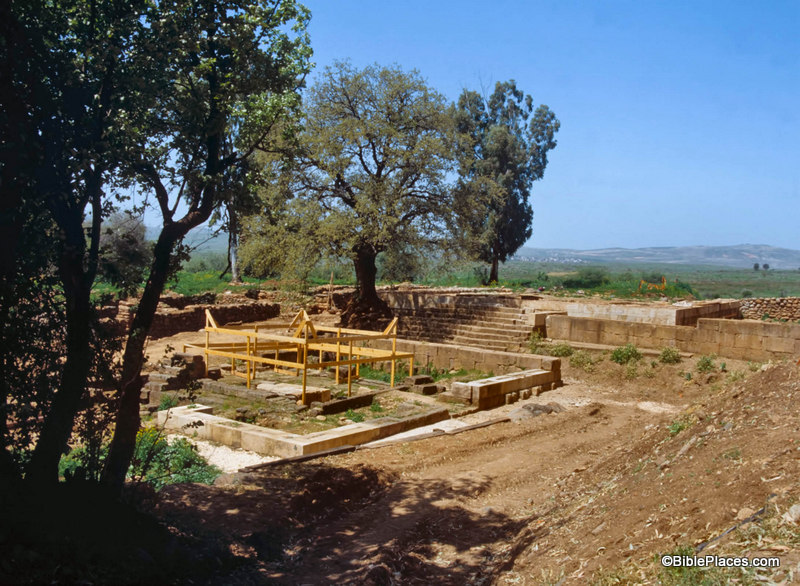
Shiloh Byzantine basilica from south, tb041106377
Area of Byzantine basilica of Shiloh with 20th century protective building. Photo from the Pictorial Library of Bible Lands.
Share:

(Post by Seth M. Rodriquez)

“Why go to Israel?”  Perhaps you’ve asked yourself that question before or someone else has asked it of you.  If you have been to Israel (or live there now) then you can probably think of several reasons why someone should go.  But for someone who has never been, this is a valid question.  After all, for most people in the world, it is a serious investment of time and money (and a certain amount of risk) to travel to the Holy Land.  Why go through all the trouble?

My favorite way to answer that question is to tell people that the Bible comes alive and somehow becomes more real when you go to Israel or any of the other lands of the Bible.  From our armchairs in what the Bible refers to as the “ends of the earth” (Acts 1:8), it is all too easy to fall into the trap of reading the Bible like you would read a fictional book.  Even if you believe every word is true, those times and places are so far removed from your everyday life that it is difficult to remember that the heroes in the Bible were real people who faced real challenges and who had to exercise real faith. 

However, traveling to biblical lands removes much of distance between you and the people in the Bible.  You see the biblical places with your own eyes and you become aware that you are standing in the same spot as David or Ruth or whomever.  Suddenly it hits you … “This is where it happened!” … and a biblical story will jump off the page into real life.

In my experience, such moments happen in different places for different people when they visit Israel.  Our picture of the week is of one of the places where it happened to me.  It comes from Volume 1 of the Pictorial Library of Bible Lands which focuses on Galilee.  It is a photograph of the High Place at Dan.  In the foreground is a reconstruction of a horned altar that once stood at that spot, and behind it are steps leading up to an elevated platform where one of Jeroboam’s golden calves once stood.

I was familiar with the story of Jeroboam’s idolatry when I first visited the site and could even point out for you on a map where Dan and Bethel were, the two places where Jeroboam erected golden calves for the Israelites to worship.  But it wasn’t until I was standing there, close to the spot where this picture was taken, that I ever stopped to think that there was an actual place on the globe where a golden calf had stood and where sacrifices were offered to it.  The absolute certainty of the place drove home to me the reality of 1 Kings 12:26-30.

Jeroboam said in his heart, “Now the kingdom will return to the house of David.  If this people go up to offer sacrifieces in the house of the LORD at Jerualem, then the heart of this people will return to their lord, even to Rehoboam king of Judah; and they will kill me and return to Rehoboam king of Judah.”  So the king consulted, and made two golden calves, and he said to them, “It is too much for your to go up to Jerusalem; behold your gods, O Israel, that brought you up from the land of Egypt.”  He set one in Bethel, and the other he put in Dan.  Now this thing became a sin, for the people went to worship before the one as far as Dan. (NASV)

So why go to Israel?  Well, for one thing, the Bible will come alive for you in ways you don’t expect.

This photograph and over 1,100 others are available in Volume 1 of the Pictorial Libary of Bible Lands which is available here for $39 (with free shipping).  Additional photographs of Tel Dan and links to more information about the site can be found on the BiblePlaces website here.

Share: