(Post by Seth M. Rodriquez)

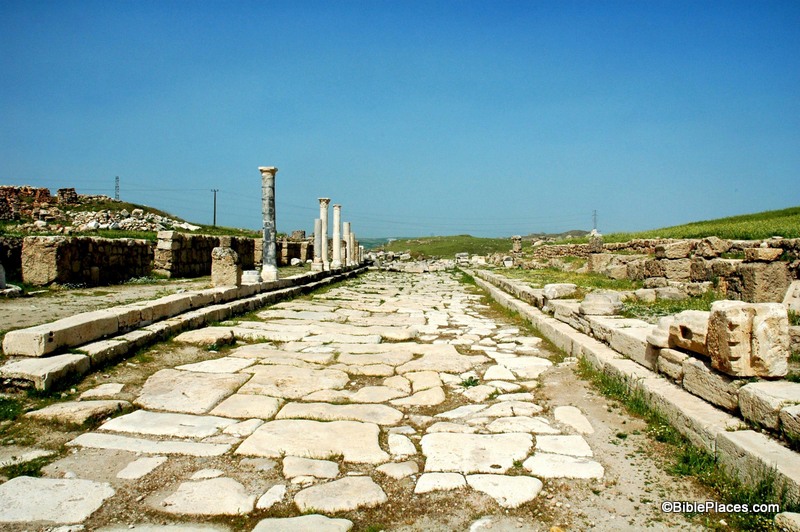
Last week, a link was provided on this blog to some fascinating 360-degree panoramas of the remains at Laodicea.  So our “picture of the week” comes from Volume 10 of the Pictorial Library of Bible Lands which focuses on Western Turkey.  The image captures the remains of the main street in Laodicea.
It is worth noting the biblical significance of this site, which is mentioned six times in the New Testament.  Paul refers to the city four times in his letter to the Colossians (Col. 2:1; 4:13; 4:15-16), and Jesus addresses the city in his Revelation to John:

14 “And to the angel of the church in Laodicea write: ‘The words of the Amen, the faithful and true witness, the beginning of God’s creation.
15 “‘I know your works: you are neither cold nor hot. Would that you were either cold or hot! 16 So, because you are lukewarm, and neither hot nor cold, I will spit you out of my mouth. 17 For you say, I am rich, I have prospered, and I need nothing, not realizing that you are wretched, pitiable, poor, blind, and naked. 18 I counsel you to buy from me gold refined by fire, so that you may be rich, and white garments so that you may clothe yourself and the shame of your nakedness may not be seen, and salve to anoint your eyes, so that you may see. 19 Those whom I love, I reprove and discipline, so be zealous and repent. 20 Behold, I stand at the door and knock. If anyone hears my voice and opens the door, I will come in to him and eat with him, and he with me. 21 The one who conquers, I will grant him to sit with me on my throne, as I also conquered and sat down with my Father on his throne. 22 He who has an ear, let him hear what the Spirit says to the churches.’” (Rev. 3:14-22, ESV.)

The cultural background of this passage is discussed in the PowerPoint notes included in the PLBL collection.  (As a side note, in my humble opinion, these notes are one of the most valuable features of the Pictorial Library.  They are a handy, concise source of reliable information about biblical sites.)  The notes in the Laodicea PowerPoint file state this:

Laodicea in Revelation

1. The church in Laodicea was the last and southeasternmost of the Asian churches addressed by John in Revelation (3:14-22). It was the only one of the seven letters written to churches of Asia Minor bearing no commendation …

2. This letter to the Laodiceans is filled with local allusions which would have brought his message to life for the people of the city.

   a. The church is said to be “poor,” contrasting with Laodicea’s role as the banking center of the province of Asia. Laodicea was famous for its wealth, changing money and minting its own coins since before the 1st century AD. Even when an earthquake destroyed their city in 60, the Laodiceans refused aid offered by Rome and rebuilt the city at their own expense.

   b. John also says that they are “blind”; Laodicea was the chief medical center of Phrygia. Nearby a temple and great medical center/school was dedicated to the Roman god Men Karou (identified with the Greek god Zeus), famous for its production of eye-salve from “Phrygian powder,” said to cure weak eyes. The irony is that these people, who took great pride in their medical skill, were unaware of their own spiritual blindness.

   c. The church is also said to be “naked,” a local allusion which relates to the major industry of the entire region: the manufacture and preparation of textiles. Laodicea’s glossy, black wool earned her a grand reputation, and her citizens wore black garments with pride, contrasting John’s advice to the Christians of the city to buy “white raiment, that thou mayest be clothed.”


So, like so many of the prophets in the Bible, Jesus uses the cultural environment of the hearers to drive home spiritual truths.  Understanding that cultural background leads us to a deeper understanding of the text.

This photo and over 900 others are available in Volume 10 of the Pictorial Library of the Bible Lands and is available here for $34 (with free shipping).  Additional images of Laodicea and links to other pages that discuss the site are available on the BiblePlaces website here.  Images and information about textile industries are available on the LifeInTheHolyLand website here.

Share:

A sonar survey has identified a large stone structure on the floor of the Sea of Galilee. It may be related to the contemporary third-millennium BC site of nearby Beth Yerah (Khirbet Kerak). The scientific article includes illustrations.

Archaeologists have discovered a port on the Red Sea from the time of Pharaoh Cheops.

Admission to the Israel Museum is free on Independence Day, April 16.

Sharks are rare in the Mediterranean Sea but not in the Red Sea. One came close to swimmers in Eilat last week.

Gannon University in Erie, Pennsylvania, has inaugurated its Archaeology Museum Gallery.

If Israel was ever mapped out on the game of Monopoly, Megiddo would be Boardwalk.

Kyle Pope has written a good article on “The Hinnom Valley and Jesus’ Teaching on Final Punishment.” Barry Britnell shares a photo of the valley.

Details for volunteers for this summer’s dig at Tel Burna are now available. Apply before May 1.
zmetro has four 360-degree panoramas of Laodicea. The excavators and restorers are making great progress at the site.

HT: Charles Savelle, Tony Lawrence, Jack Sasson, Joseph Lauer

ijna12005-fig-0004
Stone structure under the Sea of Galilee 
Illustration by Shmuel Marco
Share:
(Post by Chris McKinny)


For an introduction to this series see here.

The Benshoof Cistern Museum houses the remains of three Late Bronze-early Iron Age I (1550-1100) tombs discovered at Tel Dothan (Genesis 37:17, 2 Kings 6:13) during the Joseph Free-lead excavations in the 1950-1960s. The small exhibit is inside of a Roman/Byzantine cistern on the campus of St. George Cathedral and College in East Jerusalem.

Directions


View Secret Places: BiblePlaces in a larger map

This small museum is situated next to several important historical, archaeological and research sites such as, The Tombs of the Kings, the Garden Tomb, exposed sections of Josephus’ Third Wall, the American Colony, the Albright Institute, and the Ecole Biblique (French Archaeological School). It is also very close to several of Jerusalem’s largest hotels (e.g. Olive Tree, Dan Panorama, etc.) near highway 60.

To get to the museum it is advised that you use the above Google Map to find St. George Cathedral as backroads (and sometimes main roads) in Jerusalem are notoriously tricky for new visitors and even long-term residents. Upon entering St. George, either from the main entrance on Nablus/Shechem Street or the back entrance on Salahdin Street, you should walk through the campus to the center of the compound where you will find a door with a nice welcome sign (see picture below), which will lead you down into the exhibit.

Entrance to Benshoof Cistern Museum


Entrance Information

Admission is free. The hours of operation are from 8:00 am-2:00 pm Tuesday-Saturday and by appointment for other times (972-2-626-4704). The lady who curates the museum is quite pleasant and very excited to show off the remains for those interested – even if your visit is slightly after hours or unannounced (personal experience on both counts).

Touring Suggestion

Depending on your level of interest and the size of your group you should estimate between 20-30 minutes to view the cistern exhibit.

Museum Information and Some Personal Thoughts

The materials in the museum were excavated by Joseph Free in the 1950s, but were not published until the mid-1990s by Robert Cooley who was in charge of publishing the rest of the material from the site (see here for the most recent final publication of Dothan from the excavations carried out on the tell). The majority of the objects come from Tomb 1 – which according to the museum pamphlet is “one of the largest single-chambered cave burials of the Late Bronze and early Iron Ages to have been excavated in the Levant.” It is estimated that 250-300 Canaanites were buried inside of this cave, over 3,000 pottery vessels, ca. 100 personal ornaments, ca. 100 weapons were found with the skeletal remains (per pamphlet).

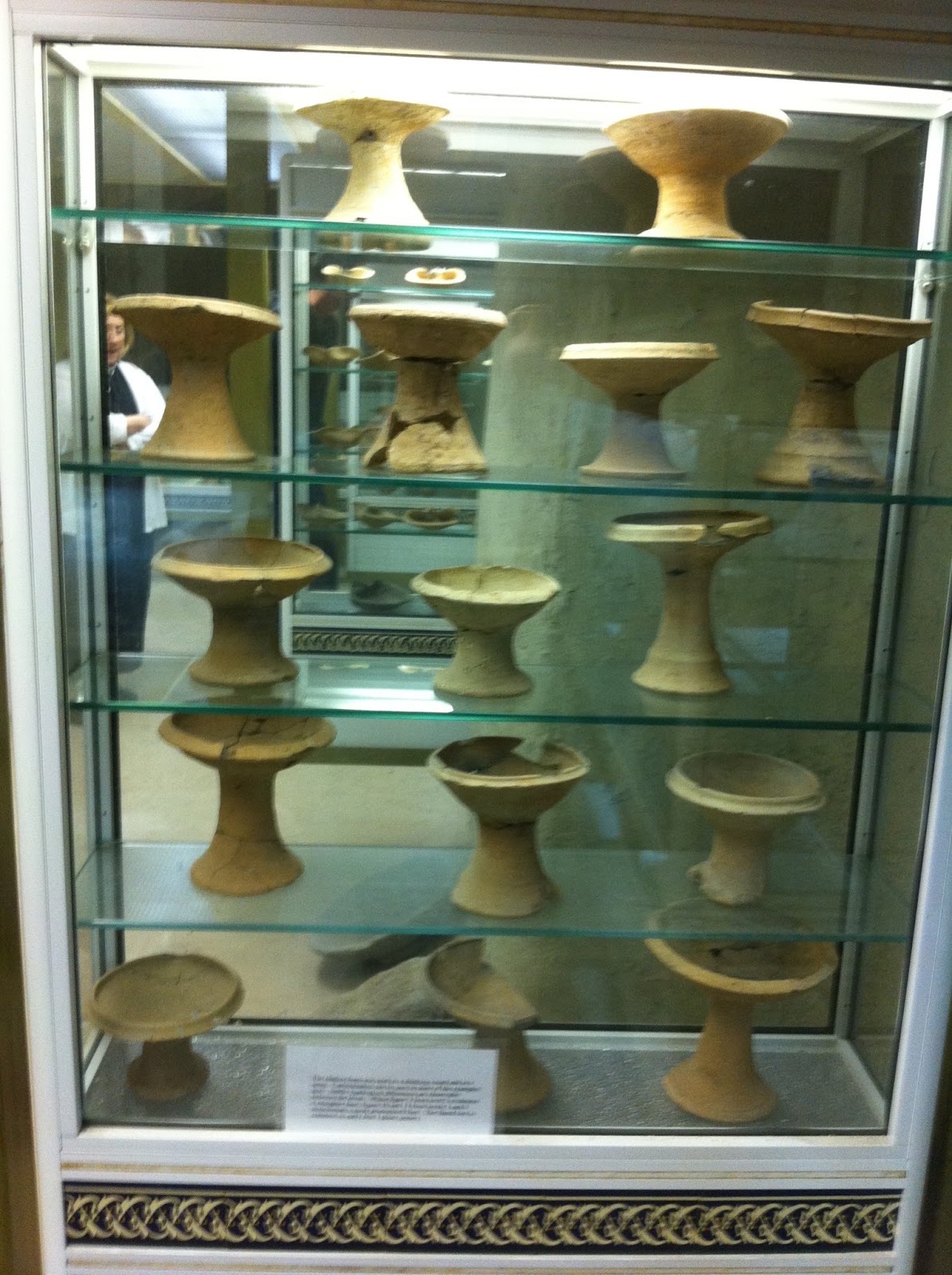
One of the great strengths of this exhibit is the well-defined organization of the various types of pottery.  Someone interested in such things as ceramic typology of the Bronze-Iron Age might be intrigued by seeing whole shelves filled with LB-Iron I lamps, chalices/goblets (see picture below), kraters, bowls, pyxides, lamps, and more (links to wikipedia description are meant to describe the form of the vessel not the specific type that you would see at this museum).

Low-quality picture of High-quality Canaanite Late Bronze Age Chalices and Goblets found in the Western Cemetery of Tell Dothan

I was especially intrigued by their large collection of chalices, as these seem identical to the types of chalices and goblets that our team has been uncovering inside of a very interesting, seemingly cultic related Late Bronze age building at Tel Burna. Shameless plug alert! Come join us in a week-and-a-half for our spring season – April 21-25, or June 2-21 for our summer season and find these for yourself. 🙂 

Due to the high quantities of consuming and serving vessels, particularly the large amount of kraters of a wide-variety of forms (used for wine-mixing), and the existence of animal bones the excavators concluded that these tombs were used for feasting in commemoration of dead ancestors. 


This funerary feast is commonly referred to as the marzeah, based upon some biblical references (Amos 6:7, Jeremiah 16:5; 8) and extra-biblical parallels (e.g. Ugarit). In relation to this, the museum pamphlet (this seems to have been written by Robert Cooley) says the following: 

Burial is described in scripture as “gathered to his people;” a time of reuniting with family members (Gen. 25:8-10; 17, 49:29-33, Judges 2:10. et al) The remains in the tomb corroborate these texts and also point to the practice of a memorial feast with an inordinate consumption of wine (Jer. 16:5-9). At the time of death the body was taken to the family tomb and either laid on the floor or on top of the debris or previous burials. It is believed a funeral banquet was held and a portion of the feast given to the deceased, and left to provide sustenance for the journey to the next world… When a subsequent death occurred the chamber was reopened and the remains of the previous burial unceremoniously swept aside, often destroying the skeletal remains and offerings. The newly deceased’s body would be carefully laid to rest and another funeral meal would ensue. Scholars infer that at the time of death an individual was considered animate, requiring food for his other journey. Decomposition of the flesh seems to have signalled the departure of the deceased to the netherworld. Thus the remains no longer held any significance. 


Conclusion
Where does this museum fit into the wider spectrum of available archaeological exhibits in Israel? 


It  certainly should be considered “specialist” in the sense that it is quite small and deals with a single period related to a single people – the Canaanites. However, it is also “special” in that it 
allows visitors to visit a significant element of a site that is largely inaccessible (Dothan) and to better understand the enigmatic ancient Near Eastern practice of ancestor funerary feasting. Which if nothing else gives a great ancient background for the modern urban practice of “pouring one out for your homies.” 🙂  
Share:

(Post by Seth M. Rodriquez)

Perhaps one of the largest obstacles to understanding what life was like in Bible times is the difference between a modern city and an ancient city.  A modern city spans hundreds of square miles, but an ancient city was typically only a few acres.  A modern city has no protection around it, but an ancient city was protected by a massive wall.  A modern city has dozens of roads leading in and out of it, but an ancient city had (at most) a handful of gates leading in and out, and often had only one.  So when a modern reader opens the Bible and reads about Boaz doing business transactions at the city gate (Ruth 4) or gossipers sitting in the gate (Psalm 69:12) or Amos calling for justice in the gate (Amos 5:15), the full significance of those passages may be lost.

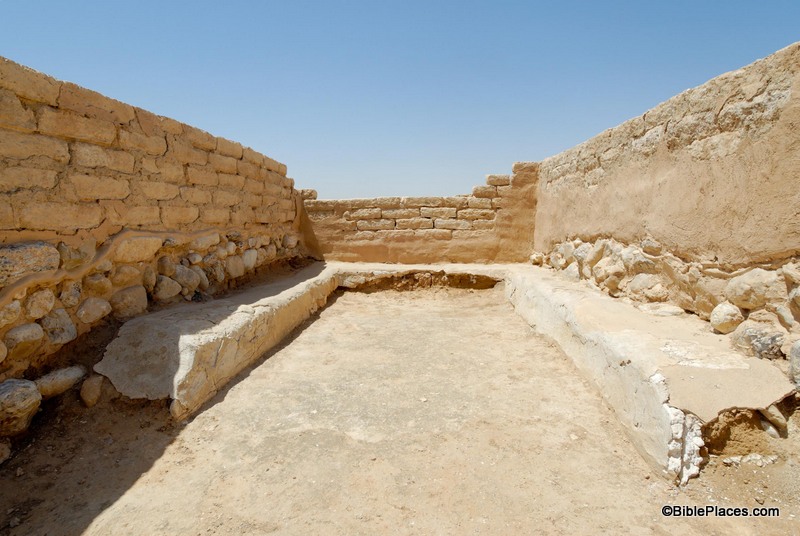
Our picture of the week comes from Volume 5 of the Pictorial Library of Bible Lands, and shows the remains of the Iron Age gate at Beersheba.  Actually it shows only one chamber within that gate.  During this time period, it was common for gates to have rooms on either side of the passageway.  For example, a double chambered gate had two rooms on one side of the passage and two on the other side.  It was shaped like an E and a 3 facing each other: E3.  These chambers sometimes were lined with benches, such as in the picture below.  This would provide a place for people to sit while carrying out the various types of business that happened in the city gate … and there was a wide variety of action here. 

Since there was always a small number of gates in an ancient city, all the foot traffic coming in and out of the city was funneled though this one place.  Consequently it became an ideal place for people to sit and do business transactions, talk about current events, or sell their wares.  It also was a convenient place for the elders and rulers to decide legal matters or prophets to  proclaim a message from the Lord.  In times of battle, these rooms provided the soldiers of the city with space to fight an enemy that had managed to break through the door.

Oded Borowski, in his book Daily Life in Biblical Times, describes the city gate this way:

When discussing the gate, one should realize that this was more than just a door; it was a gate system. Many cities, such as Hazor, Megiddo, Gezer, Lachish, and Dan, had a series of gates, outer and inner, through which traffic found its way in and out of the city.  … The main gate was a formidable structure that had two or more stories to provide space for the activities undertaken by the civic and military administrations and by the citizenry. … The street-level floor had one to three chambers on each side …. The gate area, including the chambers and the open space around it, was used in peacetime for judicial, commercial, and social activities.  The city elders, as well as the king or the regional governor, met in the gate to hold court. At Tell Dan, the remains of a low podium for an elaborate seat and canopy were found by the gate adjacent to the open area.  The chambers in the gate at Gezer contained low benches along the walls to provide seating, possibly for the elders or for merchants.  The gate was also where certain cultic activities took place (2 Kgs 23:8), as illustrated by the standing stones discovered at Dan and other sites.

In the age of computers, automobiles, and sprawling cities, there really is no good modern equivalent of the city gate.  It was the mall, the courthouse, the army base, the television, and Facebook all rolled into one.  In many ways, it was the center of daily life in the city.

Excerpt from Oded Borowski, Daily Life in Biblical Times, Society of Biblical Literature: Archaeology and Biblical Studies, No. 5 (Atlanta: Society of Biblical Literature, 2003), pp. 47-48.

This photo and over 700 others are available in Volume 5 of the Pictorial Library of Bible Lands, and is available here for $34 with free shipping.  Additional pictures of ancient gates can be seen herehere, and here on the BiblePlaces website.

Share:

Archaeologists working for the Israel Antiquities Authority (IAA) recently excavated a unique ritual bath (mikveh) in the Kiryat Menachem neighborhood of Jerusalem (southwest of the Old City). Three separate collecting tanks (otzar) were carved into the rock in order to collect as much rainwater as possible.

The IAA press release quotes Benyamin Storchan, director of the excavation:

Numerous ritual baths have been excavated in Jerusalem in recent years, but the water supply system that we exposed in this excavation is unique and unusual. The ritual bath consists of an underground chamber entered by way of steps. The miqwe received the rainwater from three collecting basins (otzar) that were hewn on the roof of the bath, and the pure water was conveyed inside the chamber through channels.
The ritual baths known until now usually consist of a closed cavity that was supplied with rainwater conveyed from a small rock-cut pool located nearby. The complex that was exposed at this time is a more sophisticated and intricate system. The bath was apparently associated with a settlement that was situated there in the Second Temple period. Presumably, due to the rainfall regime and arid conditions of the region, the inhabitants sought special techniques that would make it possible to store every drop of water.
It is interesting to note that the bath conforms to all of the laws of kashrut, like collecting the water in it naturally without human contact, and ensuring that the water does not seep into the earth which is why the bath was treated with a special kind of plaster.

The full press release is here, and three high-res photos are available in a zip file. The story is also reported by the Jerusalem Post and Arutz-7.

mikveh-kiryat-menachem-iaa-3
Archaeologist Benyamin Storchan stands in the immersion chamber of the mikveh.
mikveh-kiryat-menachem-iaa-1
Aerial view of the excavations
mikveh-kiryat-menachem-iaa-2
Aerial view of three storage tanks and channels
All photos courtesy of the IAA. The second and third are by Skyview.
Share:

Several significant excavation reports will be published in the next couple of months and Eisenbrauns is offering major discounts on pre-orders.

Megiddo V: The 2004-2008 Seasons

Gezer VII: The Middle Bronze and Later Fortifications in Fields II, IV, and VIII

Sepphoris I: The Pottery from Ancient Sepphoris
MegiddoVcover.indd
With the ongoing debate over the chronology of the Iron Age II, the Megiddo volumes may receive the most attention from scholars.

Eisenbrauns has a number of other excavation reports on sale, including volumes on Bab edh-Dhra, Lahav (volumes I-II), Tell el-
Hesi (volumes II-V), Gezer (volumes I-III, V), and Dothan. For those interested in a popular work, the Timnah volume is now marked down 50% (to $15).

There doesn’t seem to be a direct link to the sale page, so go to the home page, read about their phenomenal new “Online/Offline
Backup Service” (announced on April 1), and follow the link to the sale from there.

A couple of recently published excavation reports are reviewed in the current issue of Biblical Archaeology Review. In the article now available online, William G. Dever reviews Ashkelon 3: The Seventh Century B.C. and Hazor: The 1990–2009 Excavations: The Iron Age.

Share: