(Post by Seth M. Rodriquez)

Last week we provided a brief history of the American Colony and G. Eric Matson.  Before we move to the next collection in the Historic Views of the Holy Land series, there is one other story about the American Colony that I have to share.

Due to their reputation for organizing charitable work, their connections with the local authorities, and their location within the city of Jerusalem, the American Colony was able to play a role in some of the major historical events of their day.  Last week I mentioned that they were involved in the visit of Kaiser Wilhelm.  Another example is the following story about the day that the mayor of Jerusalem surrendered to the British in 1917:
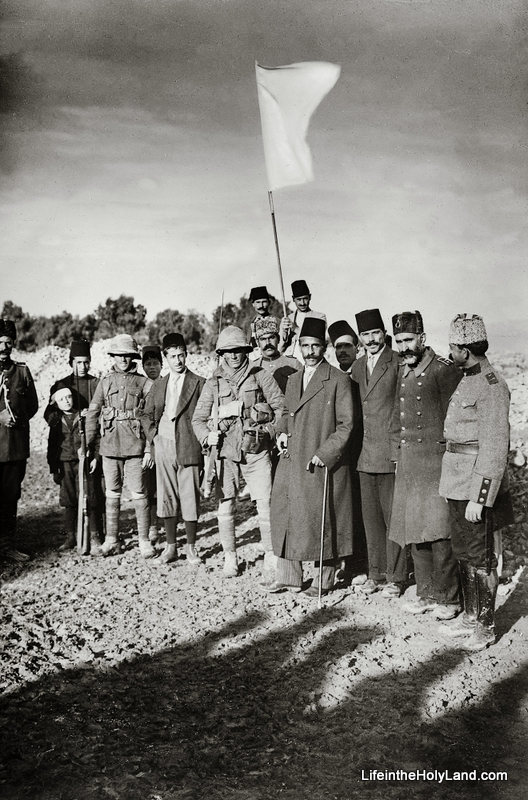
The final approach of the British forces to Jerusalem, in December 1917, and the subsequent surrender of the city, involved American Colony personnel in a number of curious and fascinating ways. For one, it gave rise to perhaps the most memorable of all American Colony photographs, that of the “first” surrender—by some counts there were as many as five!—of the city of Jerusalem in World War I. By the morning of December 9th Turkish army units had completely withdrawn from Jerusalem and the Turkish governor, Izzat Pasha, fleeing shortly before dawn (in a horse-drawn carriage borrowed from the Colony!), left in the hands of the mayor a letter of formal surrender, including an order that not a shot was to be fired in the city‘s defense. Thus, that Sunday morning the city‘s Arab mayor, Hassain Effendi al-Husseini, armed with the Pasha‘s letter of capitulation, set out to turn the city over to the British. On his way he first stopped to inform his close neighbors at the American Colony, where he had once been a student and was still a frequent visitor. Stopping first at the Big House he encountered Lewis and Edith Larsson, then proceeded to the nearby Vester house where his good friend Anna Spafford was then in residence. In the meantime, Larsson grabbed his camera, his three-year-old son, and a young assistant and hurried to join the mayor‘s growing group in Jaffa Road. In the process, someone from the American Colony—accounts differ as to who—fashioned the requisite white flag of surrender: a bed-sheet from one of the Colony-run hospitals nailed to a broomstick.

Near the village of Lifta on the western fringes of Jerusalem, the party encountered the British forward units, and the mayor tried to “surrender” to two sergeants on sentry duty. While they were waiting for higher-ranking officers to arrive, Larsson immortalized the moment with his camera, a scene showing the mayor, his entourage of municipal officers and Turkish policemen, Sergeants Hurcomb and Sedgewick of the Londoners, and the white bed-sheet flag—the famous image of the “first” surrender of Jerusalem. In the ensuing few hours, al-Husseini also “surrendered” to two artillery officers; to their commander, a Lieutenant Colonel Bailey; and then to Brigadier General C. F. Watson. Some of the local leaders asked Watson, as the ranking officer on the scene, to show himself to the populace in order to help quell some looting that had already broken out. Thus it was that Watson appeared with the mayor at Jaffa Gate and there (according to at least one version) accepted the mayor’s surrender document …. On this occasion, Larsson managed to take more photos, including an “official” shot of Watson opening the letter of surrender, with Mayor Husseini and others standing beside him. This all occurred by about 10 a.m….  

Larsson also managed to save the makeshift truce flag, which eventually found its way to the Imperial War Museum in London.

Quotation from Tom Powers, “Jerusalem’s American Colony and Its Photographic Legacy,” (essay included in The American Colony and Eric Matson Collection, 2009), pp. 35-36, 38. This photo and over 400 others are included in Volume 7 of The American Colony and Eric Matson Collection, and can be purchased here with free shipping.  For more information on the surrender of Jerusalem, see my previous post here.

Share:

Today is Passover and SourceFlix has released a new video short entitled “The Locusts.”

Recently, I sat down in the early morning to enjoy a cup of coffee and my newspaper. The headline of the Jerusalem Post read “Swarm of Locusts Crosses Sinai Border into Israel”. I leaped out of my chair, grabbed my camera gear, jumped in my car and raced towards the Egyptian border. Within three hours locusts were bouncing off my windshield! The estimated swarm of 120 million had been devastating Egypt for several days, but Israel was ready for them with pesticide-loaded planes and helicopters. So, while I didn’t get to see them in their full force, it was yet another experience in Israel that brought the pages of the Bible to life! I will never forget seeing these locusts carried in on the wind, eating everything in their path.

Click here to watch the 2-minute video.

Share:

From LiveScience.com:

For thousands of years, different groups of people have lived in the Negev desert, building stone walls and cities that survive to this day. But how did they make their living?
The current thinking is that these desert denizens didn’t practice agriculture before approximately the first century, surviving instead by raising animals, said Hendrik Bruins, a landscape archaeologist at Ben-Gurion University of the Negev.
But new research suggests people in this area, the Negev highlands, practiced agriculture as long ago as 5000 B.C., Bruins told LiveScience. If true, the finding could change historians’ views of the area’s inhabitants, who lived in the region in biblical times and even before, he added.

Bruins found that the area had been farmed in three periods.

He found three distinct layers in the earth indicating that the field had been cultivated, corresponding to three different periods of activity, with long gaps in between. The first one dated from 5000 B.C. to 4500 B.C., followed by another from 1600 B.C. to 950 B.C. and a final layer dating from A.D. 650 to A.D. 950.

The full story is here.

Avdat farm experiment, tb062400139
Experimental farm near Avdat
Photo from Pictorial Library of Bible Lands, volume 5.
Share:

The last week of ASOR’s March Fellowship Madness is here, and one donor be randomly selected to receive a copy of The Photographs of the American Palestine Exploration Society, which features over 150 pictures taken at sites around the Near East in 1875.

Here’s a very high-resolution panoramic shot of Jerusalem from the Mount of Olives.


Popular Mechanics has a story on the value of 3-D modeling for archaeology.

A 3-D model of the Temple of Amun-Ra at Karnak has been created with the help of the UCLA team who created one of Jerusalem’s Temple Mount.

Archaeologists working at Tel Habuwa east of the Suez Canal have found evidence for battles between the Egyptians and Hyksos.
A well-preserved sundial from the 13th century BC was discovered in the Valley of the Kings near Luxor.
Turkey is demanding Germany return more ancient artifacts.
The 1862 Middle East tour of the future King Edward VII is the subject of a new exhibition in 
Edinburgh.
HT: Joseph Lauer, Charles Savelle, Explorator
Share:

From Arutz-7:

Jewish groups held a mock Passover sacrifice on Thursday opposite the Temple Mount in Jerusalem. The ritual slaughter was not merely a historic reenactment, but, they say, practice in advance of the reconstruction of the Temple. The practice sacrifice has been held annually for the past several years. This year organizers were unpleasantly surprised by a veto from Israel’s Veterinary Services, which refused to authorize the event. Organizers took the matter to court, and were able to quickly get a ruling permitting the ritual. The various groups involved in the event were represented by Rabbi Yehuda Glick, who told Arutz Sheva that the ritual was carried out with as much Biblical accuracy as possible. “We took the goat, as the Torah commands, we had an altar built like the real one, and a cooking pit built according to halacha [Jewish law],” he said. “We slaughtered the goat with Leviim singing and priestly clothing, just like in the real Passover sacrifice.”

The full story includes a one-minute amateur video. Another video from a similar service several years ago was produced by SourceFlix.

Share:

(Post by Seth M. Rodriquez)

The last few weeks we have been examining photographs from The American Colony and Eric Matson Collection.  The pictures have ranged from Lower Beth Horon to Gerasa, from the damming of the Nile to the flooding of the Jordan, and from the interior of Barclay’s Gate to the Locust Plague of 1915.  We are indebted to the work of the American Colony and Eric Matson for these photographs.  This week we will focus briefly on the American Colony itself.

The American Colony started as an American religious group that migrated to Jerusalem in 1881 under the leadership of Horatio Spafford, author of the well-known hymn “It Is Well with My Soul.”  This group was known for charitable work throughout its existence.  In 1896, a significant number of Swedish immigrants joined the group (again, for religious reasons) and the group was able to develop some projects that provided some consistent income for the community.  The photography department became especially lucrative when the group was granted special permission from the German government to photograph the trip of Kaiser Wilhelm to Jerusalem in 1898.  Due to their coverage of that trip and the use of their photographs in newspapers around the world, the photography department earned recognition worldwide.  In subsequent years, the photographers of the American Colony went on several expeditions to capture pictures of various peoples and places.

For example, the photo below is from an expedition to Egypt, and captures what was surely one of the highlights from that trip: an American Colony photographer is standing near the top of one of the pyramids of Giza readying his camera and tripod.  The photo was taken sometime between 1900 and 1920.

There was a split within the American Colony in 1930, and at that time the photography business was handed over to one of the members of the photography staff: G. Eric Matson. Matson kept the department going until 1934 when he and his wife left the community. Then he started his own business called the Matson Photo Service.  He continued to add new photographs to the thousands of pictures that the American Colony had collected over the years.  Below is a picture of Matson and several others from the American Colony on the day of his wedding in 1924.

In 1946, Matson and his wife moved to America bringing most of the collection with him, and in 1966 he donated the whole collection to the Library of Congress. Finally, in the early years of the 21st century, digital copies of the American Colony and Eric Matson Collection were collected, edited, and organized by a Bible teacher named Todd Bolen, with the help of some faithful friends. 

Bolen’s edition of The American Colony and Eric Matson Collection is available for purchase at LifeintheHolyLand.com.

These photographs, along with over 250 others, are available in Volume 8 of The American Colony and Eric Matson Collection which can be purchased here for $15 with free shipping.  This volume of the collection features various people that lived in the Holy Land during the early 20th century: Arabs, Jews, Christians, Bedouin, and many others.

Share: