(Post by Seth M. Rodriquez)

Over the last few days, swarms of locusts have threatened Israel and Egypt.  The Egyptian swarm was estimated to be at least 30 million insects, while the swarm that entered Israel was only about 1 million.  In 1915, a similar locust swarm wreaked havoc in Palestine, and photographers and scientists had one of their first opportunities to study these insects up close.

In Volume 6 of The American Colony and Eric Matson Collection, there are over 80 pictures of the locust plague of 1915 as well as a copy of an article published in the National Geographic about the incident.  Locusts are mentioned over 30 times in the Bible, and the 1915 invasion provided researchers with new insights into these creatures and the damage they can cause when they travel in such large numbers.  Essentially what happened was the locusts flew into the region from the northeast, laid their eggs in various places, the parents died while the eggs hatched, the larvae crawled for miles in a direction back toward the northeast, and after reaching maturity the young insects flew off towards the east. Through this whole process, the insects ate everything in their path: the adults ate on their way in and the young ate on their way out … or as Joel 1:4 put it: “What the cutting locust left, the swarming locust has eaten. What the swarming locust left, the hopping locust has eaten, and what the hopping locust left, the destroying locust has eaten.” (ESV)

In the photo above (click to enlarge), the crawling locusts are covering digging tools used by the residents of the area to fight the onslaught of the insects.  The fought them in various ways:

  • Digging up the eggs before they hatched.
  • Setting up long lines of metal sheets and directing the locusts to pits in the ground where the locusts would be squashed (by men holding their noses) and then buried.
  • Poisoning them by adding arsenic to grain and spreading the grain in their path.
  • Using a flame thrower to burn the insects while they ate the vegetation.

The entire episode, both the insect itself and the responses of the locals, is extremely fascinating.

Some Muslim locals were resigned to the fact that the locusts had been sent by Allah and thus there was no use in fighting them. Other locals tried to trick the authorities when they were required to gather a certain quota of locust eggs (for example, by rolling white clay into what looked like a locust egg). Still others joined the fight against the insects. The following story of one fight against the locusts is recorded in the National Geographic article:

One evening while trapping them on the upper side of the hill we learned just in time that an immense number were just about to enter the property from the opposite side. At once all efforts turned in this direction, and the trap was sunk into the lower edge of the field toward which they were making; but no sooner had it been set in place than the locusts again changed their course. Notwithstanding the laborious task involved, the trap had to be moved, during which process it was nip and tuck to keep the locusts from escaping. Once, however, they made in the right direction, they jumped, hundreds at a time, into this death trap.

The evening hours were now upon us; the locusts, weary from being driven and benumbed from the cool breezes, seemed to near the trap exhausted, while those behind kept piling up till the earth for a small space was covered layers deep. To facilitate matters, with spade and rake they were scraped into the trap, now constantly being emptied.

Thus in about an hour’s time four large sacks full were caught and destroyed each containing no less than 100,000 of these insects. Many escaped and made for a near-by thorny patch, on which was now piled more dry sticks and thistles, which when set afire burned alive many thousands more. The above is but average example showing how and in what quantities they were caught. (John D. Whiting, The National Geographic Magazine, Volume XXVIII, No. 6 [Dec. 1915], pp. 535-536.)

By way of contrast, this week the Israeli authorities were able to eliminate a swarm of locusts by spraying pesticides over thousands of acres in a single day.  One hundred years of developments in technology can go a long way.

This photograph and over 600 other images of “Traditional Life and Customs” are available in Volume 6 of The American Colony and Eric Matson Collection and can be purchased here for $20 (with free shipping).  See here for another photograph of the crawling locust in this collection, and see here for a previous post on this locust plague with two additional pictures.
Share:

The Mustard Tree is the latest video from SourceFlix.

This post has some inspiration for those interested in mapping historical events using Google Earth.

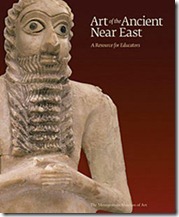
The example he uses here is the parting of the Red Sea, though I think he’s way off on the location.Art_of_the_Ancient_Near_East_A_Resource_for_Educators

A swarm of one million locusts moved from Egypt into Israel before spraying halted the invasion. Some Israelis gathered up sackfuls of the locusts to eat.

Ten years after its looting, the National Museum of Iraq is still not open to the public.

Art of the Ancient Near East: A Resource for Educators is available as a free download.

HT: BibleX, ANE-2, Jack Sasson

Share:

Classroom learning is valuable, but experience in the field is essential for students aspiring to careers in archaeology and 2013Thermometerancient Near Eastern history. The costs for even a short summer excavation can be prohibitive for many students, and thus ASOR is sponsoring March Fellowship Madness in an effort to raise $10,000. This is a great opportunity to help needy students in a worthy effort. ASOR has pledged that 100% of all gifts will go directly to the scholarships, and if the goals of 100 donors and $10,000 are met, an additional $5,000 will be donated.

You can read all of the details and donate at the ASOR site. If half of this blog’s readers donated $25 each, they would more than double their goal today and 30 students would receive scholarships.

Share:

At Petra, LiDAR (Light Detection and Ranging laser) scanning and balloon-based 35mm photography are being used with other technologies to facilitate research and conservation.

Exploring Bible Lands is doing a series on the travels of the Ark of the Covenant, beginning at the Plains of Moab, crossing the Jordan River, and continuing on to Jericho, Mount Ebal and Mount Gerizim, and now Shiloh.

JPost: “Wild animals will soon be able to safely cross bustling Route 1 when the Israel National Roads Company completes work on an ecological corridor at the Sha’ar Hagai interchange.”

This 40-second video clip with Eilat Mazar describing her discovery of the seal impression of a biblical figure could be a good way to get attention at the start of a lesson. The Jehucal bullae was discovered in 2005.


Popular Archaeology has a lengthy feature this month on the Egyptian fortress in Joppa.

Some very well-preserved leather shoes worn 2,000 years ago were recently discovered in Egypt.

Egyptian officials have rejected a proposal to rent out five of the country’s archaeological sites to international tourism companies.

For the broader world of archaeology, see the Archaeology Weekly Roundup at the ASOR Blog.

HT: Jack Sasson

Share:

Temples and Cult in the Eastern Mediterranean Basin During the Bronze and Iron Ages. Conference Marking the Retirement of Prof. Eliezer Oren and the Appearance of a Festschrift in His Honor
The Department of Bible, Archaeology and Ancient Near Eastern Studies Ben-Gurion University of the Negev, Beer-Sheva Faculty of Humanities and Social Sciences

Thursday, March 7, 2013. 
Minkoff Senate Hall, Ayerton University center Marcus Family Campus, Ben-Gurion University of the Negev, Beer-Sheva
10:00 Morning Session. Prof. Shmuel Ahituv, Chair

On Prof. Victor Avigdor Hurowitz z”l
Presentation of FestschriftAll the Wisdom of the East: Studies in Near Eastern Archaeology and History in Honor of Eliezer D. Oren, Orbis Biblicus et Orentalis 255, Fribourg and Göttingen, 2012

10:40 The Bronze Ages

Keynote Address: Gods and Rulers in Mycenaean Citadels: A Very Special Relationship. Prof. Josef Maran, University of Heidelberg (English)


Aspects of Temples and Cult in the Early Bronze Age in the Land of Israel. Prof. Pierre de
Miroschedji, CNRS, Nanterre (English)


The Cultic Precinct at Nahariyah: New Aspects of Cult during the Middle Bronze Age in the Land of Israel. Dr. Sharon Zuckerman, Hebrew University, Jerusalem (English)

13:30 Afternoon Session. Prof. Gunnar Lehmann, Chair
13:30 The Bronze Ages


Hathor in Canaan in Light of the Decorations on Jewelry Boxes. Prof. Amnon Ben-Tor, Hebrew University, Jerusalem


The Temple Precinct at Megiddo; A New Look after Twenty Years of Excavations. Prof. David Ussishkin, Tel Aviv University


The Temple and the City: The Cases of Jericho and Batrawy in the Bronze Age. Prof. Lorenzo Nigro, Universita degli Studi di Roma “La Sapienza” (English)


Distribution of Cultic Implements in the Tel Haror Temple: Spatial Analysis. Pirhiya Nahshoni, Ben-Gurion University of the Negev

15:30 The Iron Age. Prof. Amnon Ben-Tor, Chair


Evidence for Cult and Religious Activity in the 9th and 10th Centuries at Tel-Rehov. Prof. Amihai Mazar, Hebrew University, Jerusalem


The Arad Temple and its Cancellation: A Reevaluation. Prof. Zeev Herzog, Tel Aviv University


Popular Belief and Popular Art: Sacred Implements from the Favissa of a Philistine Temple at Yavneh. Dr. Irit Ziffer, Eretz Israel Museum
Summary and Conclusion. Prof. Eliezer Oren, Ben-Gurion University of the Negev

The full conference announcement is here. Lectures not marked as English will be given in Hebrew.

HT: Jack Sasson

Share:

10.5 Million Visits to the Western Wall in 2012 – The increase in tourism requires a doubling in restroom capacity.

Archaeology in Israel Update—February 2013 – Stephen Gabriel Rosenberg selects the top five stories of the month.

48 hours in the Negev – Onnie Schiffmiller provides a two-day itinerary beginning at Beersheba and moving south.

How to Prepare for a Holy Land Tour – Wayne Stiles recommends ways to prepare mentally, practically, physically, and spiritually.

8 Tips to Maximize Your Holy Land Tour – Stiles follows up his preparation post with suggestions on what to do once you’re in Israel, including what photos to take and not take, how to keep up, and why you should ask lots of questions.

Men praying at Western Wall during Sukkot, tb100906912
A “full house” at the Western Wall prayer plaza during the feast of Tabernacles. Photo from the Pictorial Library of Bible Lands, volume 3.
Share: