Temples and Cult in the Eastern Mediterranean Basin During the Bronze and Iron Ages. Conference Marking the Retirement of Prof. Eliezer Oren and the Appearance of a Festschrift in His Honor
The Department of Bible, Archaeology and Ancient Near Eastern Studies Ben-Gurion University of the Negev, Beer-Sheva Faculty of Humanities and Social Sciences

Thursday, March 7, 2013. 
Minkoff Senate Hall, Ayerton University center Marcus Family Campus, Ben-Gurion University of the Negev, Beer-Sheva
10:00 Morning Session. Prof. Shmuel Ahituv, Chair

On Prof. Victor Avigdor Hurowitz z”l
Presentation of FestschriftAll the Wisdom of the East: Studies in Near Eastern Archaeology and History in Honor of Eliezer D. Oren, Orbis Biblicus et Orentalis 255, Fribourg and Göttingen, 2012

10:40 The Bronze Ages

Keynote Address: Gods and Rulers in Mycenaean Citadels: A Very Special Relationship. Prof. Josef Maran, University of Heidelberg (English)


Aspects of Temples and Cult in the Early Bronze Age in the Land of Israel. Prof. Pierre de
Miroschedji, CNRS, Nanterre (English)


The Cultic Precinct at Nahariyah: New Aspects of Cult during the Middle Bronze Age in the Land of Israel. Dr. Sharon Zuckerman, Hebrew University, Jerusalem (English)

13:30 Afternoon Session. Prof. Gunnar Lehmann, Chair
13:30 The Bronze Ages


Hathor in Canaan in Light of the Decorations on Jewelry Boxes. Prof. Amnon Ben-Tor, Hebrew University, Jerusalem


The Temple Precinct at Megiddo; A New Look after Twenty Years of Excavations. Prof. David Ussishkin, Tel Aviv University


The Temple and the City: The Cases of Jericho and Batrawy in the Bronze Age. Prof. Lorenzo Nigro, Universita degli Studi di Roma “La Sapienza” (English)


Distribution of Cultic Implements in the Tel Haror Temple: Spatial Analysis. Pirhiya Nahshoni, Ben-Gurion University of the Negev

15:30 The Iron Age. Prof. Amnon Ben-Tor, Chair


Evidence for Cult and Religious Activity in the 9th and 10th Centuries at Tel-Rehov. Prof. Amihai Mazar, Hebrew University, Jerusalem


The Arad Temple and its Cancellation: A Reevaluation. Prof. Zeev Herzog, Tel Aviv University


Popular Belief and Popular Art: Sacred Implements from the Favissa of a Philistine Temple at Yavneh. Dr. Irit Ziffer, Eretz Israel Museum
Summary and Conclusion. Prof. Eliezer Oren, Ben-Gurion University of the Negev

The full conference announcement is here. Lectures not marked as English will be given in Hebrew.

HT: Jack Sasson

Share:

10.5 Million Visits to the Western Wall in 2012 – The increase in tourism requires a doubling in restroom capacity.

Archaeology in Israel Update—February 2013 – Stephen Gabriel Rosenberg selects the top five stories of the month.

48 hours in the Negev – Onnie Schiffmiller provides a two-day itinerary beginning at Beersheba and moving south.

How to Prepare for a Holy Land Tour – Wayne Stiles recommends ways to prepare mentally, practically, physically, and spiritually.

8 Tips to Maximize Your Holy Land Tour – Stiles follows up his preparation post with suggestions on what to do once you’re in Israel, including what photos to take and not take, how to keep up, and why you should ask lots of questions.

Men praying at Western Wall during Sukkot, tb100906912
A “full house” at the Western Wall prayer plaza during the feast of Tabernacles. Photo from the Pictorial Library of Bible Lands, volume 3.
Share:

The proposal that Sodom has been found on the northeastern side of the Dead Sea has been around for a decade or so, but with the publication of an article by Steven Collins this month it will receive the widest hearing to date. I thought it might be helpful for readers of Biblical Archaeology Review to know where to go for another perspective.

The proposal that Tall al-Hammam is Sodom fails on at least two counts, and these are helpfully summarized by two experts in their respective subjects.

Geography Fail: Bill Schlegel, professor in Israel for 25 years and author of the Satellite Bible Atlas, explains why the biblical text does not fit the geography of Tall al-Hammam.

Chronology Fail: Eugene Merrill, Distinguished Professor of Old Testament Studies at Dallas
Theological Seminary and author of Kingdom of Priests: A History of Old Testament Israel, shows in a recent Artifax article that for Tall al-Hammam to be Sodom one must deny all of the biblical dates before the time of the judges.

I’ve written about the issue several times as well:

Excavator Finds Evidence of Destruction at “Sodom” (Dec 2011)

Video: Search for Sodom and Gomorrah (Aug 2009)

Tall el-Hammam: Sodom, Abel Shittim, Abila, or Livias? (Jan 2009)

Sodom Identified? (May 2006)

One final point: the excavator of Tall al-Hammam insists that by identifying the site as Sodom he is supporting the historicity of the Bible. In fact, if his theory is true, we cannot trust the Bible for accurate details about times and places. Tall al-Hammam is certainly a significant site, but Sodom is surely to be found elsewhere.

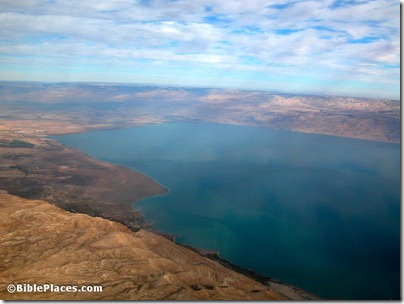
Dead Sea northern end aerial from west, tb010703242
Northern end of the Dead Sea
Photo from Pictorial Library of Bible Lands, volume 4
Share:

The Red to Dead canal is moving along faster than I realized. THe last hearings are being held now before the World Bank issues a final report. The Inter Press Service provides a good summary of the plans and problems.

The World Bank has declared the Red Sea-Dead Sea canal project feasible. Designed to “save the Dead Sea”, “desalinate water and/or generate hydroelectricity at affordable prices in Jordan, Israel and the Palestinian Authority”, and “build a symbol of peace in the Middle East”, the scheme, green groups warn, is fraught with environmental hazards.
Currently at 426m below sea level, the Dead Sea, Earth’s lowest elevation on land, is drying and dying in the desert by roughly 1.1 metres a year. Its surface area has shrunk by a third during the last 50 years from 960 square kilometres to 620 square kilometres.
[…]
What could save the Dead Sea from death foretold is a 180-km development project called the ‘Red Sea-Dead Sea Water Conveyance’.
This is how it would work: marine water would be pumped from the Red Sea. A pipeline conveyance system with six pipes and a tunnel would then flow the water by gravity, exploiting the difference in elevation at and below sea level, to a high-level desalination plant and two hydroelectric plants.
The high-salinity brine reject would be discharged to the Dead Sea to halt and, eventually, reverse its decline.
After a decade-long argument, the World Bank released a series of studies last month which deem the proposed ‘Red-Dead Canal’ (as the ambitious scheme is dubbed) technically, environmentally and socio-economically feasible.
The main objectives would thus be fulfilled, the World Bank assesses. All that for a total capital cost of 9.97 billion dollars, the World Bank estimates; half of it amortised by selling desalinated water and hydroelectricity, the other half financed out of international aid to development – “a win-win situation,” hails Shalom.

The rest of the article discusses objections to the plan, including chemical problems, earthquakes, groundwater contamination, and damage to the Red Sea coral reef. The article concludes with a forecast: “The canal could be built within six years and start operating in 2020, reaching its maturity stage by 2060.”

HT: Charles Savelle

Dead Sea from Masada, tb010810995
The disappearing Dead Sea, as seen from Masada
Photo from Pictorial Library of Bible Lands, volume 4
Share:

Information on the second Qeiyafa inscription coming later this year (Luke Chandler)
The Tel Burna Arch
aeological Project (ASOR Blog)

Israel approves drilling for oil in Golan Heights (Jerusalem Post)

John the Baptist: The First Christian Martyr (Bryant Wood)

Review of The Unsolved Mystery of Noah’s Ark (Gordon Franz and Bill Crouse)


NIV Study Bible for Kindle marked down to $6.64 (Amazon)

Ferrell Jenkins has begun a series on famous people buried in the Protestant Cemetery on Mount
Zion, including Horatio G. Spafford and James Leslie Starkey.

Online Battle Over Sacred Scrolls, Real-World Consequences (New York Times) Includes an interview with Raphael Golb.

Oak forest on Golan Heights, tb020506169
Oak forest on Golan Heights
Photo from Galilee and the North
Share: