Archaeologists have long known about some ancient cedar beams on the Temple Mount. Recent tests indicated that they dated back to the time of Solomon’s temple. (I don’t have an English reference for that at the moment.) The Temple Mount Sifting Project team recently wrote about these cedar beams:

Some of these beams predate the first Al-Aqsa Mosque and have been used and reused numerous times in various structures, which actually aided their preservation. We have some fragments of these beams among the finds at the Sifting Project.
We have been monitoring these beams for many years as they lay exposed to the weather in the open courts of the Temple Mount. We hope the Israel Antiquities Authority will succeed in placing them in a safe shelter before the coming winter. We have been requesting that the IAA deal with this issue more than three years, but these ancient beams have yet to be properly secured.

Arutz-7 reported on Sunday that some of the beams are being used as firewood.

The wood, consisting of giant beams, first appeared at the end of the 1930s, when the Al-Aqsa mosque which currently occupies the Temple Mount was refurbished. The beams had been used in the roof structure of the mosque, and already at that time they were said to be thousands of years old by archaeologists – preserved only because they had been used in the building. Some of the beams were dated to the first Temple period, others to Roman times, and at least one beam was found to have Byzantine-era designs etched on it.
[…]
Now, many of the beams have been placed at what appears to be a dumping ground next to the Golden Gate of the Old City, apparently for the use of local Arabs as firewood. Jewish groups that visited the Mount saw the beams being moved, but reported that the Arabs forbade them to take photos of the activity. Officials of the Archaeology Authority, who are responsible for the safety of these ancient beams, are nowhere to be seen.

The Arutz-7 story includes a short video allegedly showing the beams being burned next to the Golden Gate.

Cedar of Lebanon, adr090510661

Cedar trees in Lebanon
Photo from the new Lebanon volume
Share:

You can read or download the last three years of Palestine Exploration Quarterly for free with a simple registration, for a limited time. You can see the table of contents here. The issues from 2009-2011 appear to be free without registration from the table of contents. Here are a few recent articles that caught my eye:

What Would the Egyptian Pharaoh Shoshenq I Have Seen If He Had Visited the Central Jordan 
Valley?, by Lucas P. Petit.peq

Palestinian Antiquities Looters, Their Skill Development, Methodology And 
Specialised Terminology: An Ethnographic Study, by Salah H. Al-Houdalieh.

The Location of Ziklag: A Review of the Candidate Sites, Based on Biblical, 
Topographical and Archaeological Evidence, by Horton Harris.

The Location of Tarichaea: North or South of Tiberias?, by Nikos Kokkinos.

The Protestant Garden Tomb in Jerusalem, Englishwomen, and a Land Transaction in Late Ottoman Palestine, by Ruth Kark and Seth J. Frantzman.

Members of the Palestine Exploration Fund receive four issues of PEQ a year (as of 2013) as well as other privileges.

UPDATE (11/10): They changed the free access noted above. You should still be able to get to the content by registering for their free and informative mailing list.

Share:

Shimon Gibson’s excellent work is the “Deal of the Weekend” at Eisenbrauns right now. Marked down from $49.95 to $14.99, this is a great deal.

The publisher’s description:
Jerusalem in Original Photographs brings together pictures taken by the early travel photographers who captured unique moments in history. jerusalem-original-photographsStructured around a contemporary map of the town, the selection of illustrations leads the reader on a walking tour through streets often little changed over the course of the intervening century. These black and white photographs have been drawn from the Palestine Exploration Fund archives and are accompanied by masterful commentary by the renowned archaeologist, Dr. Shimon Gibson.

From a review in Near Eastern Archaeology:

Jerusalem in Original Photographs, 1850–1920 is an impressive volume, an entry point to important archival materials, a contribution to the history of photography in the Middle East, and an opportunity to reclaim the visual legacy of the last century. Photographs are valuable resources for research into the past. The immediacy of the images, the scope of the representation covering small details up to landscapes, and the visual information make for intriguing insights… “Jerusalem in Original 


Photographs, 1850–1920 is a multifaceted book. It could be displayed on a coffee table and examined for its fine images. The layout of the volume is an engaging way to remember the late Ottoman and early British Mandatory city. The volume documents an important mode of representing the city. For the specialist in the period, the book is a superb resource to examine critically architectural and other material changes during the transition from Ottoman to British rule. Reading and studying this book may prove a very enlightening endeavor for many types of audiences. Gibson deserves congratulations for producing an important scholarly resource and an attractive compilation.” — Uzi Baram, New College of Florida in Near Eastern Archaeology 65:4, 2002

The Eisenbrauns website has more details. Recommended!

Share:

A dog fell into a hole in Jerusalem and now it will become an open biblical tourist park.

Work continues in Georgia in constructing a museum for artifacts from Israel.

The next time you travel to the Golan Heights, you can remember your day this way: Bastions, Burials, Battles, and Borders.

Ferrell Jenkins shares a photo of a beautiful sunrise over the Sea of Galilee.

The Church of the Holy Sepulcher may close its doors for a day to protest its bank account being frozen for not paying its water bill.

Al Jazeera posts 15 photos on the Western Wall prayer plaza and excavated tunnels.

The Zondervan Atlas of the Bible is marked down to $14.99 for the Fabulous Friday sale at christianbook.com. (Amazon: $26.39). It might make a great gift for someone who wants to understand the Bible better.

The latest SourceFlix video short is about the olive harvest. (If you appreciate their work, you might consider making a donation some time.)

A special exhibition opens next week at the Lynn H. Wood Archaeological Museum on “The Battle over King David: Excavating the Fortress of Elah.”

I bet that this is the first (future) motion picture reference to Shaaraim in connection with the David and Goliath story. (If they ever read 1 Samuel 17, they’ll get rid of it. Shaaraim is not Qeiyafa and it’s not the Philistine base either.)

HT: Charles Savelle, Joseph Lauer

Woman harvesting olives near Bethlehem, tb111106855
Woman harvesting olives near Bethlehem
Photo from Cultural Images of the Holy Land
Share:

Much progress has been made on the 40-mile trail encircling the Sea of Galilee, reports Miriam Feinberg Vamosh in Haaretz:

Now, about 45 of the trail’s 60 kilometers (28 out of 38 miles) are cleared, and the path is returning the lakeshore to a natural treasure open to all. You don’t have to be a seasoned hiker to enjoy a walk on the Kinneret Trail; just follow the markers – a purple stripe between two white ones, guiding you through the lake’s premier natural, historical and religious attractions.
The trail is divided into seven segments, allowing a casual trekker to meander one segment for an easy walk and a more adventurous hiker to combine several into a full day’s outing. Part of the trail has been paved, and information and directional signs are on hand to guide you from site to site.
One segment that will appeal to heritage buffs and pilgrims is the two-hour walk from Capernaum National Park on the Kinneret’s north shore to the inlet of the Jordan River, a bird-watcher’s paradise. It takes in the little-known Greek Orthodox Church of the Apostles with its trademark red domes, and continues to the Ayish Ruins, where the very first lakeside cottage may have been built back in the second millennium BCE.

The full article is here. I agree that the northern shore is the most interesting for hikers.

Sea of Galilee from west, tb022107099
Sea of Galilee from the west (photo source)
Share:

(Post by Seth M. Rodriquez)

Someone recently asked me, “Can you understand the Bible without understanding the culture of the people in the Bible?”

My answer was: “Yes, you can understand the Bible without knowing the cultural background.  The Bible was written in such a way that anyone can understand its main message.  However, an understanding of the biblical backgrounds allows you to understand that message with greater depth.”

Isaiah 63 is a good example of this:

Who is this who comes from Edom,

    in crimsoned garments from Bozrah,
he who is splendid in his apparel,
    marching in the greatness of his strength?
“It is I, speaking in righteousness,
    mighty to save.”
Why is your apparel red,
    and your garments like his who treads in the winepress?
“I have trodden the winepress alone,
    and from the peoples no one was with me;
I trod them in my anger
    and trampled them in my wrath;
their lifeblood spattered on my garments,
    and stained all my apparel.” (Isa. 63:1-3, ESV)

Revelation 19:15 uses the same imagery when describing Jesus returning to triumph over His enemies:

From his mouth comes a sharp sword with which to strike down the nations, and he will rule them with a rod of iron. He will tread the winepress of the fury of the wrath of God the Almighty. (Rev. 19:15, ESV)

In poetic language, these passage describes a day when God will execute his wrath on the earth. That is the main message.  However, an understanding of the ancient practice of treading a winepress brings a fuller understanding of the imagery used here.

Our picture of the week comes from Volume 17 of the revised and expanded edition of the Pictorial Library of Bible Lands, which provides “Cultural Images of the Holy Land.”  Like Volume 16, which we discussed last week, this is a new volume of the PLBL.  It covers such cultural images as animals familiar in the biblical world (both domestic and wild), agricultural practices, Jewish cultural practicesJewish holidays, Christian holidays, the Samaritan Passover ceremony, various types of dwellings, sources of water, shepherding, pottery making, scribes, and more.  It is a valuable resource for any Bible teacher or preacher who wants to help people understand the biblical world.

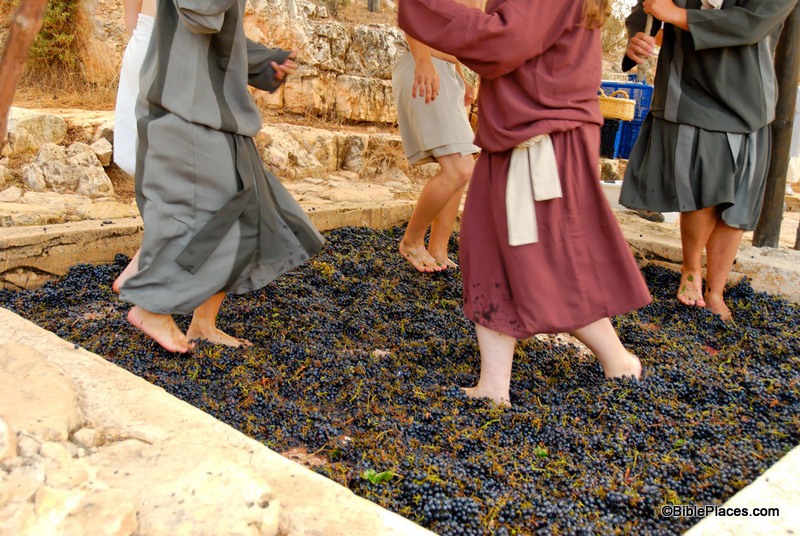
The picture is entitled simply “Treading Winepress.” It is one of a series of photos in the collection where people are reenacting the process of harvesting and treading grapes. At once, you can understand why it is called “treading” as you see the people stomping on the grapes to release the juice.  (As a side note, the juice then drained out of the winepress through a hole on one end of the vat.)

You can also see why God is asked “Why is your apparel red, and your garments like his who treads in the winepress?” (Isa. 63:2, ESV).  If you look closely at the bottom of their robes you will see that some of the red juice has splattered up onto the people’s clothes.  You can imagine what this scene would look like if someone was angry while treading out the grapes, stomping and smashing the fruit violently.  Even more juice would splatter and would look similar to blood (“their lifeblood spattered on my garments, and stained all my apparel,” Isa. 63:3).  Such a picture brings a deeper understanding of the biblical reference to Jesus in Revelation 19: “He will tread the winepress of the fury of the wrath of God the Almighty” (Rev. 19:15, ESV).

A collection such as this can be a valuable tool in the hand of a Bible teacher.  Illuminating the biblical background helps illuminate the Bible itself.

This and other photos of “Cultural Images of the Holy Land” are included in Volume 17 of the Pictorial Library of Bible Lands and can be purchased here.  Additional information and pictures of cultural images can be found here and here on the BiblePlaces website.  Those interested in this topic should also check out the many resources listed on the sister website of BiblePlaces at www.lifeintheholyland.com.

Share: